“Combining an aerial view of Stonehenge with a ride in a helicopter is an experience not to be missed”

Enjoy the opportunity of seeing the amazing structure of Stonehenge and its intriguing formation from a unique perspective. This incredible monument is a popular visitor attraction from the ground, but is even more special to see from the air with no tourists obscuring your views of this special site. One of the most historic and interesting sites in the world, is best viewed from the air so that it can be fully appreciated. You’ll be treated to unbelievable views down onto the mighty Neolithic Stonehenge and the numerous burial mounds dotted around the ancient Salisbury Plain. Who knows, from this unique vantage point you might even shed light on why Stonehenge was built.

We now offer a Stonehenge Flight Voucher for just £115 per person (Approx 60 mins with 30 mins flying)

Stonehenge Helicopter Flights

Fly Over Stonehenge

Bespoke Helicopter Tour Service

Our bespoke tours provide great photo opportunities and give you the chance to make some unique and lasting memories, which you can share with family and friends when you are back on the ground.

What could be better than treating someone special to a unique day out, tailor made for their enjoyment? We can even supply a special hamper for them to enjoy as you fly together over the countryside and famous landmarks.

There’s no shortage of other interesting sites nearby. Select to fly over stunning sights such as the stones at Avebury, the Cerne Abbas Giant and the Uffington White Horse, Salisbury Cathedral’s mighty spire or the mysterious Wiltshire crop circles, but if you’d prefer, you can simply fly over the familiar streets of your hometown and even your own house.

If you’re stuck for ideas the friendly team at Stonehenge Helicopters will help you with suggestions. We will recommend tours based on your particular interests, availability and budget using our extensive knowledge of the UK. .

Why not fly over Stonehenge and then be taken into the inner circle for an exclusive private guided special access tour, beyond the fences after the crowds have gone

Contact us for a quote – it may be cheaper than you think: experts@stonehengetours.com

Stonehenge Guided Tours
The Stonehenge Experts
www.StonehengeTours.com

Planning on visiting Stonehenge and want to experience the inner circle at sunrise or sunset?

If scheduled Stonehenge coach tours do not suit your travel plans and you are travelling with family or a small group then a ‘bespoke private tour might be the answer, giving you greater flexibility, door to door service on the day YOU want to travel. Our bespoke Stonehenge private access tours  can be tailored to suit your requirements and may be cheaper than you think.

Experience sunrise / sunset from within the inner circle of Stonehenge.  Magical!

Experience sunrise / sunset from within the inner circle of Stonehenge. Magical!

Bespoke Guided Tours of the Inner Circle of Stonehenge.

This is a rare opportunity to visit one of the most popular and mystifying Prehistoric sites in the world. The special access tour is an early morning (sunrise) or evening (sunset) event, closed off to the general public where you will be able to walk amongst the stones and stand within the stone circle!

In the evening after Stonehenge is closed to the public, or at dawn before it is open, we can arrange exclusive access for you to visit this awe-inspiring prehistoric monument and walk among the giant sarsen stones towering 6.4 m high and weighing up to 50 tonnes. Go beyond the fences & after the crowds have gone home. Walk amongst the stones & experience the magical atmosphere within the inner circle.

Normal viewing only permits access from the path that surrounds the circle. Stonehenge dates from 3100BC, and you will be walking where very few people have access. Your guide will explain some of the theories behind this amazing feat of Prehistoric construction.

A truly magical experience….

Our Stonehenge Special Access Tours (1-30 persons) can depart from London, Bath, Salisbury, Oxford, Southampton or any location in the South West of England.

Explore the beautiful South West of England in the luxury of your own private car, MPV or mini bus, enjoying the knowledge and expertise of our professional local Stonehenge experts.

Our Stonehenge private access tours can also include Bath, Highclere Castle (Downton Abbey), Salisbury Cathedral, Castle Combe, Windsor Castle, Winchester, Avebury Stone Circle, Lacock Village, The Cotswold’s or where ever you want to visit. We will help with your tour planning

Our customised private Stonehenge tours continue to get 5 STAR reports on Trip Adisor and other quality review sites

Email us your desired dates and group size for a prompt reply.

Stonehenge Guided Tours
The Stonehenge Experts!
www.StonehengeTours.com

What we learned about Stonehenge this week is that it wasn’t built for summer celebrations.

Operation Stonehenge: a BBC programme investigated the prehistoric monument

Stonehenge Photo: Alamy

First reports of the discovery of a mass of huge stones buried near Stonehenge, appearing to be the remains of another ceremonial structure four times larger, included the tantalising suggestion that it was aligned to the position of the sun on the shortest day of the year. This echoes a remarkable discovery published 20 years ago by the late Professor John North, an expert on the history of human cosmology.

In his book Stonehenge: Neolithic Man and the Cosmos, North showed by meticulous calculation how the alignment of Stonehenge was not, as was long supposed, to the Midsummer sunrise, but to its setting on the day of the Winter Solstice: in other words, to that very moment when the old year dies before nature begins its return to new life. For our Neolithic ancestors, it was thus a midwinter festival equivalent to our Christmas or the Roman Saturnalia.

We must now await further word from the academic discoverers of this new “Super-henge” on how they think its builders 4,500 years ago, like those of Stonehenge, directed it towards the position of the sun at just the moment when the year dies to be reborn. It was this which, when I first wrote about it on December 24 2006, inspired one of my sub-editors to the memorable headline “Have yourself a Megalithic Christmas”.

By  (Source – Telegraph)

Please view our Stonehenge Winter Solstice and Christmas Tours.

Stonehenge Guided Tours

A line of huge megaliths that once acted as a site for rituals carried out during the building of Stonehenge has been discovered. Here is how to visit the site

Why go

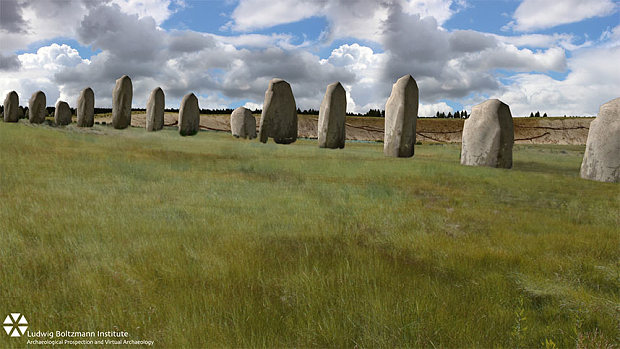
Archaeologists have discovered the remains of a massive stone monument buried under the bank of a stone-age enclosure known as Durrington Walls, just two miles from Stonehenge.

A new line of stones has been found under Durrington Walls super-henge

A new line of stones has been found under Durrington Walls super-henge

Using powerful ground-penetrating radar, investigators from Birmingham and Bradford universities, alongside an international team of experts, have uncovered a 330m-long line of more than 50 massive stones, buried under part of the bank of Britain’s largest pre-historic henge.

Professor Vincent Gaffney, an archaeologist on the project, said that the discovery has significant implications for our understanding of Stonehenge and its landscape setting.

“Not only does this new evidence demonstrate a completely unexpected phase of monumental architecture at one of the greatest ceremonial sites in prehistoric Europe, the new stone row could well be contemporary with the famous Stonehenge sarsen circle or even earlier,” he said.

What is it

Gaffney said that the stones are thought to have been erected more than 4,500 years ago to form a dramatic ritual arena. The monuments were grand, built to give the impression of authority to the living and the dead.

However, as the megaliths are buried underground, visitors to the area will not be able to see them for themselves.

Yet you can still get a great sense of their majesty if you use a bit of imagination, and Durrington Walls, the village where Stonehenge’s builders lived, is itself an interesting site.

The henge at Durrington Walls has long mystified archaeologists because one side is straight while the rest of it is curved. It surrounds several smaller enclosures and timber circles, and is connected to a newly excavated later Neolithic settlement. Thousands of people travelled great distances to gather here and feast on roast pork and apples in midwinter. The area outside the ditch and bank was once a settlement, possibly housing hundreds of homes, making Durrington Walls the biggest village in north-west Europe at the time.

Durrington
The earliest phase of Durrington Walls with its line of megaliths

How to see the site on a guided walk

The National Trust is hosting a Discover Durrington Walls event on October 10. On this 3-mile walk, you’ll explore the secrets of Durrington Walls – once home to the builders of Stonehenge – and discover 6,000 years of hidden history with National Trust’s landscape guides.

To book: Call the estate office on 01980 664780 or email stonehenge@nationaltrust.org.uk

How to see the site on an independent walk

Download a National Trust map for one of the following routes and explore for yourself.

1. Ramble around on a Durrington Walls and Landscape walk and explore the connection between two of the most important henge enclosures in the country in a less-known part of the Stonehenge World Heritage Site. To view the route: nationaltrust.org.uk/wra-1356324449264/view-page/item463554/

2. Go on a Durrington Walls to Stonehenge walk and discover the landscape in its full glory from the Bronze Age barrow First World War military railway track, as well as its diverse wildlife and plants. To view the route: nationaltrust.org.uk/stonehenge-landscape/things-to-see-and-do/view-page/item937063/

Join a guided tour from London or Salisbury

Stonehenge Guided Tours operate daily tours of Stonehenge and many of their small group tours explore the greater landscape including Woodhenge and Durrington Walls.  Exclusive private guided tours can be arranged for individuals, families and small groups with local experts.  They also specialise in Stonehenge special access tours.  To view their tours: http://www.StonehengeTours.com

Local facilities

– Picnic area (not NT) and information panel at Woodhenge car park

– WCs

– Outdoor café

– Picnic area (not NT) at Stonehenge car park, 0.75 miles from this walking route.

How to get there

Bike: National Cycle Network route 45 runs south-east of the property. See sustrans.org.uk

Bus: Wilts & Dorset 5 or 6, between Salisbury, Pewsey, Marlborough and Swindon. Service 16 from Amesbury, request stop at Woodhenge

Rail: Salisbury station, 9 miles from Woodhenge car park

Road: Woodhenge car park is 1¾ miles north of Amesbury, follow signs from A345

This article was written by Trisha Andres (Telegraph Mail)

Stonehenge Guided Tours
The Stonehenge Experts
Touring Stonehenge since 1995

Stonehenge Private Access Tours – Go beyond the fences in 2026

Demand for Stonehenge access tours far exceeds supply, dates are often sold out many months in advance. Do not expectStonehenge inner circle tours to get tickets without ordering well in advance. Register your interest with now with no obligation by simply sending us your email address and we will offer you 2026 tours before they are published online giving you the opportunity to secure your preferred travel date. These will include our exclusive small group tours and our preferred travel partner with departures from London, Salisbury and Bath.

Stonehenge Private Access visits are available most but not all months of the year, (no visits in October and November and are not available on and around the midsummer’s day).  Evening Special Access is only available in the summer months

Email: Experts@StonehengeTours.com

2026 Stonehenge Access Private Group Tours

In addition to our regular ‘scheduled group tour’ departures we are often able to get permission from the English Heritage for additional ‘inner circle’ tours for small groups (1-16 persons). These can be sunset or sunrise times depending on availability. These bespoke tours can also include Salisbury, Avebury, Bath, or Warwick Castle etc and can depart from London, Salisbury or Bath. This can often be cheaper than joining a scheduled tour, offers more flexibility, more personal and a better all round experience. Email us your desired dates and group size for a prompt reply

We specialise in arranging customised Stonehenge tours to suit your requirements. Our door to door service will take you wherever you want to go…….at the time and pace to suit you. Our personalised service gives you the ultimate freedom and flexibility without the worry of driving so you can all relax and enjoy the day.

Email: Experts@StonehengeTours.com

Stonehenge Guided Tours
The Stonehenge Experts
Operating Exclusive Stonehenge Tours since 1995

Flickr:  http://www.flickr.com/photos/stonehenge-stone-circle/sets/
Stonehenge Tours on Instagramhttp://instagram.com/stonehengetours
Stonehenge Tour Videos on YouTube: http://www.youtube.com/stonehengetours

Witness sunrise or sunset on one of our small group guided tours: http://www.StonehengeTours.com

StonehengeNews's avatarStonehenge Stone Circle News and Information

Stonehenge was primarily a functional scientific instrument, used for measuring angles.  The angles of interest were the rising and setting bearings of the sun, moon, and stars.  It was therefore possible, over a period of time, to map the entire visible sky. Please find below accurate times for the sunset, sunrise and the moon phases.

Stonehenge Sunrise

July 2015
Stonehenge, Amesbury, Wiltshire, England

SundayMondayTuesdayWednesdayThursdayFridaySaturday
1

Sunrise: 4:56am
Sunset: 9:26pm
Moonrise: 8:33pm
Moonset: 4:39am
2

Sunrise: 4:56am
Sunset: 9:26pm
Moonrise: 9:22pm
Moonset: 5:39am
3

Sunrise: 4:57am
Sunset: 9:26pm
Moonrise: 10:05pm
Moonset: 6:46am
4

Sunrise: 4:58am
Sunset: 9:25pm
Moonrise: 10:42pm
Moonset: 7:59am
5

Sunrise: 4:59am
Sunset: 9:25pm
Moonrise: 11:14pm
Moonset: 9:15am
6

Sunrise: 5:00am
Sunset: 9:24pm
Moonrise: 11:44pm
Moonset: 10:32am
7

Sunrise: 5:00am
Sunset: 9:24pm
Moonrise: none
Moonset: 11:49am
8

Sunrise: 5:01am
Sunset: 9:23pm
Moonrise: 12:12am
Moonset: 1:05pm
9

Sunrise: 5:02am
Sunset: 9:23pm
Moonrise: 12:41am
Moonset: 2:20pm
10

View original post 1,665 more words

UFO has been captured hovering above Stonehenge and a mysterious crop circle appears nearby – coincidence?

A MYSTERIOUS crop circle has appeared in a field just off the A303 around 1km from Stonehenge. A group who go around the country capturing the phenomenon sent up a drone to get a shot from the sky. View the footage herecrop-circel-wiltshire

Worldwide media have reported UFO sightings above Stonehenge (see links below).  Many of our Stonehenge tours visit this mysterious area and we have local expert guides specialising in crop circle tours. (Our exclusive crop circle tours have been featured on Sky TV, The Times and Telegraph newspapers”)

Stonehenge in Wiltshire, England, is one of the most famous prehistoric construction sites in the world. It consists of a circular formation of erect stone slabs set within an earth bank and ditch. The structure is believed to have gone through various stages of construction between 3000 B.C. and 2000 B.C

Links:
Mysterious crop circle appears near Stonehenge
Black ‘flying saucer’ UFO is pictured hovering over Stonehenge
UFO’ snapped hovering over Stonehenge being probed by alien investigators
Mysterious crop circles appear near Stonehenge (VIDEO)
This ‘disc-shaped’ UFO was snapped at Stonehenge hovering over the stonesMirror.co.uk
Black ‘Flying Saucer’ UFO Photographed Hovering Over StonehengeThe Inquisitr
Does this look like an alien ship? ‘Flying saucer’ UFO is captured hovering over Stonehenge, claim Daily Mail

Stonehenge Guided Tours
The Stonehenge and Crop Circle Experts

Fantastic time at the Summer Solstice. Wonderful feedback and a perfect sunset and sunrise!

StonehengeNews's avatarStonehenge Stone Circle News and Information

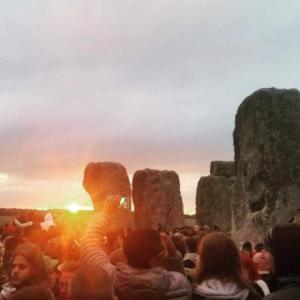
Solstice celebrations were quieter than expected this year with nowhere near the predicted 40,000 visitors descending on the Stones.

More than 23,000 see sunrise at Stonehenge during "peaceful and positive" summer solstice More than 23,000 see sunrise at Stonehenge during “peaceful and positive” summer solstice

Police said the night passed in “a positive and peaceful manner” as around 23,000 people turned up to see the sunrise.

Superintendent Gavin Williams, who led the policing operation, said: “Solstice 2015 has been a great success with approximately 23,000 people celebrating at Stonehenge in the positive, friendly atmosphere as they waited for the sunrise.

“This year the crowds were able to see the sun as it appeared over the horizon, before it disappeared under low cloud.

“There have been a lower number of arrests compared with previous years at Stonehenge, nine people were taken into custody mainly in relation to drugs offences.

“We issued 31 cannabis street warnings, issued five cautions for possession of a class A…

View original post 72 more words

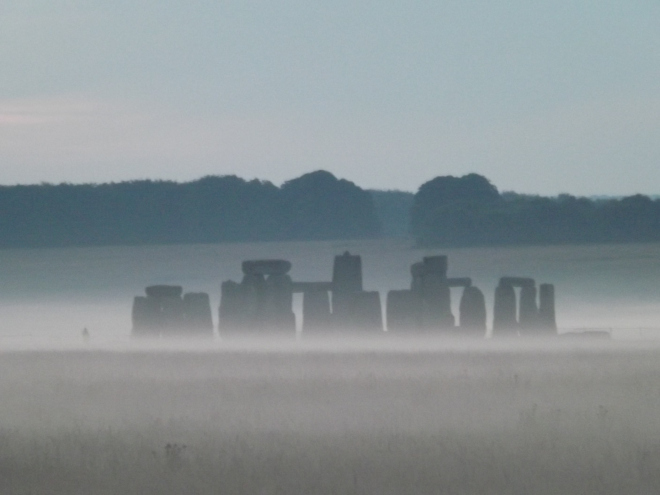
At first it was a blur on the horizon, a small, grey silhouette rising softly into the haze. Grassy meadows dotted with cowslips and grazing sheep rolled around me.

As this prehistoric monument prepares for the summer solstice, Ellie Ross joins a new tour offering an authentic view of the site

As this prehistoric monument prepares for the summer solstice, Ellie Ross joins a new tour offering an authentic view of the site

The silence was broken only by birdsong and the occasional scuff of our boots. The path dipped down into a valley before veering left – and the blur came into focus as that familiar stone circle and one of Neolithic man’s most astonishing achievements, Stonehenge.

Standing proud on the skyline, it was magnificent to behold as I followed the remnants of a parallel pair of ditches and banks. I was walking up The Avenue, the ancient ceremonial approach which once connected Stonehenge to the River Avon and which is aligned with the sunrise of the summer solstice. This is the view people would have seen more than 4,000 years ago, when they trekked up here on the final leg of their journey.

My own journey on foot had begun eight miles south, in the Woodford Valley, where the River Avon criss-crosses verdant wheat fields and dense forest. I had arrived with a group of four other walkers accompanied by David Howell, guide and local historian from the walking specialist Foot Trails.

“We’re out here to enjoy the countryside,” he said, hoisting on a hefty backpack as we prepared to embark on Journey to the Stones, a new monthly guided walk. “Please switch off your phones.”

Within moments my surroundings seemed to burst into life – the smell of wet nettles, the chirrup of skylarks, a butterfly flitting next to my elbow. We crossed a footbridge over the Avon, a tranquil, blue-black stretch that flows from Salisbury Plain to Christchurch in Dorset, 38 miles away.

“The river was an important transport route for ancient man, and played a vital role in the construction of Stonehenge,” David explained.

Not only was the Avon a highway for transporting fish, it is believed the river was used to carry the dolerite bluestones of the inner ring, which came from Wales. Although the exact origins and purpose of Stonehenge have been lost, theories as to why it was built range from human sacrifice to astronomy. But what remains is not what the original builders would have seen, as it is at least the third monument that has stood on this site.

Around 2150BC, it changed from a henge – a ditch and bank of earth – to a monument of growing importance, featuring the bluestones and later huge Sarsens from the Marlborough Downs. Work stopped around 1500BC, leaving the stone circle roughly as it is today.

Shadowing the river, we dropped into dense forest peppered with wild garlic, crossed Lower Woodford with its pretty cottages and thatched cob walls, then paused beside a field of flint.

“There was something special about the position of Stonehenge,” David said, offering around a tin of barley sugars. “We are in a chalk landscape – the flint in these fields is compressed chalk. In prehistoric times, it was easier to travel on the chalk downs than in dense valleys. Stonehenge is a natural junction for England’s chalk downs, where you can move in all directions, but remain high. Being at the heart of this superhighway meant it was an ideal meeting point for people who were dispersed around the landscape.”

We pressed on, taking in views of Lake House, the Elizabethan home of Sting, who recorded “Fields of Gold” there after apparently being inspired by the surrounding barley fields. Climbing steadily, we entered what David called the “sacred heart of the landscape”, punctuated with barrows, or burial mounds, which would once have been white.

As we climbed, a dozen grassy lumps rose out of the downs around us, expanding and contracting as our perspective shifted. Then, a gap on the horizon opened to reveal the distant but unmistakable outline of Stonehenge, bathed in sunlight, about half a mile away. The monument is false-crested, set slightly below the summit, to make it visible both from the valley and from afar.

fter half a day on David’s route, avoiding the busy national trails, we had passed no other walkers, and now I felt like we had the stones all to ourselves. It was the perfect spot for a picnic.

“Most people go straight to the stones or simply drive past them on the A303,” David said, producing a blanket and wonderful bread, cheeses, tea and cake from his backpack. But you don’t see the significance of these barrows without walking through them. As a monument, Stonehenge is so much about its landscape. It was designed to be seen from afar, as well as from inside the stone circle.”

Refuelled, we skirted a wide semi-circle around the stones to see them at different angles. Each time I paused and looked towards them, they appeared different, first short and fat, then tall and thin. But all the while they were mesmerising, a dramatic display of human ingenuity that took more than 30 million hours of labour to create.

After a busy but brief crossing of the unavoidable A303, we traversed a field to join The Avenue bending up from the Avon, turning south-west for our final approach.

Standing in the stone circle, as the shadows hugged the ground, I looked out towards the fields with their lumpy barrows, and down the chalk-strewn Avenue, where the sun will soon rise, marking the summer solstice.

Walking there

Foot Trails (01747 820626; foottrails.co.uk) offers ‘Journey to the Stones’ on the first Thursday of every month, until 6 October. The guided day walk costs £75, including return transfers from Salisbury railway station, picnic lunch, entrance to Stonehenge, the services of a guide – and the occasional fortifying barley sugar. Private guided tours can be organised on request.

More information

Article source: http://www.independent.co.uk/travel/uk/stonehenge-walking-tour-sunrise-and-stones-on-the-horizon-10331290.html

english-heritage.org.uk/stonehenge

The Independent travel offers: Discover a world of inspiring destinations

Stonehenge Guided Tours
The Stonehenege Experts

StonehengeNews's avatarStonehenge Stone Circle News and Information

English Heritage is pleased to be providing Managed Open Access to Stonehenge for the Summer Solstice on 20th – 21st June 2015.  Please help them to create a peaceful occasion by taking personal responsibility and following the Conditions of Entry and guidelines set out on these pages. CELEBRATING THE SUMMER SOLSTICE AT STONEHENGE  Stonehenge is an ancient prehistoric site and has been a place of worship and celebration at the time of Summer Solstice since time immemorial.

Stonehenge Summer Solstice 2012 Stonehenge Summer Solstice Sunrise

During Managed Open Access for Summer Solstice at Stonehenge, we support all individuals and groups conducting their own forms of ceremony and celebration providing that they are mutually respectful and tolerant of one another. Stonehenge is a place seen by many as a sacred site – please respect it and those attending. English Heritage continues to work closely with the many agencies and people from all sectors of the…

View original post 268 more words