>The quicker they do something about the Stonehenge visitor experience the better – lives are put at danger every day at Stonehenge. At least put a zebra crossing there. Condolences to the womans family.
Sorry, I cant always post good news?

AN American woman on holiday in the UK has died after being hit by a car crossing the road near Stonehenge.

The woman, who has not been named, was crossing the A344 at Stonehenge at 7.12pm yesterday when she was hit by a green Toyota RAV4, which was travelling from Amesbury towards Shrewton.

She sustained multiple injuries and was pronounced dead at Salisbury District Hospital.

The road was closed for several hours while police carried out their investigation

>

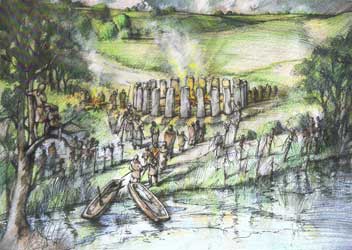
Archaeologists have discovered Stonehenge’s little sister, dubbed Bluestonehenge, just 2.8km away on the west bank of the River Avon.

The site, once made up of 25 blue Preseli stones – hence it’s nickname – was constructed about 5,000 years ago. According to archaeologists from the Stonehenge Riverside Project, Bluestonehenge linked the ‘domain of the dead’ to that of the living at Durrington Walls further upstream, with the River Avon being the vital link between the two.

Archaeologists believe the stones represented the end of the Avenue that marked the funerary processional route from the River Avon to Stonehenge: no pottery, animal bones, food residues or flint tools associated with domestic life have been found at Bluestonehenge.

Director of the project, Professor Mike Parker Pearson from the Department of Archaeology at the University of Sheffield, said: “It could be that Bluestonehenge was where the dead began their final journey to Stonehenge – Britain’s largest burial ground at that time. Maybe the bluestone circle is where people were cremated before their ashes were buried at Stonehenge itself.”

The stones at Bluestonehenge were dragged 150 miles from the Welsh mountains and set in a circle measuring 10m in diameter and surrounded by a ditch with an external bank – the henge. The outer henge was built c.2400 BC but arrowheads found in the stone circle suggest the stones were put up as much as 500 years earlier. It appears the stones were removed sometime during the Neolithic era, and some were then used up the road at Stonehenge when it underwent a major rebuild c.2500 BC. Archaeologists know that after this date Stonehenge consisted of about 80 Welsh stones and 83 local, sarsen stones so maybe some of the stones now standing at the centre of Stonehenge once stood on the banks of the River Avon. Tests to obtain radiocarbon dates from pickaxes made from deer antlers found at Bluestonehenge will give a more accurate picture of the sequence of events.
Dr Josh Pollard, co-director from the University of Bristol explained: “The newly discovered circle and henge should be considered an integral part of Stonehenge rather than a separate monument, and it offers tremendous insight into the history of its famous neighbour. Its landscape location demonstrates once again the importance of the River Avon in Neolithic funerary rites and ceremonies.”

Prof. Julian Thomas, co-director, added: “The implications of this discovery are immense. It is compelling evidence that this stretch of the River Avon was central to the religious lives of the people who built Stonehenge. Old theories about Stonehenge that do not explain the evident significance of the river will have to be re-thought.”

>
A clear out at Salisbury District Council’s Planning Office has uncovered a long lost Neolithic document, which experts say, ‘finally explains the purpose of Stonehenge’. After weeks of careful study by a team of Oxford University archaeologists – where the fragile deer hide document had be taken for radio carbon dating and translation – it was revealed today that the document is in fact a 5000-year-old failed planning application for the Stonehenge site.

Contrary to the widely accepted theory that Stonehenge was a place of pagan worship, which had been designed and built to act as some sort of giant celestial calendar – instead, the document details the henge’s intended use – that of a vast covered market place. Dr Amy Bogaard, lecturer in Neolithic and Bronze Age Archaeology at Oxford, explained, ‘Stonehenge was to be a place where local merchants and tradesmen could gather, in order to peddle their wares and services to the thousands of Bronze Age tribes people who occupied Salisbury Plain at the time’. The document includes a plan, which shows that originally 600 stalls were to be constructed over a 200 acre site that would have also boasted ample grazing for 3500 Oxen and cart. ‘Stonehenge was essentially going to be the world’s first out of town shopping centre,’ said Dr. Bogaard.

‘This is an amazing find that not only answers all of the questions we had regarding what Stonehenge was for and why it was built, but also gives us a fantastic insight into the day-to-day life of Bronze Age Britons, their beliefs, their values and their culture,’ Dr. Bogaard continued. ‘For example, we now know that Druidism is not a pagan religion at all. ‘Druids’ was actually the brand name of a chain of prehistoric pharmacists, the forerunner of their modern day counterpart ‘Boots’,’ she concluded.

The document also reveals that the developers of Stonehenge never actually completed construction of the market, as their planning application was turned down by the ‘Local Council of Elders’. The application was refused on the grounds that the planners had, ‘serious concerns over increased Oxen traffic’, ‘did not think that the developers use of imported Welsh stone was sympathetic to, or in keeping with, local architecture’ and felt that, ‘the construction of such a high rise building would detract from the natural beauty and innate flatness of the surrounding plain.’

Commenting on his department’s historically important discovery, the Chief Planning Officer for Salisbury District Council, Mr. Ken Dawson, said: ‘I’m just so thrilled that, although in a small way, my office has helped to solve the age old mystery of Stonehenge. In fact, I’m so proud that it almost feels a shame to have to bulldoze the site. UNESCO World Heritage Site or not, it’s still in breach of the planning laws.’

>This short film shows the landscape around Stonehenge as recorded by LIDAR survey (airborne 3D scanning). Millions of measurements were taken across the landscape, and here they have been turned into a ‘solid’ computer model to show how well the archaeology is recorded by this method.

Prehistoric burial mounds (barrows), the great Cursus (a 2km Neolithic monument), the Bronze Age Avenue which links Stonehenge to the River Avon, and other henges such as Woodhenge and Durrington Walls are all clearly visible.

Click here

>
The discovery of a small prehistoric circle of stones near Stonehenge may confirm the theory that the mysterious monument in southwest England was part of a massive funeral complex built around a river, researchers said Tuesday.
The new find shows that the second stone circle — dubbed “Bluehenge” because it was built with bluestones — once stood next to the River Avon about 1.75 miles (2.8 kilometers) from Stonehenge, one of Britain’s best loved and least understood landmarks.
The find last month could help prove that the Avon linked a “domain of the dead” — made up of Stonehenge and Bluehenge — with an upstream “domain of the living” known as Durrington Wells, a monument where extensive signs of feasting and other human activity were found, said Professor Julian Thomas, co-director of the Stonehenge Riverside Project.
Project director Mike Parker Pearson said it is possible that Bluehenge was the starting point of a processional walk that began at the river and ended at Stonehenge, the site of a large prehistoric cemetery.
“Not many people know that Stonehenge was Britain’s largest burial ground at that time,” he said. “Maybe the bluestone circle is where people were cremated before their ashes were buried at Stonehenge itself.”
There were very few signs of human life found around Stonehenge and Bluehenge, researchers said, lending credence to the idea that it was used as a funeral site, especially since there were signs that many human beings were cremated there.

A five-university team has been excavating the greater Stonehenge site since 2003 in a bid to unravel its meaning and use.
“This find certainly confirms the idea we’ve put forward that the river is of fundamental importance and links everything,” Thomas said. “Everything is related to the river. That suggests that even before Neolithic time it may have had spiritual or religious significance. This find enhances the idea that all the monuments in this landscape are linked in various ways.”
Researchers did not find the actual stones used to mark the smaller circle found by the river, but they did find holes left behind when the stones were removed.
The scientists believe the massive stones used for Bluehenge were dragged from the Welsh mountains roughly 150 miles (240 kilometers) away. There were clear indications that the gigantic stones from the Bluehenge site were later removed whole for use in the construction of Stonehenge, Thomas said.
They hope to use radiocarbon dating techniques to better pinpoint construction dates.
Stonehenge, a UNESCO World Heritage site, is a favorite with visitors from throughout the world and has become popular with Druids, neo-Pagans and New Agers who attach mystical significance to the strangely-shaped circle of stones, but there remains great debate about the actual purpose of the structure.
Rare excavation work at the actual Stonehenge site was begun last year in a coordinated effort to unearth materials that could be used to establish a firm date for when the first set of bluestones was put in place there.

>Have a look at this link – has he got the answer on how neolithic man moved those huge megalithic stones ? Clever guy………………..

Click here –
Solution

>THE origins and purpose of Stonehenge have always been shrouded in mystery and now the ancient monument has made it on to a list of things Britons find most confusing.
‘Why and how Stonehenge was built’ came 28th in a survey of what people think are the most confusing things – and it wasn’t the only one on the list for Wiltshire, with crop circles coming in at 35th and Swindon’s Magic Roundabout at number 48.
The survey, which polled 4,979 people between the ages of 16 and 65, placed foreign call centres, algebra, what women see in Russell Brand and why Cheryl Cole is still with her husband were named as the top four biggest confusions in Britain.
Birmingham’s Spaghetti Junction ended up 37th in the survey survey, conducted by Confused.com.

>

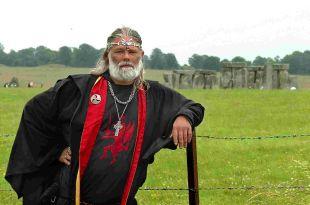
A DRUID protester is calling for remains taken from the Stonehenge World Heritage site to be returned – and has collected thousands of signatures on a petition backing his call.

King Arthur Pendragon

King Arthur Pendragon says to take the ancient remains permanently away from, what was intended to be, their final resting place would be undignified and should not be allowed.

He said: “There is no dignity left if they can just take them away and not care they were living, talking human beings at one stage.

“You wouldn’t dig up your grandmother, so what’s the difference?”

The remains were removed from the site last year for tests to be carried out as part of The Stonehenge Riverside Archaeological Project.

The project, supported by National Geographic under the leadership of Professor Mike Parker Pearson of the University of Sheffield, led to new insights into the possible uses of the site.

Radiocarbon dating of human cremation burials at the ancient monument suggested it was used as a cemetery from its inception just after 3000BC until well after the large stones went up around 2500BC.

Many archaeologists previously believed people had been buried at Stonehenge only between 2700 and 2600BC, before the large Sarsen stones were raised and the new dates provide strong clues about the original purpose of the monument.

But the Druids say they will not rest until the remains have been once again laid to rest. A spokesman for English Heritage, which manages the site, said permission to excavate is only granted when the applicant can show the benefits in the increased knowledge are likely to outweigh the damage done by the work and that excavation of human remains is regulated under the Burial Act.

The spokesman said: “Scheduled monument consent was duly granted early in 2008, with appropriate conditions to safeguard the site and ensure what was found was appropriately studied,published and deposited in a museum.

“Human burials and human remains are an important part of the record of our shared past. English Heritage believes they should always be treated with respect, and that decisions about excavation, study, display and reburial should be based on the balance of benefit and harm, giving due weight to the views and interests of all those involved.”

>

PLANS have been submitted for the long awaited new visitor centre for Stonehenge.

An image of the proposed new visitor centre

English Heritage has now submitted a planning application for the centre, which will be located one-and-a-half miles from the monument.

It has been designed to blend in with its surroundings, and the centre will not be visible from the stones themselves.

The exhibitions, café, shop and toilets will be housed in a pair of single-storey areas – one glass, the other timber-enclosed – sitting beneath a gently undulating roof. The centre will be linked to the Stones by a low-key transit system.

English Heritage’s Stonehenge project director Loraine Knowles said: “The new centre is designed to blend into the World Heritage landscape which visitors will pass through on their way to the Stones.

“It will provide enhanced opportunities for education and interpretation, and have first class facilities in keeping with Stonehenge’s status as a world-renowned tourist attraction.” Wiltshire Council will now undertake further public consultation as part of the formal planning process. Further details of the application are available from Wiltshire Council. Alongside the planning application, English Heritage is supporting Wiltshire Council with their proposals for a Traffic Regulation Order restricting motorised traffic on the A344.

>

PLANS for a new visitors’ centre for Stonehenge have been unveiled.

Visitor centre plans unveiled for Stonehenge

English Heritage has now submitted a planning application for the centre, which will be located one-and-a-half miles from the monument.

It has been designed to blend in with its surroundings, and the centre will not be visible from the stones themselves.

The exhibitions, café, shop and toilets will be housed in a pair of single-storey areas – one glass, the other timber-enclosed – sitting beneath a gently undulating roof. The centre will be linked to the Stones by a low-key transit system.

English Heritage’s Stonehenge project director Loraine Knowles said: “The new centre is designed to blend into the World Heritage landscape which visitors will pass through on their way to the Stones.

“It will provide enhanced opportunities for education and interpretation, and have first class facilities in keeping with Stonehenge’s status as a world-renowned tourist attraction.”

Stephen Quinlan, director of architects’ Denton Corker Marshall, said: “Designing a visitor centre at a site of such importance is both a major challenge and a serious responsibility. Our proposal, above all, seeks not to compromise the solidity and timelessness of the Stones, but to satisfy the brief with a design which is universally accessible, environmentally sensitive, and at the same time appears almost transitory in nature.

“If once back at home, a visitor can remember their visit to the stones but can’t remember the visitor centre they passed through on the way, we will be happy.”

Wiltshire Council will now undertake further public consultation as part of the formal planning process. Further details of the application are available from Wiltshire Council. Alongside the planning application, English Heritage is supporting Wiltshire Council with their proposals for a Traffic Regulation Order restricting motorised traffic on the A344.