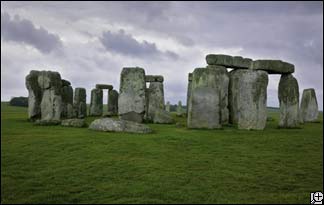
>THE origins and purpose of Stonehenge have always been shrouded in mystery and now the ancient monument has made it on to a list of things Britons find most confusing.
‘Why and how Stonehenge was built’ came 28th in a survey of what people think are the most confusing things – and it wasn’t the only one on the list for Wiltshire, with crop circles coming in at 35th and Swindon’s Magic Roundabout at number 48.
The survey, which polled 4,979 people between the ages of 16 and 65, placed foreign call centres, algebra, what women see in Russell Brand and why Cheryl Cole is still with her husband were named as the top four biggest confusions in Britain.
Birmingham’s Spaghetti Junction ended up 37th in the survey survey, conducted by Confused.com.
November 2, 2009
>Stonehenge makes list of ‘confusing’ things
Posted by StonehengeNews under UncategorizedLeave a Comment
November 1, 2009
>Calls for remains to be returned to Stonehenge
Posted by StonehengeNews under King Arthur at Stonehenge - Return the Druid Bones NowLeave a Comment
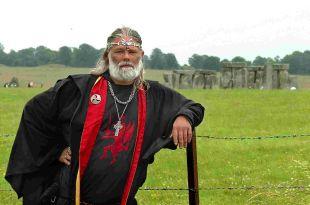
A DRUID protester is calling for remains taken from the Stonehenge World Heritage site to be returned – and has collected thousands of signatures on a petition backing his call.
King Arthur Pendragon
King Arthur Pendragon says to take the ancient remains permanently away from, what was intended to be, their final resting place would be undignified and should not be allowed.
He said: “There is no dignity left if they can just take them away and not care they were living, talking human beings at one stage.
“You wouldn’t dig up your grandmother, so what’s the difference?”
The remains were removed from the site last year for tests to be carried out as part of The Stonehenge Riverside Archaeological Project.
The project, supported by National Geographic under the leadership of Professor Mike Parker Pearson of the University of Sheffield, led to new insights into the possible uses of the site.
Radiocarbon dating of human cremation burials at the ancient monument suggested it was used as a cemetery from its inception just after 3000BC until well after the large stones went up around 2500BC.
Many archaeologists previously believed people had been buried at Stonehenge only between 2700 and 2600BC, before the large Sarsen stones were raised and the new dates provide strong clues about the original purpose of the monument.
But the Druids say they will not rest until the remains have been once again laid to rest. A spokesman for English Heritage, which manages the site, said permission to excavate is only granted when the applicant can show the benefits in the increased knowledge are likely to outweigh the damage done by the work and that excavation of human remains is regulated under the Burial Act.
The spokesman said: “Scheduled monument consent was duly granted early in 2008, with appropriate conditions to safeguard the site and ensure what was found was appropriately studied,published and deposited in a museum.
“Human burials and human remains are an important part of the record of our shared past. English Heritage believes they should always be treated with respect, and that decisions about excavation, study, display and reburial should be based on the balance of benefit and harm, giving due weight to the views and interests of all those involved.”
November 1, 2009
>Stonehenge plan moves forward –
Posted by StonehengeNews under Picture of new visitor centre ? Look like an air craft hanger to me ?Leave a Comment
PLANS have been submitted for the long awaited new visitor centre for Stonehenge.
An image of the proposed new visitor centre
English Heritage has now submitted a planning application for the centre, which will be located one-and-a-half miles from the monument.
It has been designed to blend in with its surroundings, and the centre will not be visible from the stones themselves.
The exhibitions, café, shop and toilets will be housed in a pair of single-storey areas – one glass, the other timber-enclosed – sitting beneath a gently undulating roof. The centre will be linked to the Stones by a low-key transit system.
English Heritage’s Stonehenge project director Loraine Knowles said: “The new centre is designed to blend into the World Heritage landscape which visitors will pass through on their way to the Stones.
“It will provide enhanced opportunities for education and interpretation, and have first class facilities in keeping with Stonehenge’s status as a world-renowned tourist attraction.” Wiltshire Council will now undertake further public consultation as part of the formal planning process. Further details of the application are available from Wiltshire Council. Alongside the planning application, English Heritage is supporting Wiltshire Council with their proposals for a Traffic Regulation Order restricting motorised traffic on the A344.
November 1, 2009
>Visitor centre plans unveiled for Stonehenge October 2009
Posted by StonehengeNews under Stonehenge new visitor centreLeave a Comment
PLANS for a new visitors’ centre for Stonehenge have been unveiled.
Visitor centre plans unveiled for Stonehenge
English Heritage has now submitted a planning application for the centre, which will be located one-and-a-half miles from the monument.
It has been designed to blend in with its surroundings, and the centre will not be visible from the stones themselves.
The exhibitions, café, shop and toilets will be housed in a pair of single-storey areas – one glass, the other timber-enclosed – sitting beneath a gently undulating roof. The centre will be linked to the Stones by a low-key transit system.
English Heritage’s Stonehenge project director Loraine Knowles said: “The new centre is designed to blend into the World Heritage landscape which visitors will pass through on their way to the Stones.
“It will provide enhanced opportunities for education and interpretation, and have first class facilities in keeping with Stonehenge’s status as a world-renowned tourist attraction.”
Stephen Quinlan, director of architects’ Denton Corker Marshall, said: “Designing a visitor centre at a site of such importance is both a major challenge and a serious responsibility. Our proposal, above all, seeks not to compromise the solidity and timelessness of the Stones, but to satisfy the brief with a design which is universally accessible, environmentally sensitive, and at the same time appears almost transitory in nature.
“If once back at home, a visitor can remember their visit to the stones but can’t remember the visitor centre they passed through on the way, we will be happy.”
Wiltshire Council will now undertake further public consultation as part of the formal planning process. Further details of the application are available from Wiltshire Council. Alongside the planning application, English Heritage is supporting Wiltshire Council with their proposals for a Traffic Regulation Order restricting motorised traffic on the A344.
November 1, 2009
>£10m investment for Stonehenge visitor centre
Posted by StonehengeNews under UncategorizedLeave a Comment
THE planned visitor centre for Stonehenge has received a £10m boost from the Government.
Stonehenge
The move has been confirmed today by the Secretary of State for Culture, Media and Sport, Ben Bradshaw.
Mr Bradshaw said: “Stonehenge is one of our best known historic attractions, but facilities for visitors are below par.
“This will mean Stonehenge will be ready to cope with all the extra visitors expected because of the Olympics.
“The capital investment announced today means that our most iconic World Heritage Site will finally be able to welcome visitors in a way that is fitting to its international importance.”
Welcoming the announcement, Baroness Andrews, Chair of English Heritage, said: “English Heritage is delighted at this financial commitment from the Government to secure the future of Stonehenge. “Thanks to this investment, Stonehenge will finally have a setting which is worthy of its significance.”
October 26, 2009
>New ‘Stonehenge’ discovered – October 2009
Posted by StonehengeNews under UncategorizedLeave a Comment
>
ANOTHER stone circle has been discovered just a mile away from Stonehenge.
The find, on the west bank of the River Avon, has been named Bluestonehenge after the colour of the 25 Welsh stones from which it was formed.
The discovery was made during the Stonehenge Riverside Project, in which teams from British universities led by Professor Mike Parker Pearson from the University of Sheffield are studying the area around the famous monument.
The stone circle is 10 meters in diameter and surrounded by a ditch and external bank.
Although the stones at the site of the new discovery were removed thousands of years ago, the holes remain and show it was a circle of bluestones brought from the Preseli Mountains in Wales.
Like the stones that make up Stonehenge it appears they were dragged 150 miles 5,000 years ago and put up in a circle.
Archaeologists revealed the builders of the stone circle used deer antlers as pickaxes and radio carbon dating is being carried out to give more precise dates.
Experts also believe the stones from Bluestonehenge were removed by Neolithic people, and possibly dragged along the route of the Avenue to Stonehenge, to be incorporated within its major rebuilding in around 2,500 BC.
Director of the project, Prof Pearson said: “It could be that Bluestonehenge was where the dead began their final journey to Stonehenge.
“Not many people know that Stonehenge was Britain´s largest burial ground at that time. Maybe the bluestone circle is where people were cremated before their ashes were buried at Stonehenge itself.”
Dr Josh Pollard, co-director from the University of Bristol added: “This is an incredible discovery. The newly discovered circle and henge should be considered an integral part of Stonehenge rather than a separate monument, and it offers tremendous insight into the history of its famous neighbour. Its landscape location demonstrates once again the importance of the River Avon in Neolithic funerary rites and ceremonies.”