A 360 degree cinema is being developed so visitors to Stonehenge can experience standing inside the ancient circle.

Access to Stonehenge has been fiercely contested for decades, with campaigners arguing that they should be allowed into the stone circle.

A 360 degree cinema is being developed so visitors to Stonehenge can experience standing inside the ancient circle.

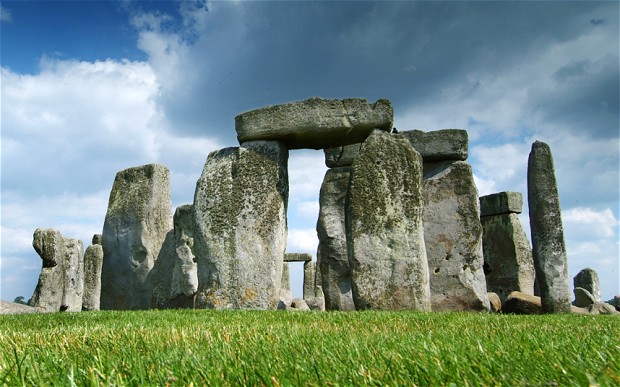
Stonehenge receives one million visitors a year and is a World Heritage Site. Photo: Christopher Jones for the Telegraph

Now, English Heritage has developed a possible solution, a virtual visit in a 360 degree cinema where visitors can “experience” standing in the ancient circle.

It will be the centrepiece of a new £27 million centre at the site and is one of a number of audio visual attractions being built to bring the prehistoric monument to life.

These will include a 32ft “landscape wall”, on to which computer generated images of the countryside around the circle and other ancient earthworks will be projected.

In addition, there will be five “people films”, shown on screens in one of the two vast pods being built to house the visitor centre. These will provide information about the monument and prehistoric items on display.

There will also be films exploring the conflicting theories over the establishment and use of the circle.

Outside the centre, replica Neolithic dwellings are being built, where visitors will be able to see how early inhabitants of the sites lived.

The plans for the centre are revealed in a series of tender documents from English Heritage, seeking firms to provide the technological content for the audio visual displays. The documents describe the “immersive 360 degree projected film” as the “most important and high profile piece of audio visual ever undertaken by EH”.

The new auditorium’s 100ft circumference will compare with about 300ft in the actual stone circle.

Robert Campbell, the head of interpretation at the centre, said: “It’s meant to give people a sense of what it is like to stand in the middle of Stonehenge because most people just won’t be able to do that. It won’t feel like you are standing in a computer programme. The idea is to take our visitors back in time.”

The virtual visits may not win over all campaigners including Pagans and Druids who want open access to Stonehenge, which was created about 5,000 years ago.

When it was first opened to the public, it was possible to walk among and even climb on the stones. However, they were roped off in 1977 due to problems with erosion.

Visitors are now kept a short distance away, although English Heritage does permit access during the summer and winter solstice, and the spring and autumn equinox. Some access visits early in the morning or late in the evening can also be booked.

Stonehenge receives one million visitors a year and is a World Heritage Site. The multi-million project is being built 1.5 miles from the stones.

Article source: By , and David Barrett (http://www.telegraph.co.uk/earth/environment/archaeology/9950377/Stonehenge-visitors-to-experience-standing-in-the-ancient-circle.html)

Stonehenge Tour Guide

Stonehenge Guided Trips are offering their usual transport option from London for this event:

http://www.stonehengetours.com/html/stonehenge-autumn-equinox-tour-2011.htm

StonehengeNews's avatarStonehenge Stone Circle News and Information

The Autumn Equinox occurs at 8.44pm on Sunday 22 September 2013. 

Celebration of the Autumn Equinox will take place at Stonehenge at sunrise on Monday 23rd September 2013.

Stonehenge Autumn Equinox Visitors wishing to celebrate the Autumn Equinox at Stonehenge will be given access into the monument when it is considered sufficiently light and therefore safe to do so. This is likely to be from approximately 6.15am.

Sunrise that morning will be at approximately 6.56am. Visitors will be asked to vacate the site by 8am.

Please note that access to Stonehenge might not be possible if the ground conditions are poor or if it is considered that access might result in severe damage to the monument.   Limited facilities are available at Stonehenge for the duration of the access although these facilities will not be open prior to the access commencing.

If you require disabled parking, please email Sally Gardner at sally.gardner@english-heritage.org.uk.

View original post 148 more words

Stonehenge Landscape ToursStonehenge is the best known of all the prehistoric monuments in the British Isles and probably also in Europe. Along with the Neolithic monuments around Avebury situated 28km to the north, it forms a UNESCO recognised World Heritage Site (WHS), the parts of which are separated by the southern edge of the Marlborough Downs, Pewsey Vale and the Salisbury Plain military training area.

The Stonehenge Landscape takes in much of the World Heritage Site around the famous stone circle. The National Trust owns 830ha of land surrounding Stonehenge, and within the extended landscape around the stone circle are burial mounds and a huge ‘cursus’ enclosure.

The Stonehenge Landscape takes in the henge monument at Durrington Walls – the largest henge in Britain. Walk the ceremonial routes travelled about this extraordinary landscape in the footsteps of the builders of Stonehenge.

There are terrific views of Stonehenge from paths through the Landscape. During June and July the fields are covered with a profusion of wildflowers.

Among the area included in Stonehenge Landscape are Stonehenge Down, which features ceremonial walkway, a Bronze Age barrow cemetery, and the cursus enclosure. At King Barrow Ridge are further Bronze Age mounds, and at Normanton Down is a round barrow cemetery. Entry to Stonehenge Landscape is free, although at peak times there may be a charge at the Stonehenge car park for visitors who are not members of the National Trust or English Heritage.

Link: http://www.english-heritage.org.uk/professional/research/landscapes-and-areas/archaeological-field-survey-and-investigation/stonehenge-landscape/

Link: http://www.nationaltrust.org.uk/stonehenge-landscape/

Stonehenge and Avebury Stone Circle Landscape Tours: http://www.stonehengetours.com/

Stonehenge Tour Guide


More than 20,000 revellers gathered at the famed monument for sunrise on the longest day of the year.

Stonehenge By Pejman Faratin

Stonehenge
By Pejman Faratin

The sun rose at 4:52am this morning; however cloud cover meant it remained hidden at the World Heritage Site.

It was the last summer solstice ahead of a ‘historic’ transformation of the site, including the creation of a new visitor centre around 1.5 miles away.

Loraine Knowles, Stonehenge director at English Heritage, said the closure and grassing over of the A344 was ‘a real milestone in terms of the history of the site’.

‘When you are in Stonehenge in the future, when grass is established, you will be able to make the link between the monument and the rest of the heritage landscape to the north,’ she added.

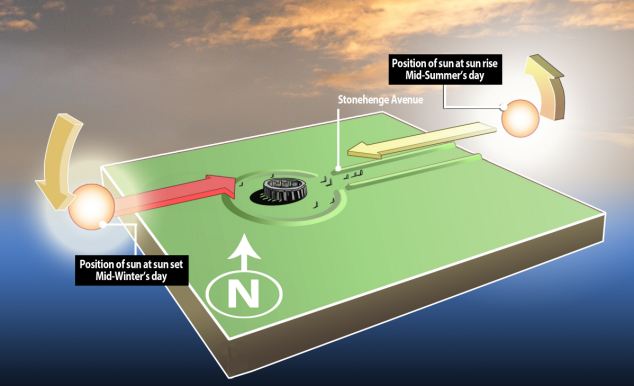
Visitors will also be able to access the avenue, the route by which the monument was approached when it was used as a place of great ceremony.

Police say there were fewer arrests than usual this year, with 22 people taken into custody, most for drug-related offenses.

The solstice has typically drawn a wide and varied crowd to the mysterious set of standing stones whose purpose remains unclear.

The ancient stone circle on the Salisbury Plain about 80 miles (130 kilometers) south-west of London, was built in three phases between 3000 B.C. and 1600 B.C

Article Source: http://metro.co.uk/2013/06/21/gallery-summer-solstice-2013-at-stonehenge-3850650/summer-solstice-at-stonehenge-8/

Stonehenge Tour Guide

StonehengeNews's avatarStonehenge Stone Circle News and Information

When dealing with prehistory (before the written word) arguments will abound as to ‘who, when and why’, and no more so than the famous monument on Salisbury Plain, the circle of stones known the world over as Stonehenge. 5,000 years ago, give or take a decade, work began here with an initial earth bank and ditch with some form of wooden structure within. Debate continues as to what exactly was placed within the earth circle and further debates are put forward about the various phases of constructing the stone circle, where the stones came from and the importance of the Moon and Sun in the process of worship at the site. For a lot of day trippers it’s Stonehenge’s iconical status that brings them here in their thousands whether they are familiar with the documentaries churned out by travel channels, read Tess of the D’Urbervilles or have watched National Lampoon’s European Vacation.

Stonehenge inner circle tourMost…

View original post 686 more words

The first crop circle of 2013 has appeared in Wiltshire between Stonehenge and Avebury Stone Circle.  Click here to view the image and location.

Crop-circle-at-wiltsWiltshire is well known for its crop circles and much mystery still remains as to why they occur and the meanings behind their complex formations.

Crop circles in Wiltshire often occur around the heart of the county in and around Avebury, usually first appearing in April and continuing into the summer months. The Wiltshire Crop Circle Study Group established in 1995 to help the crop circle phenomena in all aspects. Within their website, the latest Wiltshire crop circles are published.

Crop circle code of conduct

Visitors are requested:

  • To seek permission from landowners at all times before entering private property.
  • To always use gates or stiles to enter fields – please do not climb over fences.
  • To close gates after passing through them.
  • Not to take vehicles into fields and ensure vehicles do not block landowners access points.
  • Where possible use ‘tramlines’ (where farmers’ tractors have cleared a path) to enter crop circles, so causing as little damage as possible to standing crops.

http://www.visitwiltshire.co.uk/ideas-and-inspiration/crop-circles
http://www.cropcircleconnector.com/2013/June2013.html
http://stonehengetours.com/weird-wiltshire-stonehenge-crop-circle-tour.htm

A druid who has lost his second legal bid to get human remains reburied at Stonehenge has said he will fight on.

King Arthur Pendragon lost a High Court bid to have the bones reburied in 2011

King Arthur Pendragon lost a High Court bid to have the bones reburied in 2011

King Arthur Pendragon claims the cremated bones discovered in 2008 are the remains of members of the royal line and wants them re-interred.

Having lost a High Court bid to have the bones reburied in 2011, permission to take the case to a full judicial review has also been refused.

But the druid leader said it was “by no means the end of the campaign”.

The cremated remains of more than 40 bodies, thought to be at least 5,000 years old, were removed from the burial site at the ancient stone circle in Wiltshire in 2008.

‘Broken up Weetabix’

But Mike Pitts, one of the archaeologists who found the remains, said they did not uncover “individual burials” but bone fragments that were “very small and damaged”.

“What we’re attempting to do is to isolate individual people, to recognise bits of bone that came from individuals, within this mass of bone that was just dumped in a mass like broken up Weetabix at the bottom of this pit,” he said.

“So studying these is an extremely detailed, time consuming and forensic process.”

Ministers gave permission to allow the bones to be examined at Sheffield University until 2015.

But Mr Pendragon has vowed he will continue his fight to have the remains reburied.

“The judge in refusing to let me take this particular case did say that if they [the remains] do not go back in the ground in 2015 – which the current licence says they’ve got to be – that I will take another case against them,” he said.

“And the judge has given me permission to do that.”

Source: http://www.bbc.co.uk/news/uk-england-wiltshire-22558293

Stonehenge Tourist Guide, Salisbury

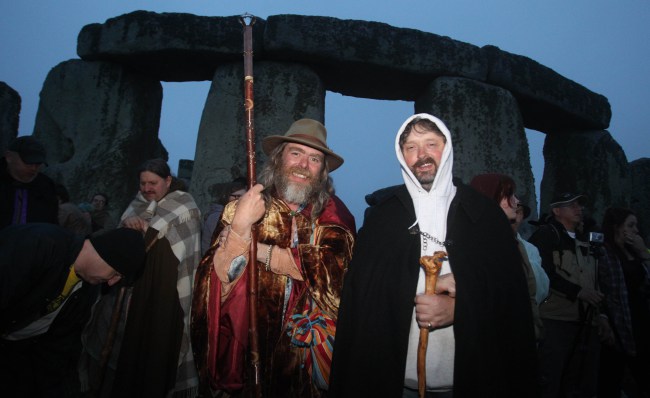
They were once caricatured as be-robed bearded druids with an odd Victorian  belief in the spirits of nature, but paganism – especially in the West – is  fast-growing and almost mainstream now.

The number of pagans has doubled in the past decade and with Glastonbury TorAvebury and Stonehenge, the West is leading a religious revival in our  pre-Christian beliefs. Yesterday, pagans said they hoped to have finally  convinced the public at large they are peace-loving nature  devotees, and called  for greater recognition of paganism and pagans, after figures showed it was  probably the fastest growing religion in the country

Pans and Druids at StonehengeProfessor Ronald Hutton, from Bristol University, reckons there could be as  many as a quarter of a million pagans in Britain – probably the highest number  since Roman times – and now boosted by the results emerging from the recent  census, they are getting firmer in asserting their beliefs in a largely secular  or Christian country.

Pagan leaders have highlighted the numbers of people who declared themselves  to be pagans in the 2011 census, which reveal that 79,473 people said they were  in England and Wales, compared with 42,262 in the whole of Britain back in  2001.

Chris Crowley, the president of the Pagan Federation, said that figure was  important because pagans were not awarded their own tick box on the census  forms, and to declare their religion as ‘pagan’, people had to tick the box  marked ‘other’ and specifically write ‘pagan’ next to it.

Emboldened by the rise in numbers to make paganism the seventh biggest  religion in this country, Mr Crowley said he was pleased people were more  accepting than previously. “We take issue with people using our beliefs in  tawdry and cavalier fashion,” he said.

“When we first approached the Charity Commission for Wales and England in  1997 seeking charity status, one of its officials asked us if we sacrifice  humans. I think we’ve come an awful long way in public understanding since  then,” he added.

Pagans have long been drawn to the West with sites like ancient Pre-Christian  sites like Glastonbury, Avebury and Stonehenge as important symbols of their  beliefs.

“We are far from an amusing curiosity. Pagans are a serious and growing  religious group and these latest census figures reflect that,” added Mr  Crowley.

The British Isles perhaps are best known as the home of the Druids, but those  are only a small number of modern pagans, explained Prof Hutton, a leading  expert in pre-Christian Britain.

Pagans celebrate events such as the summer and winter solstice by gathering  before sunrise in gardens, forests, hilltops or beaches for organised rituals or  their own personal reflection.

Read more (Western Daily Press) : http://www.thisisbath.co.uk/Paganism-longer-cloaked-mystery/story-18889957-detail/story.html#ixzz2SOxVqVem

Stonehenge Tour Guide


Aerial archaeologist Ben Robinson visits Amesbury in Wiltshire where excavations have revealed that the history of people living in this location dates back much further than previously thought.

Photo: English Heritage

Photo: English Heritage

New evidence from the dig, at a site called Vespasian’s Camp, has revealed traces of human settlement 3,000 years before nearby Stonehenge was built. A team of archaeologists has uncovered evidence of sustained hunter gatherer activity which dates to 8,000 years ago – long before Stonehenge
David Jacques explains why the discovery is of international importance and what it means in terms of unlocking the secrets of Stonehenge, located less than a mile away.

The Flying Archaeologist – Stonehenge is broadcast on Friday, 19 April at 19:30 BST on BBC One West and South. The series is broadcast nationwide from Wednesday, 1 May at 20:30 BST on BBC Four Watch a clip here: http://www.bbc.co.uk/news/uk-england-22019089

32-foot-tall stack of stones discovered

Stonehenge has some company in the department of mysterious stone structures: In a new paper, researchers are now revealing that an unusual rock formation was discovered via sonar in the Sea of Galilee a decade ago. Divers who have since gone down to inspect it say it’s a 32-foot-tall cone-shaped formation made of “unhewn basalt cobbles and boulders,” reports LiveScience, which describes it as a cairn—a stack of rocks piled on top of each other. Its diameter measures about 230 feet (double that of Stonehenge’s outer circle), and it’s estimated to weigh 60,000 tons.

Giant rock structure found under sea

Giant rock structure found under sea

Though the researchers admit they don’t know what the structure’s purpose was (LiveScience notes similar cairns have been used to mark graves), they have determined it was definitely made by humans, likely on land; a rising sea would have later submerged it. “The boulders have natural faces with no signs of cutting or chiseling,” researchers wrote in the International Journal of Nautical Archaeology. “Similarly, we did not find any sign of arrangement or walls that delineate this structure.” Up next: The team hopes to conduct an underwater archaeological expedition in order to mine for artifacts and pinpoint the age of the structure—which one researcher believes could date back more than 4,000 years.


Article by: By Ruth Brown,  Newser Staff
http://www.newser.com/story/165993/in-sea-of-galilee-a-mystery-bigger-than-stonehenge.html

Stonehenge News