>
Design watchdog hits out at plans for £20m visitor centre at megalithic jewel in England’s cultural crown

Its footpaths are “tortuous”, the roof likely to “channel wind and rain” and its myriad columns – meant to evoke a forest – are incongruous with the vast landscape surrounding it.

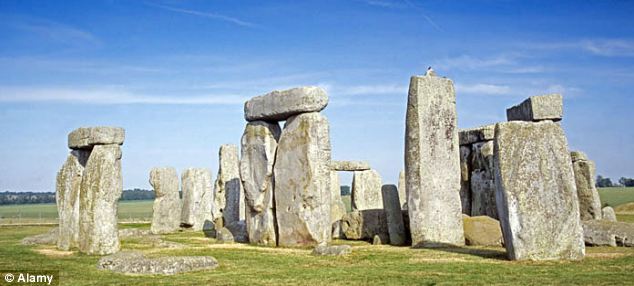
So says the government’s design ­watchdog over plans for a controversial £20m visitor centre at Stonehenge, the megalithic jewel in England’s cultural crown. CABE, the Commission for Architecture and the Built Environment, has criticised the design of the proposed centre, claiming the futuristic building by Denton Corker Marshall does little to enhance the 5,000-year-old standing stones which attract more than 800,000 visitors each year.

Its concerns are the latest chapter in the long saga surrounding the English Heritage-backed project, and follow a ­government decision two years ago to scrap on cost grounds a highly ambitious £65m scheme to build a tunnel to reroute traffic to protect the World Heritage site.

The centre, which has been approved by Wiltshire county council planners, has divided opinion.

“We question whether, in this landscape of scale and huge horizons and with a very robust end point that has stood for centuries and centuries, this is the right design approach?” said Diane Haigh, CABE’s director of design review.

“You need to feel you are approaching Stonehenge. You want the sense you are walking over Salisbury Plain towards the stones.”

But the “twee little winding paths” were “more appropriate for an urban ­garden” than the “big scale open air ­setting the stones have”, she added.

The many columns were meant to be “lots of trunks” holding up a “very delicate roof”, she said. “Is this the best approach on what is actually a very exposed site. In particular, if it’s a windy, rainy day, as it is quite often out there, it’s not going to give you shelter. We are concerned it’s very stylish nature will make it feel a bit dated in time, unlike the stones which have stood the test of time”.

CABE believed the location of the ­centre, at Airman’s Corner, is good, and were pleased “something was happening at last”, but questioned the “architectural approach”. The centre has the full support of local architects on the Wiltshire Design Forum, and has been passed by the local planning committee. Nevertheless English Heritage recognised it was an emotional and divisive subject.

“Innovative architectural designs will always polarise opinion, and often nowhere more so that within the architectural world itself,” it said in a statement.

“The Stonehenge project has to overcome a unique set of challenges,” it said. “This has required a pragmatic approach and, following widespread consultation, we maintain the current plans offer the best solution”.

Stephen Quinlan, partner at Denton Corker Marshall, defended the design. The roof was meant to be a “sun canopy” and not offer weather protection in what was, principally “an outdoor experience”.

“It’s not an iconic masterpiece. It’s a facility to help you appreciate the Stonehenge landscape. It’s intellectually ­deferential in a big, big way to Stonehenge as a monument.

“I wouldn’t even mind if you couldn’t remember what the building looked like when you left. The visitor centre is not the destination,” Quinlan said.

However, he added: “We don’t take criticism from CABE lightly. And we are ­crawling through their comments to see if there are any improvements we can make.”

>
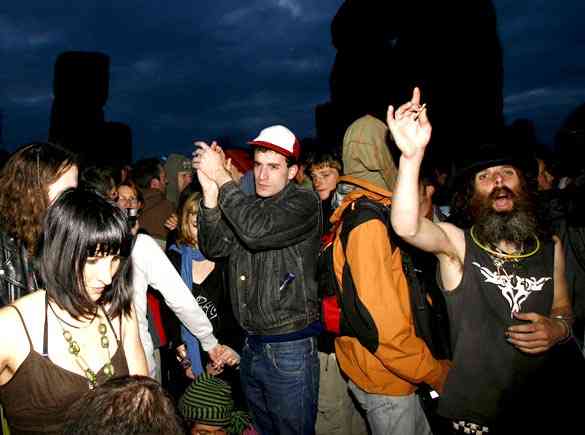
Salisbury Plain, Wilts – (Ass Mess): Druids, vegans and assorted goths are to be excluded from Summer solstice commemoration ceremonies at Stonehenge this year after locals branded them a pest to wildlife who habitually dump excessive tonnes of toxic human waste into the surrounding ecosystem.

“Each year we have to put up with acres of foreign lentils sprouting up in the fields surrounding this ancient monument after these hippies crap all over our pastureland,” local Soil Association representatives have told the press.

“Mostly they are organic free-trade Peruvian-origin virulent strains that defy digestion and germinate in the lower gut before acts of nature deposit them in the ancient Wiltshire countryside.

“For the last five years we have had to spend over ten million pounds on heavy duty industrial crop busting machinery to uproot these foreign lentil varieties which spread like wildfire across the county.”

Despite Ministry of Agriculture measures to contain the outbreaks the invasive legumes keep sprouting and often affect indigenous wildlife nesting in the myriad hedgerows of the nearby countryside.

“We’ve tried asking the solstice visitors to amend their diets before and during their annual pilgrimages to our country’s most ancient monument, but do they listen?

“Even installing bio-degradeable lavatory facilities at vast cost to the taxpayer is a futile act because many of these vegan and Druid chappies only void in the open, under moonlight and according to their spiritual beliefs.

“Most of them appear to prefer soiling themselves than using one of our portable hygenic chemical toilet facilities,” local health official reported.

A five mile exclusion zone has cordoned off the Stonehenge monument today in anticipation of an early influx of the annual travellers whose convoys have already been spotted on the nearby local bypass armed with their trademark teepees, wigwams and calor gas fry-up equipment.

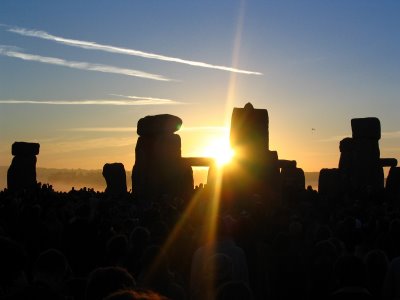
The sun’s annual ingress into the sign of Cancer takes place on Thursday evening this week.

You have been warned.

I did promise a few laughs on this blog – it can’t all be serious. Ha ha…………..

>
Survey of landscape suggests prehistoric monument was surrounded by two circular hedges.
The Monty Python knights who craved a shrubbery were not so far off the historical mark: archaeologists have uncovered startling evidence of The Great Stonehenge Hedge.

Inevitably dubbed Stonehedge, the evidence from a new survey of the Stonehenge landscape suggests that 4,000 years ago the world’s most famous prehistoric monument was surrounded by two circular hedges, planted on low concentric

banks. The best guess of the archaeologists from English Heritage, who carried out the first detailed survey of the landscape of the monument since the Ordnance Survey maps of 1919, is that the hedges could have served as screens keeping even more secret from the crowd the ceremonies carried out by the elite allowed inside the stone circle.

Their findings are revealed tomorrow in British Archaeology magazine, whose editor, Mike Pitts, an archaeologist and expert on Stonehenge himself, said: “It is utterly surprising that this is the first survey for such a long time, but the results are fascinating. Stonehenge never fails to reveal more surprises.”

“The time these two concentric hedges around the monument were planted is a matter of speculation, but it may well have been during the Bronze Age. The reason for planting them is enigmatic.”

Pitts wonders if the hedges might have been to shelter the watchers from the power of the stones, as much as to ward off their impious gaze.

If the early Bronze Age date is correct, when the hedges were planted the Stonehenge monument already had the formation now familiar to millions of tourists, after centuries when the small bluestones from west Wales and the gigantic sarsens from the Stonehenge plain were continually rearranged.

The survey also found puzzling evidence that there may once have been a shallow mound among the stones, inside the circle. It was flattened long ago, but is shown in some 18th century watercolours though it was written off as artistic licence by artists trying to make the site look even more picturesque. The archaeologists wonder if the circle originally incorporated a mound which could have been a natural geological feature, or an even earlier monument.

>
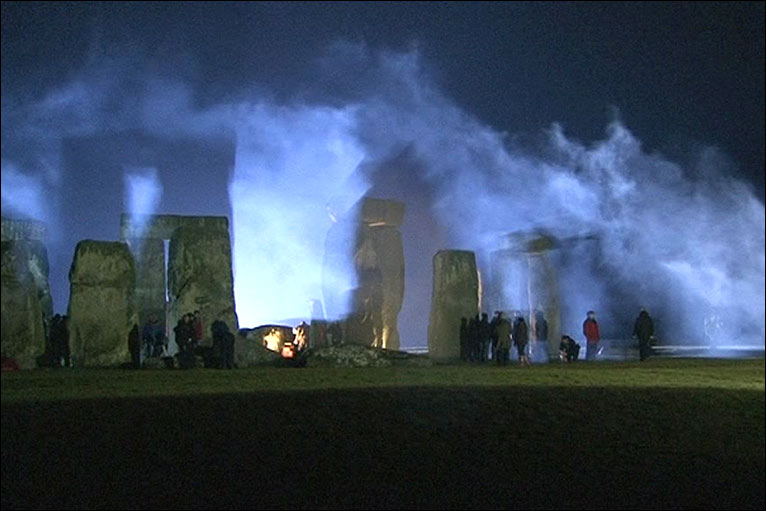
On Tuesday night, February 2, Wiltshire’s ancient stone monument was taken over by a film crew…..filming season five of BBC 1’s Doctor Who.

Exclusive leak….
Turns out that when the moon lies above the stone circle and the sun is on the opposite side of the earth, the stone circle acts as a gateway to a parallel time and place. Standing in the centre of the circle can allow one to be at one with the entire universe but unfortunately induces runaway ageing and exposure to other more evil personalities bent upon conquest. Dr Who finds himself imprisoned within the stone circle of an advanced extra-galactic civilisation and is held as a hostage until dastardly demands are met. The clock is running and the Doctor is rapidly ageing towards infancy. A twist in the tale is the entity that is allowed into the modern Human world when the stone circle is activated. Sadly, the choices are harsh…..either allow the proposed McDonalds drive-through planned for the Avenue, the bowling alley, the souvenir shop and the vast visitor facilities or, the Doctor will be wearing nappies for the remainder of this series and the evil personality (a hybrid mutation of David Icke and Schliemann) will win executive control of English Heritage.

Doctor Who at Stonehenge
Despite it being a closed set…
Local fans, braved the rain hoping to catch a glimpse of the action: “I’ve been a fan of Doctor Who since I was five, that’s 35 years now, and this has been the first chance I’ve had to see it being filmed.”

…plus returning professor River Song (Alex Kingston) have all been spotted on set – along with a brazier or two – the rumour is that the latest episodes including The Eleventh Hour, The Beast Below and Victory of the Daleks will all be set ‘some time in the past’.

With early filming reports claiming that the Doctor aka Matt Smith along with his sexy assistant Amy Pond played by Karen Gillan…

>
Ancient man had his own form of ‘sat nav’ that helped him find his way across Britain, according to new research.

The sophisticated geometric system was based on a stone circle markers.

Our ancestors were able to travel between settlements with pinpoint accuracy thanks to a complex network of hilltop monuments.

These covered much of southern England and Wales and included now famous landmarks such as Stonehenge and The Mount.

Researcher Tom Brooks analysed 1,500 prehistoric monuments, including Stonehenge and Silbury Hill in Wiltshire, and found them all to be on a grid of isosceles triangles – those with two sides of equal length – each pointing to the next site.

He believes this proves there were keen mathematicians among the ancient Britons 5,000-6,000 years ago, at least two millennia before the Greeks who were supposed to have discovered geometry.
Many monuments are 250 miles or more away but GPS co-ordinates now show all are accurate to within 100 metres and provided a simple map for ancient Britons to follow.

Incredibly, the triangles still exist today as many medieval churches, abbeys and cathedrals were constructed on top of the original stone circle markers.

Historian and writer Tom Brooks, from Honiton, Devon, believes prehistoric men were ‘highly intelligent surveyors and planners.’
He said: ‘It is known that many, if not all, early churches, abbeys and cathedrals were constructed on ancient sites and this diagram illustrates that point.

‘This ancient form of geometry permits the production of various patterns across our landscape linking prehistoric settlements and waymarks.

‘Such is the mathematical precision that it is inconceivable that this work could have been carried out by the primitive indigenous culture we have always associated with such structures.

‘Such patterns could only have been the work of highly intelligent surveyors and planners which throws into question all previous claims as to the origin of mathematics.

‘All this suggests a culture existing in these islands in the past quite outside our expectation and experience today.’

Mr Brooks analysed 1,500 sites stretching from Norfolk to north Wales. These included standing stones, hilltop forts, stone circles and hill camps.

Each was built within eyeshot of the next. Using GPS co-ordinates, he plotted a course between the monuments and noted their positions to each other.

He found that they all lie on a vast geometric grid made up of isosceles ‘triangles’.

Each triangle has two sides of the same length and ‘point’ to the next settlement.
Thus, anyone standing on the site of Stonehenge in Wiltshire could have navigated their way to Lanyon Quoit in Cornwall without a map.

Mr Brooks believes many of the Stone Age sites were created 5,000 years ago by an expanding population recovering from the trauma of the Ice Age.

Lower ground and valleys would have been reduced to bog and marshes, and people would have naturally sought higher ground to settle.

He said: ‘The modern-day diagram links 13 churches within four counties of south-west England, ranges across 60 miles, and is a remarkably accurate arrangement of isosceles triangles projecting to varying compass points.

‘The medieval system reaches from Derbyshire to Cambridgeshire, Sussex, Hampshire, Somerset and Wales, using only isosceles triangles accurate to within 100m over distances up to 250 miles.’
‘Prehistoric Geometry in Britain: the Discoveries of Tom Brooks’ is now on sale priced £13.90.

Read more: http://www.dailymail.co.uk/sciencetech/article-1240746/Prehistoric-sat-nav-set-ancestors-Britain.html#ixzz0eHHBmsJa
>WOW 360-degree views of Stonehenge – click here

Avebury and Stonehenge can be explored with the click of a mouse from today as the National Trust’s most famous sites have been added to Google’s Street View mapping.

Over 20 historic locations across the UK – including castles, landscapes and country houses – have been scanned using a panoramic camera, bolted to the back of a tricycle, and added to Google’s online mapping service.

Users can now take a 360-degree, ground-level tour of sites such as Corfe Castle in Dorset, Fountains Abbey in North Yorkshire, Lindisfarne Castle in Northumberland, and Plas Newydd in Wales.

Austen fans with a romantic sensibility can even take a virtual turn around Lyme Park in Cheshire – made famous by Colin Firth’s emergence from its lake as Mr Darcy in the BBC’s adaptation of Pride And Prejudice.

Google’s Street View cyclists pedalled over 125 miles on the 18-stone trike, following marked routes around the National Trust sites to capture them from every angle.

Ed Parsons, technologist at Google, said: “We were delighted to be able to open up some of the UK’s most famous landmarks to the rest of the world via the web.”

However, he does not believe the online experience will discourage tourists from visiting the sites in person.

“It’s a fun way to preview what to see and do on a day out,” he said.

“Or whet your appetite for where to go next.”

Google will continue to collect images from other National Trust sites throughout 2010, including UNESCO World Heritage Site the Giant’s Causeway, in County Antrim.

>
PLANS for the new £27.5million visitor centre and facilities at Stonehenge have been given the go ahead by Wiltshire Council.

Despite concerns raised about increased congestion, the size of the new car park and transportation from the centre to the ancient monument, 12 out of 13 councillors on the council’s strategic planning committee voted to approve the scheme.

The project involves building a new centre with a car park at Airman’s Corner, with a land train to take visitors to the stone circle.

The existing visitor centre and parking will be removed and the A344 from Stonehenge to the A303 will be closed off and grassed over.

Cars will be diverted to Longbarrow Roundabout and along the A360 to Airman’s Corner, where a new roundabout will be constructed.

“There is no question that something is needed,” said Amesbury councillor Fred Westmoreland. “To me, this site makes sense.

“Most of the objections which are being made are looking for a solution we are never going to get. This is the third planning application, or the fourth, and you will never get everyone to agree on everything.

“If in five years or five months time we find the road system does not work, no problem, we can change the system. If we find the buildings themselves are not working particularly well, we can amend them.

Cllr Christine Crisp said: “There is public money on the table to make this one happen. If it is delayed a year or two years, we will have no idea whether there is any public money on the table to make that development happen.”

Loraine Knowles, Stonehenge project director for English Heritage, said: “This is an important step in returning Stonehenge to a more dignified setting and creating facilities more fitting for a world-renowned tourist attraction.

“We can now begin to look forward to providing a much improved, high quality experience for visitors at an environmentally sensitive development.”

* Councillors also approved an application to move the Airman’s Cross monument from its current position at the staggered junction into the visitor centre grounds, where it will be placed next to the path from the car park to the centre.

English Heritage welcomes Stonehenge Vistor Centre decision

English Heritage has welcomed yesterday’s decision by Wiltshire Council’s planning committee to approve plans for a new visitor centre for Stonehenge.

Loraine Knowles, Stonehenge project director for English Heritage, said: “This is an important step in returning Stonehenge to a more dignified setting and creating facilities more fitting for a world-renowned tourist attraction.

“We can now begin to look forward to providing a much improved, high quality experience for visitors at an environmentally sensitive development.”

With planning permission in place for the visitor centre, plans for the closure of the A344 adjacent to the Stones (from the A303 to Byway 12) will now be put forward for approval. At the same time, Wiltshire Council will be consulting on proposals to restrict motorised vehicles on the remaining part of the A344 and on nearby Byways.

Following a lengthy consultation and extensive technical assessments, the Prime Minister announced on 13 May last year that Airman’s Corner would be the location for new Stonehenge visitor facilities. Together with proposals for the closure of the A344, the scheme will enhance the monument’s setting by removing the existing visitor facilities (including car parking) and improving the visitor experience with new exhibition and education facilities. A fully accessible transit system will run from the new visitor centre to a drop-off near the Stones.

Airman’s Corner is about 1.5 miles (2.5km) west from Stonehenge, on the junction of the A344 and A360. It is at the edge of the World Heritage Site and is easily accessible by road. The land is currently used for farming, with very few residents living close to the site.

>
Stonehenge may have been used as a site where knowledge was communicated ritually, according to a new theory.

Lynne Kelly, La Trobe University doctoral researcher and science writer, has been working on technologies oral cultures used to present and pass on scientific knowledge.

Kelly demonstrated the constant changes in the archaeology at Stonehenge are consistent with the mnemonic (conveying through chants and rituals) needs of the knowledge elite as they settle, while delivering the inaugural Marshall McLuhan Lecture in Chicago.

‘Instead of moving between sacred places to perform the cycle of ceremonies which encode all formal knowledge of their culture, Neolithic Britons replicated that landscape in the monuments they built over 1,500 years in transition from a mobile hunter-gathering to settled agriculture,’ says Kelly.

The Neolithic Britons who built Stonehenge, like other cultures starting to settle, lacked a written language with which to preserve their knowledge.

Kelly says the most reliable recording system they had were mnemonic methods, whereby knowledge ranging from animal behaviour to astronomy could be communicated.

To facilitate this, she argues that Stonehenge itself acted as a knowledge centre, a function that it had in common with many other sites around the world, says a university release.

Kelly’s research draws parallels with oral cultures such as Native American, African and Aboriginal Australian, and finds clues in the physical remains of Stonehenge.

>
A new research project that promises to significantly improve our understanding of Stonehenge is going ahead after receiving an £800,000 grant.

Dr Oliver Craig, from the University of York’s Department of Archaeology, is part of the team behind Feeding Stonehenge, a follow-up to the earlier Stonehenge Riverside project which saw a wealth of material excavated from nearby Durrington Walls.

The latest stage of the research involves the analysis of that material, including pottery, stone tools and animal bones, to shed new light on the people who built and visited Stonehenge.

“Earlier investigations have made huge inroads into our understanding of what is one of the world’s most important prehistoric monuments but many questions remain unanswered”

Feeding Stonehenge is being supported by a grant from the Arts and Humanities Research Council.

Dr Craig said: “This research will allow us to gauge Stonehenge’s significance in the 3rd Millennium BC and the extent of its sphere of influence.

“Earlier investigations have made huge inroads into our understanding of what is one of the world’s most important prehistoric monuments but many questions remain unanswered.

“The next stage will focus on how the people who built Stonehenge lived, what they ate, when the monument was visited and where the visitors came from.”

Initial chemical analysis of cattle teeth found in the area suggests the animals were raised hundreds of miles away before being walked to Durrington Walls for slaughter and consumption.

One aim of Feeding Stonehenge that will be covered by the York team will be to try and understand what the pottery was used for by conducting chemical analysis of any organic residues present.

Pottery was used for domestic as well as ceremonial activities but it is not known what types of foods were prepared for these different activities.

The Feeding Stonehenge research is led by Professor Mike Parker Pearson of the University of Sheffield working alongside Dr Craig, Dr Umberto Albarella, from the University of Sheffield and Dr Jane Evans, from the NERC British Geological Survey.

>
I am a professional tour guide who can provide ‘private’ guided sightseeing tours of Stonehenge for small groups.
I specialise in Stonehenge and ancient Britain and can often get permission from the English Heritage to take you beyond the fences and touch the Stones after the site is closed to the public. (special access or inner circle tours)

Private tours can depart from London, Salisbury, Bath or Bristol

Some of my popular ‘favourite’ day tour itineraries include:
King Arthur Day Tour
Stonehenge
Glastonbury and King Arthurs Avalon
Challice Well Gardens (reputed buriel site of the Holy Grail
Avebury Stone Circle
Silbury Hill

Great Heritage Trail Day Tour
Stonehenge
Roman City of Bath
Lacock Village
Castle Coombe

Wessex Explorer Day Tour
Salisbury Cathedral
Old Sarum Hillfort
Stonehenge
Avebury Stone Circle
Chalk Hill figures
Buriel Mounds
Crop Circles (April to Septemeber)

However, private bespoke tours can be tailored to suit your requirements and can offer the ultimate flexibility throughout your day (s) visiting almost any location you wish to visit.

I promise a well balanced day with continuous information about not only the places we visit but England in general. My style of touring guarantees an informative, entertaining day, certainly never boring.
I frequently see so called ‘professional’ guides giving an uninspired hasty tour of tourist attractions and then demand huge tips for their ‘sloppy’ services at the end of the day.
MY MISSION STATEMENT: In the unlikely event of you not being entirely satisfied with my services I will NOT charge you!

I truly appreciate that many of you will only visit Stonehenge or England once and deserve a great experience.
I can supply 100’s of testimonials from satisfied customers (individuals/ families/groups) and have a 1st class reputation with many of the UK tour operators. (my heads getting bigger and bigger the more I write) Seriously folks, give me the opportunity to quote for your private group tour (1 – 16 passangers) and I wont disappoint.
By contacting me direct you can also ‘cut out the middle man’ i.e travel agents who add a big fat commission for doing little
Direct Email: tour.guide@rocketmail.com