>
Britain’s failure to deal with road traffic around the prehistoric stone circle is condemned as ‘a national disgrace’

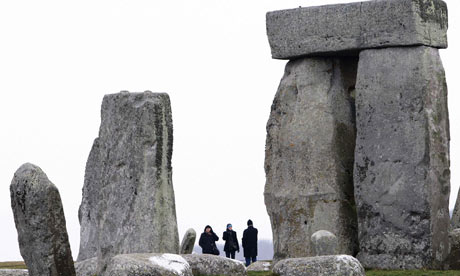
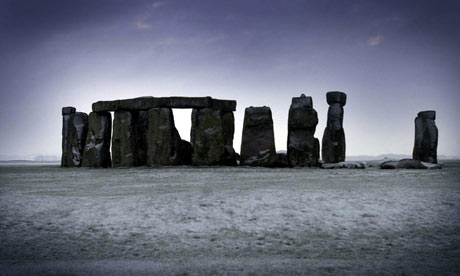
The traffic-choked roads still roaring past Stonehenge in Wiltshire have earned the world’s most famous prehistoric monument a place on a list of the world’s most threatened sites.

The government’s decision to abandon, on cost grounds, a plan to bury roads around Stonehenge in a tunnel underground and the consequent collapse of the plans for a new visitor centre, have put the site on the Threatened Wonders list of Wanderlust magazine, along with the 4×4-scarred Wadi Rum in Jordan, and the tourist-eroded paths and steps of the great Inca site at Machu Picchu in Peru.

Lyn Hughes, editor in chief of Wanderlust, said the A303 and A344 junctions near Stonehenge meant the site was “brutally divorced from its context”. She said: “Seeing it without its surrounding landscape is to experience only a fraction of this historical wonder. The fact that the government and various planning bodies cannot agree on implementing a radical solution to this problem is a national disgrace.”

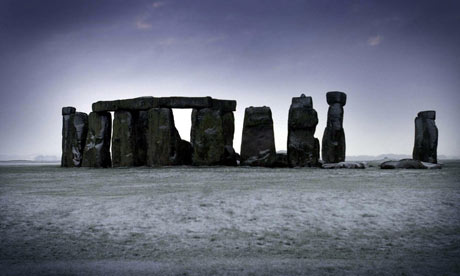
The first great earth banks and ditches of the monument date back 5,000 years, and it was then repeatedly remodelled, with the addition of the circle of sarsen stones the size of doubledecker buses, and smaller bluestones brought from west Wales, and said to have healing powers.

Hughes was echoing the words 21 years ago of the parliamentary public accounts committee, which in 1989 damned the presentation of the site and the facilities for tourists as “a national disgrace”.

Since then millions have been spent on alternative road plans and architectural designs for the visitor centre, on exhibitions, consultations and public inquiries, without a sod of earth being turned.

Argument about how to care for the site raged throughout the 20th century: the circle itself is in the guardianship of English Heritage, while the National Trust owns thousands of acres of surrounding countryside, studded with hundreds more henges, barrows and other prehistoric monuments.

At the moment the best hope is that a much simpler and cheaper visitor centre can still be created, two kilometres from the site, in time for London’s hosting of the 2012 Olympics.

>
The team who worked on the Stonehenge Riverside Project in 2009 are to return to their findings to explain the eating habits of the people who built and worshipped at the stone circle over four thousand years ago. Once again led by Professor Mike Parker Pearson from the University of Sheffield, the new ‘Feeding Stonehenge’ project will analyse a range of materials including cattle bones and plant residue.
At the time of the Winter Solstice experts believe people would have brought livestock with them to Stonehenge for a solstice feast. Initial research suggests the animals were brought considerable distances to the ceremonial site at this time of year. “One of the unforeseen outcomes (of the Stonehenge Riverside Project) is the vast quantity of new material – flint tools, animal bones, pottery, plant remains, survey data, and chemical samples – which now needs analysing,” explained Professor Parker Pearson. “We are going to know so much about the lives of the people who built Stonehenge – how they lived, what they ate, where they came from.”
A large collection of cattle jaws collected during the last few years’ excavations will now undergo strontium and sulphur isotope analysis to establish where they originally came from and when they were culled. This will give experts a better idea of where people had travelled from to visit the site. The research will also offer a better understanding of the dressing of the famous sarsen stones of Stonehenge and insights into how the public and private spaces at Durrington Walls and Stonehenge differ from each other. Researchers will also try and ascertain whether Britain’s Copper Age started 50 years earlier than first thought. Circumstantial evidence points to copper tools being in use at Durrington Walls earlier than originally thought. Cut-marks on animal bones should reveal whether they were made by copper daggers as opposed to flint tools.
“I’ve always thought when we admire monuments like Stonehenge, not enough attention has been given to who made the sandwiches and the cups of tea for the builders,” said Parker Pearson. “The logistics of the operation were extraordinary. Not just food for hundreds of people but antler picks, hide ropes, all the infrastructure needed to supply the materials and supplies needed. Where did they get all this food from? This is what we hope to discover.”
‘Feeding Stonehenge’, will take place over the next three years. Find out more about the Stonehenge Riverside Project at: http://www.shef.ac.uk/archaeology/research/Stonehenge

>
THE new Stonehenge visitor centre will show off artefacts from Salisbury and South Wiltshire Museum’s collection to a wider audience English Heritage is collaborating with the museum and Wiltshire Heritage Museum to present and interpret the story of the World Heritage Site in a dedicated exhibition space in the centre, at Airman’s Corner.

In returning for loaning items from their collections, the museums will get help from English Heritage with their own displays and with enhancing their archives.

Loraine Knowles, Stonehenge project director at English Heritage, said: “The exhibition will be part of an overall experience that will draw on all the senses and lead people to a greater understanding, not just of Stonehenge, but of the people who built it.”

Salisbury museum director Adrian Green said: “We look forward to supporting the development of the visitor centre, and also redisplaying our own nationally important collections from the World Heritage Site to complement the new exhibition at Stonehenge.”

David Dawson, director of the Wiltshire Heritage Museum, said “Together we can present the full story of Stonehenge and encourage visitors to explore Wiltshire.”

>
I just had to add this web link. This very funny sketch by the comedian Eddie Izzard about Stonehenge is sure to put a smile on your face.
Click on this link and enjoy!

Oh Yeah – What exactly is a Pagan ?
A brief introduction

Paganism is a spiritual way of life which has its roots in the ancient nature religions of the world. It is principally rooted in the old religions of Europe, though some adherents also find great worth in the indigenous beliefs of other countries. Such belief in the sacredness of all things can be found world-wide. Pagans see this as their heritage, and retain the beliefs and values of their ancestors in forms adapted to suit modern life. We celebrate the sanctity of Nature, revering the Divine in all things; the vast, unknowable spirit that runs through the universe, both seen and unseen.

Pagans honour the Divine in all its aspects, whether male or female, as parts of the sacred whole. Every man and woman is, to a Pagan, a beautiful and unique being. Children are loved and honoured and there is a strong sense of community. The woods and open spaces of the land, home to wild animals and birds, are cherished. Paganism stresses personal spiritual experience, and Pagans often find that experience through their relationship with the natural world that they love. We seek spiritual union with Divinity by attuning with the tides of Nature and by exploring our inner selves, seeing each reflected in the other. We believe that we should meet the Divine face to face, within our own experience, rather than through an intermediary. Although some paths do have leaders and teachers, these people act as facilitators, using their own wisdom and experience to help guide those in their care towards discovering their own sense and interpretation of the Divine. Our rites help us harmonise with the natural cycles, and so they are often held at the turning points of the seasons, at the phases of the moon and sun, and at times of transition in our lives.

There is a great variety of traditions within the broad spectrum of Paganism. This reflects the range of our spiritual experience, for we believe that everyone is unique, and so everyone’s spirituality must be equally unique. Some Pagans follow multiple Gods and Goddesses, their names familiar to all from the pages of European folklore and mythology: others focus on a single Life Force of no specific gender; yet others devote themselves to a cosmic couple – Goddess and God, or Lord and Lady. We celebrate our diversity for we believe that each person should find their spirituality according to the dictates of the quiet, inner voice of their own soul. For this reason we respect all sincere religions, and do not proselytise or seek converts. From other faiths and from society generally, we ask only tolerance.

In these days of environmental concern and eco-awareness, Pagans are often at the forefront of Green awareness. Pagans of all paths respect the rights of every living soul, whether human, animal, plant or rock. We are ever mindful of the actions of cause and effect, whether by thought or deed, upon the creatures of the Earth. We encourage free thought, creative imagination and practical human resourcefulness, believing these to be fundamental to our spending our lives in harmony with the rhythms of the natural world. We rejoice that some of our personal beliefs should now be shared by so many other people. These beliefs are the heritage of all people from our distant and common ancestors – they are equally the concern of all our descendants.

>
Many of you have been eagerly awaiting the release of Stonehenge ‘special access’ tours for 2010
I have been contacted by some of the London Tour operators who have just published their dates for March – September this year.
I can highly recommend the following tour operators;

The Sightseeing Tour Company
www.BestValueTours.co.uk

OR

Gr8xpectations (AllstarLeisure Ltd)
www.Welcome2Britain.com

These companies have been operating tours for over a decade and I have recieved excellent feedback about their tours and customer service.

It is important to book these tours early as they are extremely popular!

There will be some more dates published soon with different itineraries – watch this space………….. I hope this has helped – good luck !

Their itinerary is as follows:

STONEHENGE INNER CIRCLE TOURS:

Highlights: Private viewing of Stonehenge at sunset * Enter the stone circle and touch the stones * Visit Lacock, a delightful Saxon village * See where Harry Potter and Pride and Prejudice were filmed * Meal stop in a 13th century inn (food/drinks not included) * Visit Bath – free time to shop and explore * Entrance to the Roman Baths and Pump Room included

After your pick-up directly from or near to your hotel, we drive to Bath to visit the Roman Baths and Pump Room. In the late afternoon we visit Lacock for an early evening supper in a 13th century inn, before driving to Stonehenge. As the sun begins to set, we enter the stone circle (which is normally roped off to the public) for a unique private viewing. The most dramatic and atmospheric way of visiting Stonehenge.
Stonehenge – Private Viewing at Sunset and tourch the Stones
Built nearly 5,000 years ago, Stonehenge is the most popular prehistoric monument in the world. Most visitors to the site are not allowed direct access to the stones. With Premium Tours you get that access, with a private viewing of the mysterious monoliths. We will enter the stone circle itself and stand beside the mighty Sarsen rocks towering above us. Our guide will explain the history of this ancient site, pointing out the altar, slaughter and heel stones, above which the sun rises dramatically on the summer solstice. There will be time to enjoy the peace, away from the crowds, as we experience Stonehenge at its most mystical and atmospheric best. Not to be missed!

Lacock
Lacock is a little known, picturesque village dating back to the Saxon era. Many of the beautiful buildings originally formed part of an extensive monastic complex and are now owned by The National Trust. So pretty is the village that it has provided the setting for many movies and television dramas including Jane Austens Pride and Prejudice and more recently Harry Potter and the Philosophers Stone. We will take a delightful walk before we enjoy an early evening supper* (or breakfast for morning tours*) in The George, a vintage English pub built in 1361.
*food/drink not included

Bath
Bath, a world heritage site, is a beautiful Georgian city with delightful crescents, terraces and architecture. There will be plenty of time to visit Bath Abbey, or to shop and explore. Your guide will also conduct an optional walking tour to show you where Charles Dickens lived and worked as a young man, and a give you a chance to sample some delicious cheeses fresh from the local dairy farms. Then we will enter the magnificent Roman Baths, where over one million litres of boiling water still burst free from the hot springs everyday.

We are please to offer this tour on the following dates:

2010 OPERATING DATES
Month Date

January 2010 2nd, 15th, 25th

February 2010 1st, 5th, 8th, 15th, 22nd, 26th

March 2010 1st 4th, 8th, 11th, 15th, 26th

April 2010 1st, 4th,7th, 8th, 11th, 12th, 15th, 17th, 18th, 21st, 22nd, 25th, 26th, 29th

May 2010 5th, 6th, 9th, 10th, 13th, 16th, 19th, 23rd, 24th, 27th, 30th
June 2010 3rd, 6th, 7th, 10th, 13th, 16th
July 2010 1st, 4th, 7th, 8th, 11th, 12th, 15th, 18th, 22nd, 25th, 26th, 29th
August 2010 5th, 9th, 12th, 15th, 18th, 19th, 23rd, 26th, 29th
September 2010 2nd, 5th, 6th, 9th, 12th, 16th, 19th, 30th
>
Professor Mike Parker Pearson and his team have been awarded a further £800,000 grant to discover exactly how the people who built Stonehenge lived, what they ate and where they came from.

The research team from the Department of Archaeology at the University of Sheffield will study how at the time of the Winter Solstice, Stone Age people would have needed to have brought livestock with them to Stonehenge to feed on. Initial research suggests the animals were brought considerable distances to this ceremonial site at this time of year.

Funded by the Arts and Humanities Research Council (AHRC) as part of their annual large grants research scheme, this new project, entitled `Feeding Stonehenge´, will allow the team to answer some key questions about Stonehenge over the next three years.

The team will develop their research further by analysing the bones of the cows slaughtered in the area 4,500 years ago to calculate where the cattle had been moved from to give a better guide of where the people had travelled from to visit the site. In addition, the archaeologists will aim to gain a better understanding of the dressing of the sarsen stones, study how the public and private spaces at Durrington Walls differ from each other and establish in which season animals were culled at Stonehenge and Durrington Walls.

The grant forms one of 34 major research grants made by the AHRC in 2009 to projects that will help further our understanding of human culture and creativity. It was awarded following the already revolutionary Stonehenge Riverside project, also led by Professor Mike Parker Pearson, which strengthened the idea that nearby Durrington Walls was part of the Stonehenge complex. The large collection of cattle jaws collected during the last few years of excavations will now undergo strontium and sulphur isotope analysis to establish where they came from.

The newest project will now see the archaeologists study the material resources required for building Stonehenge and the other henge complexes of Wessex. In addition, the team will try and ascertain whether Britain´s Copper Age started 50 years earlier than first thought. Circumstantial evidence points to copper tools being in use at Durrington Walls earlier than previously calculated. Cut-marks on animal bones should reveal whether they were made by copper daggers as opposed to flint tools.

Professor Mike Parker Pearson from the Department of Archaeology at the University of Sheffied, said: “The Stonehenge Riverside Project’s results were well beyond anyone’s expectations – archaeologists and general public alike. It has allowed us to completely re-write the story of Stonehenge. One of the unforseen outcomes is the vast quantity of new material – flint tools, animal bones, pottery, plant remains, survey data, and chemical samples – which now needs analysing.

“The new grant from the AHRC for the ‘Feeding Stonehenge’ project allows us to get the maximum information out of this unexpected wealth of remains. We are going to know so much about the lives of the people who built Stonehenge – how they lived, what they ate, where they came from. The AHRC’s grants have been crucial for helping us find out more about one of the world’s most important prehistoric monuments. They have enabled the project to develop in directions which could not possibly be predicted when we started digging.”

In early September the AHRC spent a day visiting the 2009 excavation near Stonehenge and interviewing the research team. A short video podcast is now online that offers viewers an insight in to the scale of the excavations undertaken during 2009.

>

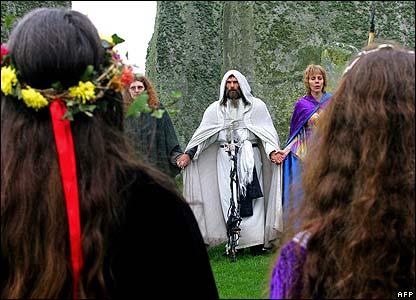
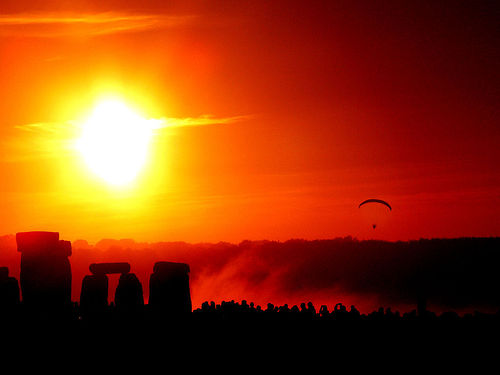
AROUND 300 pagan worshippers braved freezing temperatures to celebrate the winter solstice at Stonehenge, but turned up on the wrong day.

Dressed in traditional robes, they met at the stone circle on Monday to mark the rising of the sun on the shortest day of the year, but got their calculations wrong.

The winter solstice occurs when the tilt of the Earth’s axis is at its furthest from the Sun, resulting in the fewest hours of sunlight of the year.

Although it normally falls on December 21, the exact time of the solstice varies each year and this year the solstice was 5.47pm on Monday so, because the sun had already set, the official celebrations took place at sunrise on Tuesday.

But the hundreds of enthusiastic worshippers who turned up a day early went ahead and celebrated anyway.

English Heritage, which manages the site, decided to open the gates and welcome them even though it was the wrong day.

Hundreds more pagans and druids turned up on Tuesday morning for the official winter solstice celebrations.

>
Winter Solstice is today, Dec. 21, 2009, the day when the Earth tilts farthest away from the sun. It’s the shortest day of the year and the official start of winter. The word “solstice” comes from the Latin “sun stands still” and celebrations of the solstice pre-date Christmas. Stonehenge in England is the site of solstice festivals, apparently dating back some 4,500 years ago, when the site was in its proper cultural context. Some experts now believe that Stonehenge was the site of an ancient barbecue and midwinter celebration that culminated on the Winter Solstice, which also marks the beginning of longer days. From today’s Guardian: “Recent analysis of the cattle and pig bones from the era found in the area suggests the cattle used were walked hundreds of miles to be slaughtered for the solstice celebrations – from the west country or west Wales.”

And from English Heritage: “The monument we see today still inspires awe and admiration. Stonehenge attracts some 800,000 visitors a year and on the summer Solstice, thousands of people gather to watch the sunrise. Although thousands of years older than the Druids, the stone circle witnessed many druidic ceremonies, especially during the 19th century.”

>
Sheffield University archaeologists believe enigmatic prehistoric monument was used for ritual banquets on special occasions.

Some 4,500 years ago, as the solstice sun rose on Stonehenge, it is very likely that a midwinter feast would already have been roasting on the cooking fires.

Experts believe that huge midwinter feasts were held in that period at the site and a startling picture is now emerging of just how far cattle were moved for the banquet. Recent analysis of the cattle and pig bones from the era found in the area suggests the cattle used were walked hundreds of miles to be slaughtered for the solstice celebrations – from the west country or west Wales.

Professor Mike Parker Pearson of the University of Sheffield and his team have just won a grant of £800,000 from the Arts and Humanities Research Council, to answer some of the riddles about the enigmatic prehistoric monument.

The grant is to fund Feeding Stonehenge, his follow-up research on the wealth of material, including animal bones, pottery and plant remains, which they found in recent excavations at Durrington Walls, a few miles from the stone circle – a site which Parker Pearson believes key to understanding why Stonehenge was built and how it was used.

His team fully excavated some huts but located the foundations of scores more, the largest neolothic settlement in Britain. To his joy it was a prehistoric tip, “the filthiest site known in Britain”, as he dubbed it.

“I’ve always thought when we admire monuments like Stonehenge, not enough attention has been given to who made the sandwiches and the cups of tea for the builders,” said Parker Pearson.

“The logistics of the operation were extraordinary. Not just food for hundreds of people but antler picks, hide ropes, all the infrastructure needed to supply the materials and supplies needed. Where did they get all this food from? This is what we hope to discover.”

Stonehenge was begun almost 5,000 years ago with a ditch and earth bank, and developed over 1,000 years, with the circle of bluestones brought from the Preseli hills in west Wales, and the double decker bus sized sarsen stones.

It was too early for the Phoenicians, the Romans or the largely mythical Celtic druids. The Anglo Saxons believed Stonehenge was the work of a race of lost giants, and a 12th-century historian explained that Merlin flew the huge stones from Ireland.

It has been explained as a place of druidic sacrifice, a stone computer, a place of witchcraft and magic, a tomb, a temple or a solar calendar. It is aligned on both the summer and winter solstice, crucial dates which told prehistoric farmers that the time of harvest was coming, or the shortest day of winter past.

Although not all archaeologists agree – Geoff Wainwright and Tim Darvill have dubbed Stonehenge the stone age Lourdes, a place of healing by the magic bluestones – Parker Pearson believes it was a place of the dead, while Durrington Walls, with its wooden henge, was the place of its living builders, and the generations who came to feast, and carry out rituals for their dead, moving from Durrington to the nearby river and on by the great processional avenue to Stonehenge.

He found no evidence that Durrington was permanently inhabited or farmed, and the first tests on the pig and cattle bones support his theory that it was a place where people gathered for short periods on special occasions.

The pigs were evidently slaughtered at mid-winter, and he expects the cattle bones to back this. What the sample already tested shows is that they were slaughtered immediately after arrival, after travelling immense distances.

“We are going to know so much about the lives of the people who built Stonehenge,” Parker Pearson said, “how they lived, what they ate, where they came from.”

>
“A Unique Experience!”

For those of you who have not visited this sacred site, I should mention that the complex is roped off. Visitors observe the stones from a distance and are not permitted within the temple complex……….special access tours allow you to be amongst the stones and to actually touch them. A guide will bring to life its many myths, legends and rich and fascinating history. All tours depart from central London and Salisbury. This truly is the best way to experience Stonehenge!

There are a number of companies offering this service (some better than others) and I will post their available dates and contact details on this blog first. Remember some tour operators only take small groups and demand is high, many filling up months before – you have been warned, book early!

Simply bookmark this page or ‘follow’ this blog and I will post all Stonehenge ‘inner circle’ tour dates in advance with details on how to book and get a discount………….