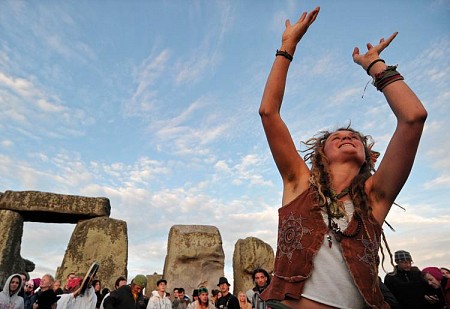
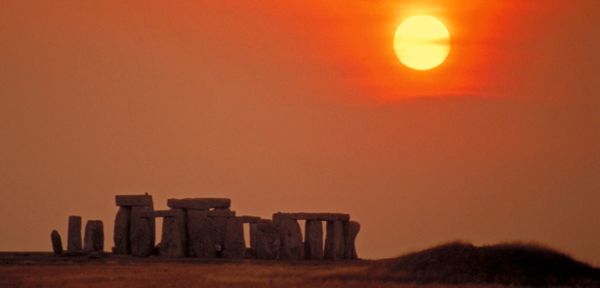
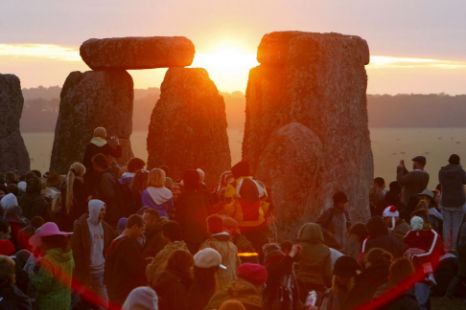
The summer solstice as celebrated at Stonehenge is a night and dawn of peace, love and quality loon-spotting opportunities.
Neo-druids, pagans and general New Age types don their glad rags (and, in some cases, fake beards) to watch the sun rise on this long day of summer. All-night celebrations help revellers stay awake until dawn.

Stonehenge Summer SolsticeWhy: An important date for pagans, the summer solstice festival dates back thousands of years. It celebrates the longest day of the year, when the sun is at its maximum elevation. About 20,000 people flock to prehistoric Stonehenge to see it in as atmospherically as possible each year.

Do it because: It’s one of the few opportunities to get close to the stones, as English Heritage provides open access especially for the occasion. Be aware that only small amounts of booze are permitted per person and that camping is not allowed.

SOURCE: TNT MAGAZINE – http://www.tntmagazine.com/travel/top-guides/peace-love-and-paganism-celebrate-the-summer-solstice-at-stonehenge

Solstice Tour: http://www.stonehengetours.com/summer-solstice-tour.htm

The Stonehenge Tour Company – www.StonehengeTours.com

Magical history tour will cater for several languages.  A history tour in several languages has been launched to encourage people to come to the city.  The Local Tour Operator launched daily audio tours of Stonehenge and ancient Wiltshire.

Join them on a journey as they travel back 5000 years in time.
Daily at 09:30 from the centre of Salisbury our “Magical History Tour” sets out to discover the mysteries of Stonehenge.  This is a an alternative to joining a coach tour from London.

in English, German, French and Italian.

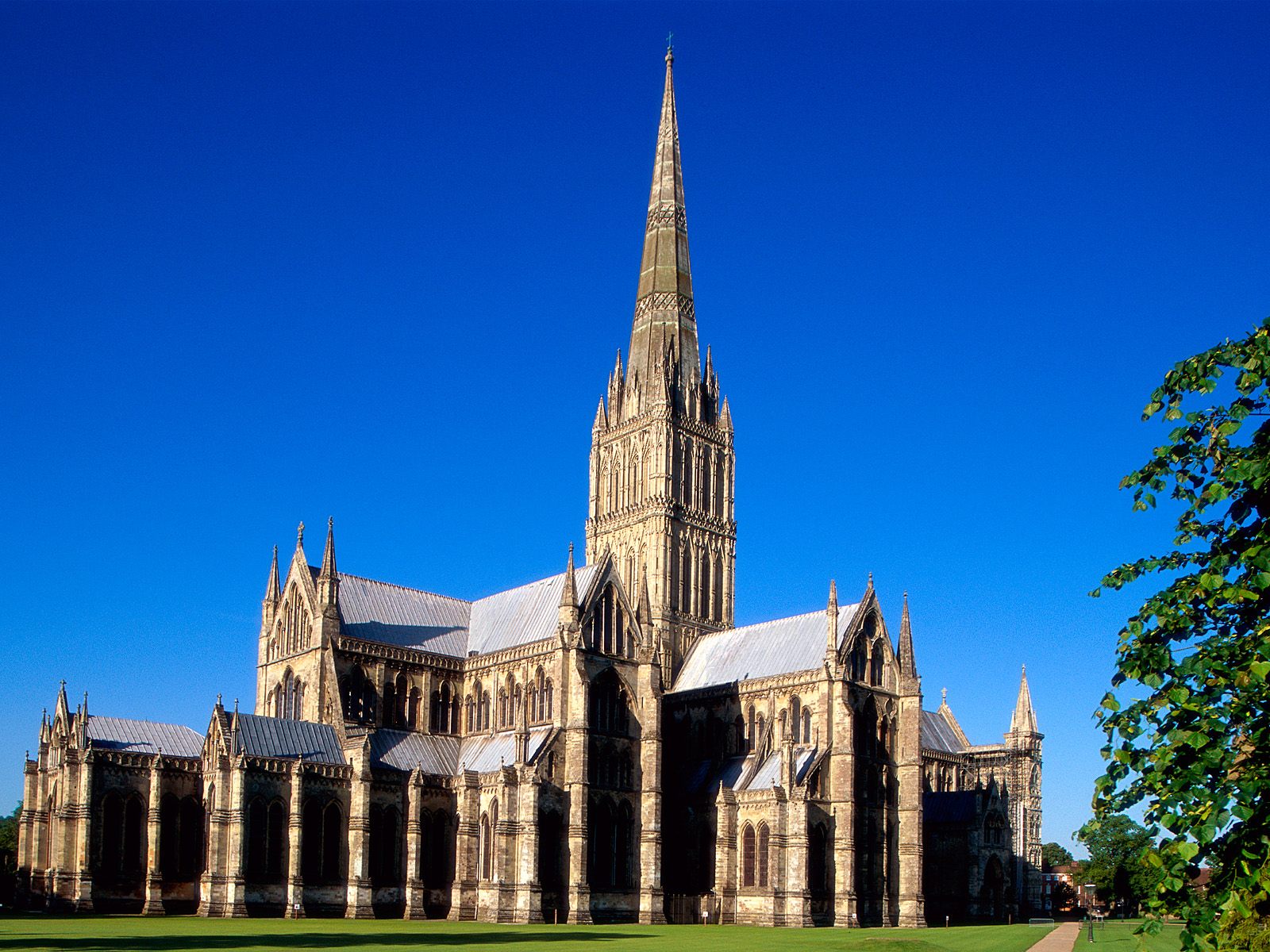
On your return you will have seen some of the most beautiful English countryside, been fascinated by Stonehenge, seen Old Sarum the iron age fort which was the earliest settlement here and finally viewed the Cathedral from a special place, missed by most tourists.

They look forward to welcoming you on board. Why not catch a train from London and join this local tour.

 Salisbury, Stonehenge and Sarum Tours
Shrouded in mystery the World Heritage site at Stonehenge attracts people
from all over the world.  Visit their website:

Our experience at Salisbury, Stonehenge & Sarum Tours ensures that you return home with lasting memories of the day when you stepped back in time. We have a selection of tours to meet all tastes from Cruise Guests with limited time to the visitor wanting to enjoy all the wonderful sites more leisurely. We also have our “Magical History Tour” to Stonehenge, which runs daily at 09:30. Commentary in English, German, French and Italian.

No tour to England would be complete without a tour of Stonehenge. Where is Stonehenge? Stonehenge is situated near Salisbury in the county of Wiltshire. Stonehenge is a Neolithic stone circle which even today is still shrouded in mystery.

Salisbury Stonehenge and Sarum Tours specialise in arranging multilingual tours of Stonehenge and surrounding places of interest including Salisbury and Old Sarum.
Salisbury, Stonehenge and Sarum Tour Guides are all local people who have been especially trained to achieve our “Yellow Badge” standard.

We meet our guests in the mediaeval city of Salisbury and you travel to Stonehenge in one of our modern vehicles.

The Stonehenge Tour from Salisbury Stonehenge and Sarum Tours will no doubt be one of your most memorable trips. So when you travel in England make sure that you take one of our tours to Stonehenge. We are also specialists catering for Southampton cruise passengers and their airport transits.

The Magical History Tour – English – German – French – Italian – simultaneously


Salisbury Stonehenge Sarum Tours
The tour lasts 3 hours during which time you will have available multi lingual commentary in English, German, French and Italian. Disposable earphones are provided but feel free to bring your own personal ones with you. You will be given a tour program with maps describing you tour.

Firstly we drive along the picturesque Woodford Valley along a route too narrow for large buses where you will pass through traditional English villages with thatched cottages. You will see the homes of some very interesting and diverse residents. We shall tell you more about this as we drive along. Before we arrive at Stonehenge the bus will make a short stop so you can see the location of the newest discovery: Blue Stonehenge. Upon arriving at Stonehenge your guide will take you to the entrance where you will receive a multi lingual audio tour. You may now spend time pondering the mysteries of this World Heritage Site, buy souvenirs and purchase refreshments. We shall stop here for 60 minutes, but if the weather is bad guests find that 45 minutes is sufficient. We now drive across “Salisbury Plain” on our way to “Old Sarum”. This area has become a “Hotspot” for “crop circles” and UFO’s”. In spring and early summer it is quite possible that you could spot a crop circle but UFO’s might be more difficult to find. At Old Sarum, the original Iron Age settlement of Salisbury you will learn how the Celts, Saxons, Danes, Vikings and Normans all lived here. Look and enjoy the magnificent 360° vista and look down on the medieval city of Salisbury. Our last stop is at the “Harnham Mill” because it offers wonderful views of the magnificent St Mary’s Cathedral. Regrettably many tourists never see the Cathedral from this aspect, often being bussed into the city from London before being “whizzed” off to their next destination. It is from here that the respected English artist John Constable chose to depict Salisbury Cathedral in his famous paintings. At this point we offer you the option of leaving the tour and walking along the town path, through the water meadows, into the City. It is a gentle and flat 1,200 metre stroll which takes no more than 15 minutes. Your Tour Program highlights the interesting wildlife, which can be seen in the water meadows, which is a  nature “Preservation Area”. For those returning to Salisbury with the bus, our drive takes 5 minutes and we shall drop you off where we started, in the Guildhall Square.

Magical History Tour Italan

The tour starts and returns from the Guildhall Square at 09:30 – see map. You will see our Guide on the steps of the Guildhall carrying a large psychedelic umbrella
Magical History Tour German

Stonehenge for 60 minutes, WC, refreshments and shop

Magical History Tour French

Old Sarum for 30 minutes WC and shop
Harnham Mill for 15 minutes
Highly recommended!
Download Brochure: http://www.salisburystonehengetours.co.uk/
Link source: www.salisburyjournal.co.uk/
The Stonehenge Tour Company –


Stonehenge inner circle tour

Stonehenge inner circle tour

Heading to London this summer?  Yeah, so is everyone else. This week, Jaunted’s London embed, Lilit Marcus, will share some definite destinations for getting out of town and out of the crowds.
If you can make it through a visit to Stonehenge without making a Spinal Tap joke, you’re a better person than I am. The stone formation, built by Druids during the Bronze Age, is still one of the world’s great wonders as well as a UNESCO World Heritage site. That said, it’s also kind of in the middle of nowhere. Though there are plans to build a more convenient rail route out to Stonehenge, currently the only way to get there is by car. There are several tour companies who will take you there and back from London and it’s also quite common to combine this with a trip to Bath, which is the route I took.

Because most of us have seen pop culture references to Stonehenge, the expectation is that the mysterious rocks are huge and majestic. It’s not huge, but it’s definitely still majestic. The series of stones was believed to be a burial ground (human bones have been found there) but there are plenty of other theories, namely that the location of the stones helped to determine the calendar because of the way the light fell during different times of the year.

You can’t get up close to the stones anymore(thanks, all those people who thought it was cool to try and carve your initials into the side), but there’s plenty of beautiful countryside around the site and plenty of opportunities for unobstructed photos. There’s a very good audio tour included with the price of admission, and history buffs will like the opportunity to listen to extra sections or get additional information on their favorite topics. (Also, literature majors will appreciate the shoutout to Tess of the D’Urbervilles, which has a scene set at Stonehenge.)

Once you’ve fully circled the formation and gotten the necessary Facebook photos in front of the Heel Stone, there’s not much else to do but check out the gift shop and cafes.The shop includes specific Stonehenge gear like books, magnets, and even lollipops (they’re blackurrant flavored), as well as Englishy treats like knit blankets and boxes of tea. Getting a history rundown and a stuffed Wilshire sheep in one quick jaunt seems like a pretty good deal, and you can be back in London before dinnertime.

Article source: http://www.jaunted.com

It is still possilbe to get inside the Stones if you book one of our exclusive Stonehenge private access tours:
http://www.StonehengeTours.com

The Stonehenge Tour Company

Fire Garden at Stonehenge 11th / 12th July 2012   
A magical, sensory experience awaits you as Stonehenge is transformed into a glowing fairytale. Fire Garden Stonehenge Tour 2012
Exclusive Guided Tour from London operated by ‘The Stonehenge Tour Company’

As the sun goes down over one of Britain’s most iconic World Heritage sites, French outdoor alchemists Compagnie Carabosse fan the flames of our imaginations with an elemental Fire Garden.

A magical, sensory experience awaits you as Stonehenge is transformed into a glowing fairytale environment where fire sculptures dance in the landscape, mysterious fiery engines illuminate the stones and flaming fire pots and cascades of candles line the pathways.

“A unique opportunity to walk amongst the Stones* at sunset and enjoy this gloriously atmospheric feast for the senses.”
“A once in a lifetime opportunity”

Maria Bota, Festival Director said:

“We aim to inspire, entertain and make moments which transform people and spaces. Our thanks to the remarkable Compagnie Carabosse for their beautiful fire garden creations, to English Heritage, with whom we have worked for many years at Stonehenge, for their continued collaboration and to London 2012 for enabling us to bring this idea to flickering life.”

Carabosse have staged their striking installations across Europe. Each event is unique to its specific location, and here they ignite their creative spark to create a remarkable moment in the historic Wiltshire landscape.

PRACTICALITIES AND TIMINGS The guided walk to Stonehenge from the Fire Garden Car Park to the Fire Garden at Stonehenge is around 1 kilometre, about a 15 minute walk, through National Trust farmland. You will have a beautiful view before you of Stonehenge and the Fire Garden in the landscape. Sensible footwear is definitely advisable as the land is agricultural and the route includes some sloping ground.

*IMPORTANT Please do not climb, stand on or lean against the stones. This is in the interest of personal safety and protection of this special site. As well as putting the stones themselves at risk, climbing on them can damage the delicate lichens. This includes the stones that are fallen.

HighlightsFire Garden at Stonehenge
Stonehenge Stone Circle close up
Includes Entrance Fee
Luxury Midi Coach Travel Minimum 2 hours at Stonehenge
Stonehenge Expert Guide Services
Fire Garden Experience

Bookings and information: http://www.stonehengetours.com/stonehenge-fire-garden-tour-july-2012.htm

The Stonehenge Tour Company – www.StonehengeTours.com

By the time you read this, the Olympic Torch Relay will be well underway on its 70-day run. Depending on when this gets posted, it may even have got as far as Weston-super-Mare, the unchallenged jewel of the north Somerset coast whose beautiful beaches, near-perfect all year round weather and magnificent pier (newly reopened just a year ago) will form the perfect backdrop for the . . .

Sorry. Eagle-eyed readers may have noticed from the blurb to the right of this piece that Weston is, in fact, the seaside resort, which I have the honour of representing as its Member of Parliament. So I may be just a touch partisan in my assessment.

For all that, though, the Torch Relay is undoubtedly a rather brilliant way of bringing the excitement of the Olympics to the widest possible UK community. Its light will – figuratively, and to an extent, literally – shine on places and people that very often get overlooked, especially in a year when – necessarily – the nation’s capital is the main focus.

Summer Solstice at Stonehenge

Summer Solstice at Stonehenge

So I’m very happy to pay tribute to all the local and national media who will magnify this light as it progresses.  Hopefully it will not just get us all in the mood for the Games themselves, but also remind us what a brilliant, diverse and beautiful country we all share.

Part of the operation behind making this all happen involves social media, of course. Pictures and stories will fan out from the torch as it snakes around the country. And one of those doing the blogging, tweeting and whatever the verb is for posting stuff on Facebook as the torch progresses, is VisitBritain.

“17 per cent of German tourists want to go to the Highland Games”

There’ll be news on Love UK, VisitBritain’s Facebook page (with around 800,000 fans) along with an app to help them pass virtual flags around the world, and live tweets from @VisitBritain, while their corporate feed, @VisitBritainBiz will unveil daily ‘killer facts’ about what foreign tourists look for in a visit to the UK.

For example, 17 per cent of German tourists want to go to the Highland Games, 41 per cent of Russians would like to see the sun rise at Stonehenge and a rather modest 19 per cent of Americans fancy going shopping at Harrods.

Each of these gems derives from up-to-date visitor surveys which will delight and inform and, if deployed with skill, create a never-ending stream of conversation openers and pub quiz fodder.  Enjoy.

  • By
  • Minister for Tourism in UK Government at The Department for Culture, Media and Sport (DCMS).

Needless the say ‘The Stonehenge Tour Company’ offer private guided tours with Russian speaking expert guides

The Stonehenge Tour Company – www.StonehengeTours.com

Short on time and want to visit Stonehenge on a budget ?

Use our Stonehenge Direct service from London. This tour departs daily every morning and every afternoon.  Board our luxury coach for a direct Express service to Stonehenge. On arrival our driver will take you onto the site, where you can enjoy the stones at your leisure with a fascinating audio-guide tour, in the language of your choice.

Languages on the Audio Guide: English, Italian, Swedish, Russian, German, Mandarin, Spanish, Japanese, French, Dutch.

Stonehenge Express Tour

Stonehenge Express Tour

Highlights:
Entrance to Stonehenge included Audio guide tour at the site
Professional driver and luxury air-conditioned coach
Scenic drive through the Salisbury plain

The most famous prehistoric monument in the world, and now a world heritage site, Stonehenge stands alone in the vast empty tract of Salisbury plain. Its origins date back nearly 5,000 years and it has been home to pagan religion and spiritual worship, not to be mention public debate ever since. What was this vast collection of stones intended for? Was it observatory of the moon, a temple to the sun, or an elaborate cemetery? Who were the people who carried and carved these 40 ton rocks? Come and unlock the secrets for yourself and marvel at this remarkable and mysterious feat of ancient engineering and design. Entrance to the site with audio guide is included.
Price: from £30

View and book the ‘Stonehenge Express’ tour here: http://www.stonehengetours.com/day-tours.html

The Stonehenge Tour Companywww.StonehengeTours.com

Olympic project was almost scuppered by discovery of similar inflatable monument created two years previously

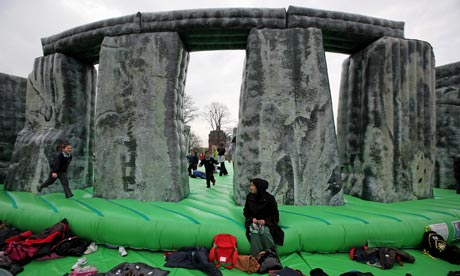
Two thousand people a day have come to frolic on Jeremy Deller’s latest artwork – a bouncy castle that is a precise replica of Stonehenge. Men, women, children: all leap, stride and somersault on Glasgow’s new favourite playground before it travels south to become one of the attractions of the London 2012 festival.
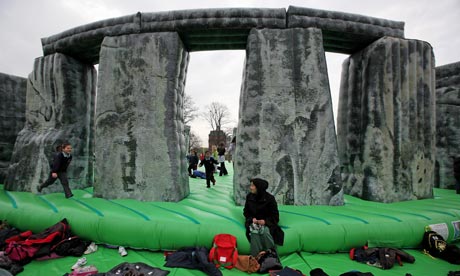
A neat idea, you might think. Sacrilege, as Deller has called his work, is not only a lot of fun (it is impossible not to smile when you shed your shoes, dignity, and understanding of gravity), but also thought-provoking.

The artist has transformed a great symbol of British history into a party. In real life, you cannot get near Stonehenge. Open to myriad interpretations and fantasies over its long history, it has now been given yet another existence through Deller’s impish version of a grand public sculpture

It turns out that Deller is not the first artist to have made an inflatable megalithic monument. In 2010, two years before Deller’s work was launched at the Glasgow International art festival, Jim Ricks, a California-born artist, Galway-based, unveiled his Poulnabrone Bouncy Dolmen – a precise, double-size replica of a megalithic table tomb built around 6,000 years ago in the Burren, Co Clare. The work toured various locations in Ireland last summer.

So is this a case of plagiarism? Or sheer coincidence? Are bouncy castles having what in fashion is known as a “moment”? Why, after several millennia of human creativity, have two inflatable megalithic monuments come along at once?

Deller became aware of Ricks’ sculpture, he said, while researching a manufacturer for Sacrilege. According to Ricks: “Jeremy contacted me in October and I didn’t think much of it … I didn’t register who it was.”

“I consider it an identical concept,” Ricks told the Guardian. “In terms of the description of the work, they are incredibly similar,” admitted Deller.

But Deller said that the idea for a bouncy Stonehenge had long pre-dated Ricks’s Dolmen. He had originally thought of submitting an idea for bouncy-castle versions of historic sites to an Arts Council England-run public-art competition in 2009, but was too busy at the time. Finally, he decided to realise the idea for Glasgow International, with the London mayor’s office as co-funders.

“The Olympics people got really nervous in case Jim decided to sue us,” said Deller.

Happily for them, he was not minded to. In fact Ricks forgot all about it, until: “I spoke to the manufacturer by chance about six weeks ago and it dawned on me, so I decided to go over to Glasgow. Part of me was like, ‘I’m ruined!’ It was the same idea done bigger and more visibly. But another part of me is delighted because Sacrilege is awesome, Jeremy was a cool down-to-earth guy, and it’s nice to know we’re on the same wavelength … in a ‘great minds think alike, fools seldom differ’ way.”

“You can be generous about it,” said Deller, “and realise that two people can have a very similar idea. It is, after all, a very simple idea.”

According to Ricks: “Jeremy is a lovely man, and I have no reason to doubt his story.”

Where the works differ, perhaps, is in the nuance. “Sacrilege is a way for people – not just kids – to enjoy a historical monument that is supposed to be revered,” said Deller. “It’s comedic, it’s absurd. It could be something you’d see in a satire on the Olympics or on art. I like to think of it as beyond parody.”

Ricks said that his sculpture had come out of observing the power of the Poulnabrone Dolmen as a regional and national symbol. He added: “At the height of the Celtic Tiger period, on every special occasion there seemed to be a bouncy castle around. Bouncy castles became a sort of vernacular monumental sculpture. So I decided to bring those two things together, and create a sort of hybrid version of Irish identity.”

The story of the megalithic bouncy castles is not yet at an end. Deller hopes that Sacrilege will travel to Northern Ireland as part of its Cultural Olympiad tour. If it does, he will invite Jim Ricks to bring his Poulnabrone Bouncy Dolmen over the border to visit. Let the bounce-off commence.

Full article in the Guardian: http://www.guardian.co.uk/culture/charlottehigginsblog/2012/may/02/bouncy-stonehenge-glasgow?newsfeed=true

The Stonehenge Tour Companywww.StonehengeTours.com

Take our Stonehenge, Glastonbury & Avebury tour and experience the history and mystery of some of the most famous pilgrimage sites in the South of England.

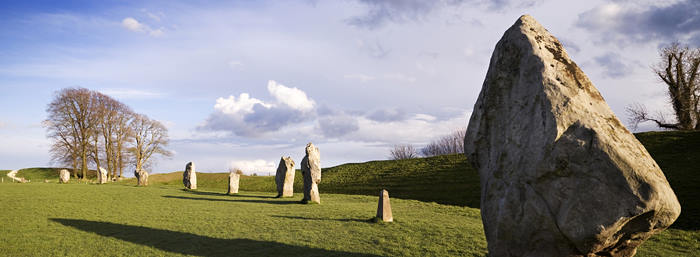
Avebury Stone Circle

Avebury Stone Circle


 From Neolithic Stone Circles to the ancient Glastonbury Abbey (King Arthur and Queen Guinevere’s supposed final resting place).
You will visit the ancient Stone Circles of Stonehenge & Avebury which have both been drawing visitors for over 5000 years! We also take you through the history of King Arthur and visit famous ruins of Glastonbury Abbey, with time to explore the nearby village.
Our stop in Avebury gives you plenty of time to enjoy this ancient site’s atmosphere & perhaps have a pint at the famous Red Lion Pub located in the centre of Avebury Stone Circle. The Red Lion is on the Top Ten list of the most haunted pubs in England!
Read more about this tour and the sites visited below:
Includes:

  • · No More than 15 passengers,
  • · Return luxury mini coach travel
  • · Visit & entrance to Stonehenge
  • · Visit to Avebury Stone Circle
  • · Explore King Arthur’s Avalon & visit the ancient ruins of Glastonbury Abbey
  • · Free time in Glastonbury Village
  • · Plus Tour Manager

7.25am-7.45am Pick ups London Zone 1 – at time of booking please specify your requested pick up location.

(We will contact you the day prior to your tour to confirm your pick up time and location – please ensure we have a valid contact phone number/email address that you will have access to in London the day before)
6.30pm – Approximate arrival back in Central London.
**Please note details are subject to changes**

On our Stonehenge, Glastonbury & Avebury tour we visit some very historic and magical sights including:
· Stonehenge, a World Heritage Site and one of the most famous historic & tourist attractions in the UK.
· Avebury stone circle-one of the world’s largest & most mysterious

Glastonbury Tor

Glastonbury Tor - Isle of Avalon

pre-historic stone circles
· Glastonbury & the mythical ‘Avalon’ to discover the mystery, chivalry and romance of King Arthur where you have a chance to explore the ruins of Glastonbury Abbey & Glastonbury village with its medieval buildings and unusual shops catering to wiccans, pagans, witches & hippies!

About Stonehenge
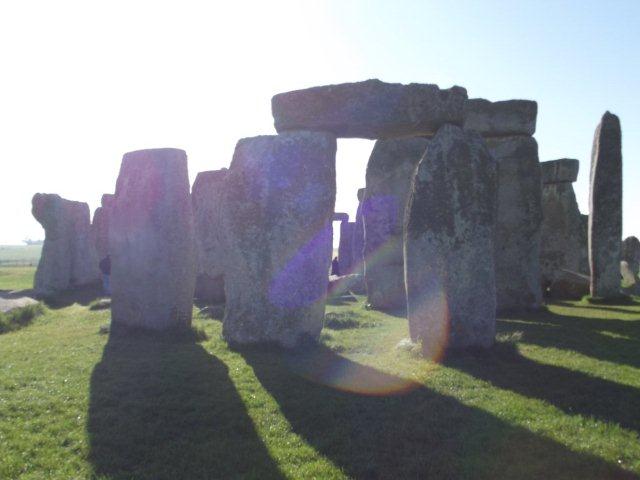
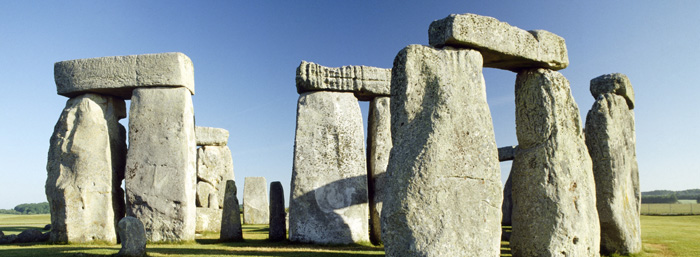
Stonehenge, one of the wonders of the world is an ancient stone circle that has drawn visitors from all over the world for over 5000 years! What’s left to see today are the substantial remnants of the last in a sequence of such monuments erected between circa 3000BC and 1600BC.
There has always been an intense debate over what purposeStonehenge once served, it is certainly a focal point in a landscape filled with prehistoric ceremonial structures. The site is now an official World Heritage Site.
About Avalon, Glastonbury, the Abbey & King Arthur
A legend tells of how Joseph of Arimathea brought the Holy Grail toGlastonbury and built a simple church on the site of this great abbey, possibly the first Christian church in England”.
Glastonbury, in addition to many other places, has been linked to King Arthur. This link at Glastonbury though, is in death rather than life. Arthur was the legendary English King ‘Arthur of the Britons’. He was raised by the wizard Merlin and when only a boy (after many men had tried and failed) Arthur gained the throne by withdrawing a magic sword Excalibur from stone. The nearby CadburyCastle supposedly became his ‘Camelot’.
After his many exploits and stories concerning his Knights, the Round Table and the Holy Grail, he was wounded at the battle of Camlan. This was around the year 542 and he was then taken across the water to the Isle of Avalon for his wounds to be healed.
Legend proclaims that after Arthur’s death a strong spirit haunted the ruins of the Abbey. Appearing as a black armoured knight with red glowing eyes and a desire to eradicate all records of the ancient Arthurian legends, which is why (it is said) that those seeking to discover the truth find so few facts.
Glastonbury is also home to one of the worlds largest performing arts festivals & is famous as a ‘mecca’ for modern day hippies, pagans & witches!

About Avebury
Avebury is the site of a huge henge and several stone circles in the English county of Wiltshire which surround the village of Avebury. It is one of the finest and largest Neolithic monuments in Europe dating to around 5,000 years ago.
It is older than the megalithic stages of Stonehenge, which is located about 20 miles to the south. The henge is aScheduledAncientMonument and a World Heritage Site.
About The Red Lion Pub
The pub is 400 years old and located at the centre of the Avebury stone circle where every six weeks a pagan festival is held. It is in the Top Ten list of most haunted pubs in the country and has been seen on TV as such. The main ghost is that of an old landlady “Florrie” who was supposedly killed here by her husband.
– please ensure we have a valid contact phone number/email address that you will have access to in London the day before.

Visit our website to view this and many more Exclusive Stonehenge Tours
The Stonehenge Tour Companywww.StonehengeTours.com 

Children were walking on air today after Turner Prize-winning artist Jeremy Deller unveiled his life-size bouncy castle… of Stonehenge.

The 20ft-high inflatable, called Sacrilege, is modelled on the prehistoric monoliths and was opened to the public on Glasgow Green as part of the 18-day Glasgow International Festival of Visual Arts Festival.

It was designed using detailed plans of the Salisbury monument and took two months to make thanks to the efforts of workers at Inflatable World Leisure, who Mr Deller said built the first ever bouncy castles in the UK.

King of the bouncy castle ... Jeremy Deller's Sacrilege at Glasgow Green is part of the Glasgow international festival of visual arts. Photograph: Jeff J Mitchell/Getty Images

King of the bouncy castle ... Jeremy Deller's Sacrilege at Glasgow Green is part of the Glasgow international festival of visual arts. Photograph: Jeff J Mitchell/Getty Images


Scroll down for video

The 20ft-high inflatable, called Sacrilege, is modelled on the prehistoric monoliths and was opened to the public on Glasgow GreenThe 20ft-high inflatable, called Sacrilege, is modelled on the prehistoric monoliths and was opened to the public on Glasgow Green

Children were walking on air today after Turner Prize-winning artist Jeremy Deller unveiled his life-size bouncy castleChildren were walking on air today after Turner Prize-winning artist Jeremy Deller unveiled his life-size bouncy castle

His giant inflatable is one of the highlights of a festival programme featuring more than 130 artists at almost 50 venues across the city.

Mr Deller, who won the Turner Prize in 2004, said: ‘It has taken two months to put together so it is wonderful to finally see it up and being used by the public.

‘Stonehenge is a part of our history and it is such an iconic structure that I wanted to recreate it as accurately as I could.

‘We haven’t done it exactly but it is as close as we could get it. People should come down – it’s here for two weeks and it’s free.’

After appearing in Glasgow, the castle – the artist’s first major work in Scotland – will be taken on a tour of the UK.

Artist Jeremy Deller has a go on his installation in ScotlandArtist Jeremy Deller has a go on his installation in Scotland

The giant inflatable took two months to build and is one of the highlights of a festival programme featuring more than 130 artists at almost 50 venues across the cityThe giant inflatable took two months to build and is one of the highlights of a festival programme featuring more than 130 artists at almost 50 venues across the city


After appearing in Glasgow, the castle - the artist's first major work in Scotland - will be taken on a tour of the UKAfter appearing in Glasgow, the castle – the artist’s first major work in Scotland – will be taken on a tour of the UK

Other highlights at the Glasgow festival include solo shows by Glasgow-based 2009 Turner Prize winner Richard Wright, Adrian Wiszniewski and Karla Black.

Mr Deller added: ‘I couldn’t have done it without the help of Inflatable World Leisure who built the first bouncy castle in the UK, so they are good company to be in.’

The festival also includes the first UK show called Triumph, an installation of more than 2,500 discarded sporting trophies collected by Polish-born Aleksandra Mir, and an exhibition focused on Glasgow’s Socialist Sunday School movement that flourished in the early 20th century.

More than 90 per cent of the work on show during the 18-day festival is either new or previously unseen in the UK.

'Stonehenge is a part of our history and it is such an iconic structure that I wanted to recreate it as accurately as I could,' Mr Deller said‘Stonehenge is a part of our history and it is such an iconic structure that I wanted to recreate it as accurately as I could,’ Mr Deller said

There will also be a range of newly commissioned works drawing on other artistic disciplines such as dance, film and music.

Teacher Lynda Darrock, 31, visited the bouncy castle with children from Annette Street Primary School in Govan, Glasgow.

She said: ‘The children thought it was absolutely amazing. They were talking about it all day, I even had a go myself.

‘They keep asking if we are going back.

‘Jeremy spent lots of time talking to the children beforehand and afterwards asking if they enjoyed it. He was brilliant.

‘Some of the children have been to Stonhenge and they were blow away with how similar it is to the real thing. They had a great day.’

AND HERE’S THE REAL THING… THE MAGIC AND MYSTERY OF STONEHENGE

The Wiltshire monument was completed around 4,500 years ago and is believed to have taken around 35 years to complete.

The largest of the gigantic upright stones weighs about 40 tons – the equivalent of an articulated lorry.

A Time Team dig (for the Channel 4 show) in 2009 established that Stonehenge was built around the same time as Durrington Walls, another henge, or circular earthwork, two miles away.

The two adjacent henges were part of the same complex, with Durrington Walls the location for a massive Neolithic village that housed the workers who built Stonehenge.

The Time Team suggested that this site housed up to 4,000 people, which would have made it the largest Neolithic settlement in north-west Europe.

The Wiltshire monument was completed around 4,500 years ago and is believed to have taken around 35 years to completeThe Wiltshire monument was completed around 4,500 years ago and is believed to have taken around 35 years to complete

While the circle at Durrington Walls represented life and the land of the living, Stonehenge, encircled by burial mounds, represented the land of the dead, the team claimed.

The two were connected by the River Avon and the procession route from one to the other represented the transition from life to death.

It is thought that the stones used at Stonehenge were moved from Marlborough Downs, about 20 miles to the north.

Digs suggest that the area around the stone circle was used to bury the cremated remains of hundreds of people.

Other experts believe that it was a place for healing.

Meanwhile, a study earlier this week suggested Stonehenge could have been designed with acoustics in mind like a Greek or Roman theatre.

A team of researchers from the University of Salford spent four years studying the historic site’s acoustic properties in a bid to crack the mystery of why it was built.

While they could not confirm the exact purpose of the stones, the researchers did find the space reacted to acoustic activity in a way that would have been noticeable to the Neolithic man.

‘Stonehenge is very well known, but people are still trying to find out what it was built for and we thought that doing this research would bring an element of archaeology that so far hasn’t been looked at,’ lead researcher, Bruno Fazenda said.

He added the new area of acoustic science, named archaeoacoustics, could be helpful in the archaeological interpretation of important buildings and heritage sites, some of which may not exist in their original form, such as in the case of Stonehenge.

Because the site in Wiltshire is in a derelict state, researchers travelled to Maryhill in the U.S. where a full-sized concrete reconstruction of Stonehenge was built in 1929 as a memorial to the soldiers of WWI.

They were able to make proper acoustic measurements that allowed an investigation into striking acoustic effects such as echoes, resonances and whispering gallery effects.

The second phase consisted in the creation of a full 3D audio-rendition of the space using a system comprised of 64 audio channels and loudspeakers especially developed at the University of Salford based on Wave Field Synthesis.

This system enables an accurate and immersive recreation of what Stonehenge would have sounded like.

SOURCE – Read more: http://www.dailymail.co.uk/news/article-2132789/Stonehenge-bouncy-castle-comes-Glasgow.html#ixzz1sgMI1wJF

The Stonhenge Tour Company
www.StonehengeTours.com

Whatever went on there, it would have impressed the ancient Britons. Even if it was only whispering

Stonehenge

Bits missing. But when it was all in place, there’d have been booms, rumbles, echoes and reverberations. Photograph: Jason Hawkes/Getty

Salford‘s clever academics, who once took me shopping in a virtual supermarket – you sat in an armchair wearing a helmet and a glove – have now recreated the sound of Stonehenge.

We are nowhere nearer cracking the mystery of the monument as a result; but who would want to be? Apart from all the mountains of remaindered books of theories, a puzzle solved is never as gripping as a conundrum still under way.

But the four-year project by Dr Bruno Fazenda and colleagues atHuddersfield and Bristol universities, has established how the shouts, speeches, songs or sacrificial screams would have sounded, whatever material they may have contained. The method has been a painstaking piece of ‘archaeoacoustics’, a relatively new discipline which reveals the sound quality of buildings from the past.

Fazenda says:

Stonehenge MemorialStonehenge is very well known, but people are still trying to find out what it was built for and we thought that doing this research would add an element of archaeology that so far hasn’t been looked at. It’s a new area of acoustic science and it could be very helpful in the archaeological interpretation of important buildings and heritage sites, some of which may not exist in their original form, such as in the case of Stonehenge.

The number of missing bits at the famous stone circle by the A303 in Wiltshire was an obvious problem, and tests there by the team produced only a limited number of weak echoes and no noticeable reverberation. Ancient Britons would not have been terribly overawed by this, if the monument was built to impress. But luckily there is a full-sized replica in the United States.

Built out of concrete and erected at Maryhill, Washington state, as a memorial to US soldiers killed in the First World War, this revealed a wealth of special effects. Fazenda found:

It was possible to make proper acoustic measurements that allow an investigation into striking effects such as echoes, resonances and whispering gallery effects. The data gathered does not unequivocally reveal whether the site was designed with acoustics in mind, like Greek or Roman theatres. It nevertheless shows that the space reacted to acoustic activity in a way that would have been noticeable to the Neolithic man.

The next stage, in the tradition of my virtual supermarket foray, was to create an ‘audio 3D rendition’ of the recorded sounds, using 64 audio channels and bespoke loudspeakers from Salford university based on wave field synthesis. Fazenda says:

This system give us an accurate and immersive recreation of what Stonehenge would have sounded like. We can not only see ourselves surrounded by the stones using virtual reality, but we can also listen how the stone structure would have enveloped people in a sonic experience. It is as if we can travel back in time and experience the space in a more holistic way.

There’s more on the subject on a separate and excellent website called Sonic Wonders which has all manner of acoustic revelations. Here’s a clapping experiment on YouTube courtesy of them – background details are here.

Source: http://www.guardian.co.uk/uk/the-northerner/2012/apr/19/stonehenge-acoustics-archaeology-salford-university-bruno-fazenda

Join a guided tour of Stonehenge and hear about the many new theories
The Stonehenge Tour Companywww.StonehenegTours.com