Stonehenge visitors will soon be able to trace the route along which people in prehistoric Britain made their way to the monument, when new visitor facilities open to the public.

From 18 December visitors will be able to walk along the newly completed Stonehenge Avenue, which will have been reconnected to the stone circle after being severed by the A344 road for centuries.

They will also be able to explore an exhibition of almost 300 prehistoric artefacts such as tools, jewellery and pottery.

Visitors will enjoy a 360-degree virtual, immersive experience, allowing them to ‘stand in the stones’, before they enter a gallery presenting the facts and theories surrounding Stonehenge through artefacts.

Many of the artefacts will be on show for the first time.

The permanent exhibition, curated by English Heritage experts, will be housed in a new visitor building located 1.5 miles to the west of Stonehenge.

The centre boasts indoor and outdoor seating for up to 260 people, a dedicated education space, and new, downloadable and hand-held free audio guides in 10 languages.

The £27m project also includes grassing over a section of the A344, which was closed permanently in June.

Simon Thurley, chief executive of English Heritage, said: “This world famous monument, perpetually described as a mystery, finally has a place in which to tell its story.

“The exhibition, created with imagination and rigour, will change the way people experience and think about Stonehenge forever – beyond the clichés and towards a meaningful inquiry into an extraordinary human achievement in the distant past.

“The exhibition will put at its centre the individuals associated with its creation and use, and I am very proud with what we have to unveil to the world in December.”

Stonehenge started as an early form of henge monument, built around 5,000 years ago, where prehistoric people buried their cremated dead.

It was built in several stages, with the lintelled stone circle being erected in the Neolithic period in around 2,500 BC.

Stonehenge remained important into the early Bronze Age (2,200–1,500 BC), when many burial mounds were built nearby.

Submitted by Emma McFarnon (http://www.historyextra.com/news/%E2%80%98missing-piece%E2%80%99-stonehenge-avenue-open-visitors-december)

Stonehenge Tours Guide

The new Stonehenge visitor centre is due to open on Wednesday December 18th 2013.

English Heritage have been unveiling details of the first exhibitions at the site of the Stone Circle.221699-320x240_credit-show
It’s taken a number of years to get to this stage – and at a cost of £27 million, it’s the biggest capital project English Heritage have ever done.

300 prehistoric artefacts will be displayed in the exhibitions, and there’ll be a virtual experience where we can take a look at the stones from within the circle.
Today will also be the first time the visitor centre building itself, which is almost complete 1.5 kilometres away at Airman’s Cross, will be seen without its scaffolding.

Lorraine Knowles is from English Heritage – click play to hear her interview with Spire FM’s Faye Marsh:
http://www.spirefm.co.uk/news/local-news/1086351/opening-date-of-stonehenge-visitor-centre-revealed/

Article with thanks tp Spire FM, Salisbury

Stonehenge Tour Guide

Modern researchers have puzzled for centuries over the striking stone construction known as Stonehenge. But now researchers have discovered new aspects of the site, including a processional road, that may eventually help unravel some of its mysteries.

Researchers believe they have found an ancient path that once connected Stonehenge with a river and possible village nearby.

Researchers believe they have found an ancient path that once connected Stonehenge with a river and possible village nearby.

There are many theories about why ancient peoples constructed the prehistoric megalithic monument, which is estimated to have been built between 3000 and 1520 B.C. Located outside Salisbury, England, Stonehenge is the focus of ongoing research projects coordinated by English Heritage, a cultural preservation agency.

One of those projects recently uncovered previously hidden sections of an ancient pathway that researchers believe led directly to the site from the Avon River in the nearby town of Amesbury.

Known as the Avenue, the pathway is believed to have been built sometime between 2600 and 2200 B.C., according to English Heritage. Over time, parts of the road were obscured, and a modern road called A344 was built across it, reports LiveScience. The new road has made it almost impossible for researchers to confirm the purpose of the Avenue, according to LiveScience.

In an effort to answer some of these questions, researchers carefully began removing the paved A344. While the banks of the original path had long since eroded away, archaeologists were excited to find traces of two parallel ditches that once ran on either side of the path. These ditches connected segments of the Avenue bisected by A344.

“And here we have it –- the missing piece in the jigsaw,” Heather Sebire, properties curator and archaeologist at English Heritage, said in an interview with BBC History Magazine. “It is very exciting to find a piece of physical evidence that officially makes the connection which we were hoping for.”

While the purpose of the Avenue is not exactly clear, Sebire told LiveScience she believes it was involved in ancient processions to and from the site.

“It was constructed in 2300 BC so is a later addition to the stone circle, but people would have processed along it to the monument,” Sebire told BBC Magazine. “It’s quite a dramatic finding.”

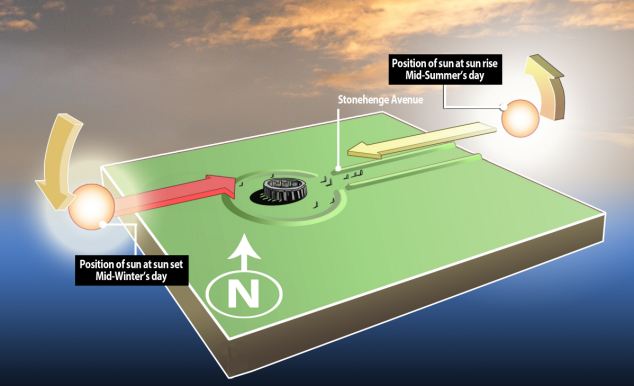
At least one researcher unaffiliated with English Heritage believes the excavation could help confirm a theory that the Avenue leading to Stonehenge was built along the solstice axis. As archaeologist Mike Parker Pearson told National Geographic, this means that the direction of the Avenue moving away from the monument points toward where the sun rises on the midsummer solstice, the longest day of the year. But if you turn, the path leading back toward Stonehenge points toward where the sun sets on the midwinter solstice, the shortest day of the year.

Article source: The Huffington Post  By : http://www.huffingtonpost.com/

Stonehenge Tour Guide

StonehengeNews's avatarStonehenge Stone Circle News and Information

Two ditches belonging to the Stonehenge Avenue buried beneath the modern roadbed of the A344 have been uncovered during works to decommission the road as part of English Heritage’s project to transform the setting and visitor experience of Stonehenge.

The two ditches represent either side of The Avenue, a long linear feature to the north-east of Stonehenge

linking it with the River Avon. It has long been considered as the formal processional approach to the monument and is aligned with the solstice axis of Stonehenge. But its connection with Stonehenge had been severed by the A344 for centuries as the road cut through the delicate earthwork at an almost perpendicular angle.

The two ditches were found in excavations undertaken by Wessex Archaeology in their expected positions near to the Heel Stone, about 24 metres from the entrance to monument.


Missing Piece in the Jigsaw

Heather Sebire…

View original post 478 more words

  • Excavations confirm that Stonehenge was  built on an Ice Age landform
  • Ridges found to point at the mid-winter  sunset and mid-summer sunrise
  • Experts claim that ancient people  believed the geological scars signified the ‘union of heaven and earth’ at the  longest and shortest day of the year
  • Evidence has also been found that the now  broken circle was once complete

The ancient people who built Stonehenge chose  the site in modern-day Wiltshire because of its solar significance,  archaeologists claim.

The ridges were created by Ice Age meltwater and naturally point directly at the mid-winter sunset in one direction and the mid-summer sunrise in the other

The ridges were created by Ice Age meltwater and naturally point directly at the mid-winter sunset in one direction and the mid-summer sunrise in the other

In what is described as a ‘missing piece in  the jigsaw’ in our understanding of England’s greatest prehistoric site,  excavations confirm the theory that its ancient processional route was built  along an ice-age landform which was naturally on the solstice axis, according to  Professor Mike Parker Pearson, a leading expert on Stonehenge.

The monument’s original purpose still remains  shrouded in mystery, but this is a dramatic clue, he said.

The route, known as the Avenue, extended 1.5  miles from the standing stones’ north-eastern entrance to West Amesbury. It has  been likened to The Mall leading to Buckingham Palace.

After the closure of the A344 road, which  bisected the route, archaeologists have been able to excavate there for the  first time.

The excavations were conducted by Wessex  Archaeology for English Heritage.

Just below the modern road’s surface, they  unearthed ditches dug by prehistoric builders.

Professor Parker Pearson identified  naturally-occurring fissures that once lay between ridges which follow the route  of the Avenue.

The ridges were created by Ice Age meltwater  and naturally point directly at the mid-winter sunset in one direction and the  mid-summer sunrise in the other.

Professer Parker Pearson is excited by the  evidence, which he describes as ‘hugely significant’.

‘It tells us a lot about why Stonehenge was  located where it is and why they were so interested in the solstices,’ he  said.

‘It’s not to do with worshipping the sun,  some kind of calendar or astronomical observatory.

‘It’s about how this place was special to  prehistoric people. This natural landform happens to be on the solstice axis,  which brings heaven and earth into one.’

He explained that Stonehenge is ‘all about  the solstices’ and our ancestors could see this in the land.

The excavations support theories that first  emerged in 2008 with an exploration of a narrow trench across the Avenue.

Professor Parker Pearson said: ‘It’s being  able to see the big picture.’

Dr Heather Sebire, English Heritage’s  Stonehenge curator, said: ‘The part of the Avenue that was cut through by the  road has obviously been destroyed forever, but we were hopeful that archaeology  below the road would survive.

‘And here we have it – the missing piece in  the jigsaw. It is very exciting to find a piece of physical evidence that  officially makes the connection which we were hoping for.’

She expects the latest findings to spark  vigorous academic debate, and English Heritage has not expressed an opinion on  the naturally-formed ridges, their interpretation being confined to the ditches.

The original A344 road is to be grassed over  next year as part of English Heritage’s £27m transformation of the World  Heritage Site, which draws more than one million annual visitors.

A new visitor centre will be opened, 1.5  miles away out of sight, to allow Stonehenge to reconnect with the surrounding  landscape.

The latest study has also identified three  holes where missing stones would have stood on the outer sarsen circle –  evidence, it is believed, that the circle was indeed once complete.

Astonishingly, at least to the layman, even  the most sophisticated surveys failed to spot them.

Two eagle-eyed members of staff happened to  notice dry surface areas of grass, or parchmarks.

Professor Parker Pearson said: ‘The problem  is we’ve not had a decent dry summer in many years.

‘Stonehenge is always regularly watered – and  the only reason these have shown up is because – for some reason this year –  their hose was too short… So we’re very lucky.’

Susan Greaney, an English Heritage historian,  added: ‘The discovery… has certainly strengthened the case for [the monument]  being a full circle.’

Full article: By Dalya Alberge: http://www.dailymail.co.uk/sciencetech/article-2415888/Stonehenge-WAS-built-solstice-axis-Ice-Age-meltwater-carved-sun-facing-ridges-landscape-later-inspired-4-500-year-old-rock-circle.html

Stonehenge Tour Guide


The Heritage Trust's avatarThe Heritage Trust

A French postcard (circa 1916) depicting a Bristol Monoplane flying over Stonehenge
Private collection Great Britain


View original post

A 360 degree cinema is being developed so visitors to Stonehenge can experience standing inside the ancient circle.

Access to Stonehenge has been fiercely contested for decades, with campaigners arguing that they should be allowed into the stone circle.

A 360 degree cinema is being developed so visitors to Stonehenge can experience standing inside the ancient circle.

Stonehenge receives one million visitors a year and is a World Heritage Site. Photo: Christopher Jones for the Telegraph

Now, English Heritage has developed a possible solution, a virtual visit in a 360 degree cinema where visitors can “experience” standing in the ancient circle.

It will be the centrepiece of a new £27 million centre at the site and is one of a number of audio visual attractions being built to bring the prehistoric monument to life.

These will include a 32ft “landscape wall”, on to which computer generated images of the countryside around the circle and other ancient earthworks will be projected.

In addition, there will be five “people films”, shown on screens in one of the two vast pods being built to house the visitor centre. These will provide information about the monument and prehistoric items on display.

There will also be films exploring the conflicting theories over the establishment and use of the circle.

Outside the centre, replica Neolithic dwellings are being built, where visitors will be able to see how early inhabitants of the sites lived.

The plans for the centre are revealed in a series of tender documents from English Heritage, seeking firms to provide the technological content for the audio visual displays. The documents describe the “immersive 360 degree projected film” as the “most important and high profile piece of audio visual ever undertaken by EH”.

The new auditorium’s 100ft circumference will compare with about 300ft in the actual stone circle.

Robert Campbell, the head of interpretation at the centre, said: “It’s meant to give people a sense of what it is like to stand in the middle of Stonehenge because most people just won’t be able to do that. It won’t feel like you are standing in a computer programme. The idea is to take our visitors back in time.”

The virtual visits may not win over all campaigners including Pagans and Druids who want open access to Stonehenge, which was created about 5,000 years ago.

When it was first opened to the public, it was possible to walk among and even climb on the stones. However, they were roped off in 1977 due to problems with erosion.

Visitors are now kept a short distance away, although English Heritage does permit access during the summer and winter solstice, and the spring and autumn equinox. Some access visits early in the morning or late in the evening can also be booked.

Stonehenge receives one million visitors a year and is a World Heritage Site. The multi-million project is being built 1.5 miles from the stones.

Article source: By , and David Barrett (http://www.telegraph.co.uk/earth/environment/archaeology/9950377/Stonehenge-visitors-to-experience-standing-in-the-ancient-circle.html)

Stonehenge Tour Guide

Stonehenge Guided Trips are offering their usual transport option from London for this event:

http://www.stonehengetours.com/html/stonehenge-autumn-equinox-tour-2011.htm

StonehengeNews's avatarStonehenge Stone Circle News and Information

The Autumn Equinox occurs at 8.44pm on Sunday 22 September 2013. 

Celebration of the Autumn Equinox will take place at Stonehenge at sunrise on Monday 23rd September 2013.

Stonehenge Autumn Equinox Visitors wishing to celebrate the Autumn Equinox at Stonehenge will be given access into the monument when it is considered sufficiently light and therefore safe to do so. This is likely to be from approximately 6.15am.

Sunrise that morning will be at approximately 6.56am. Visitors will be asked to vacate the site by 8am.

Please note that access to Stonehenge might not be possible if the ground conditions are poor or if it is considered that access might result in severe damage to the monument.   Limited facilities are available at Stonehenge for the duration of the access although these facilities will not be open prior to the access commencing.

If you require disabled parking, please email Sally Gardner at sally.gardner@english-heritage.org.uk.

View original post 148 more words

Stonehenge Landscape ToursStonehenge is the best known of all the prehistoric monuments in the British Isles and probably also in Europe. Along with the Neolithic monuments around Avebury situated 28km to the north, it forms a UNESCO recognised World Heritage Site (WHS), the parts of which are separated by the southern edge of the Marlborough Downs, Pewsey Vale and the Salisbury Plain military training area.

The Stonehenge Landscape takes in much of the World Heritage Site around the famous stone circle. The National Trust owns 830ha of land surrounding Stonehenge, and within the extended landscape around the stone circle are burial mounds and a huge ‘cursus’ enclosure.

The Stonehenge Landscape takes in the henge monument at Durrington Walls – the largest henge in Britain. Walk the ceremonial routes travelled about this extraordinary landscape in the footsteps of the builders of Stonehenge.

There are terrific views of Stonehenge from paths through the Landscape. During June and July the fields are covered with a profusion of wildflowers.

Among the area included in Stonehenge Landscape are Stonehenge Down, which features ceremonial walkway, a Bronze Age barrow cemetery, and the cursus enclosure. At King Barrow Ridge are further Bronze Age mounds, and at Normanton Down is a round barrow cemetery. Entry to Stonehenge Landscape is free, although at peak times there may be a charge at the Stonehenge car park for visitors who are not members of the National Trust or English Heritage.

Link: http://www.english-heritage.org.uk/professional/research/landscapes-and-areas/archaeological-field-survey-and-investigation/stonehenge-landscape/

Link: http://www.nationaltrust.org.uk/stonehenge-landscape/

Stonehenge and Avebury Stone Circle Landscape Tours: http://www.stonehengetours.com/

Stonehenge Tour Guide


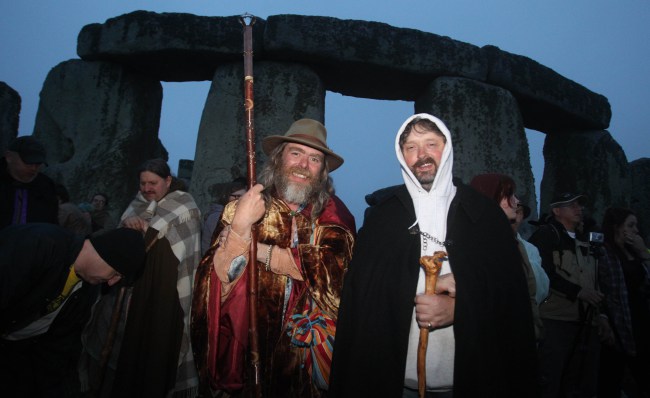
More than 20,000 revellers gathered at the famed monument for sunrise on the longest day of the year.

Stonehenge By Pejman Faratin

Stonehenge
By Pejman Faratin

The sun rose at 4:52am this morning; however cloud cover meant it remained hidden at the World Heritage Site.

It was the last summer solstice ahead of a ‘historic’ transformation of the site, including the creation of a new visitor centre around 1.5 miles away.

Loraine Knowles, Stonehenge director at English Heritage, said the closure and grassing over of the A344 was ‘a real milestone in terms of the history of the site’.

‘When you are in Stonehenge in the future, when grass is established, you will be able to make the link between the monument and the rest of the heritage landscape to the north,’ she added.

Visitors will also be able to access the avenue, the route by which the monument was approached when it was used as a place of great ceremony.

Police say there were fewer arrests than usual this year, with 22 people taken into custody, most for drug-related offenses.

The solstice has typically drawn a wide and varied crowd to the mysterious set of standing stones whose purpose remains unclear.

The ancient stone circle on the Salisbury Plain about 80 miles (130 kilometers) south-west of London, was built in three phases between 3000 B.C. and 1600 B.C

Article Source: http://metro.co.uk/2013/06/21/gallery-summer-solstice-2013-at-stonehenge-3850650/summer-solstice-at-stonehenge-8/

Stonehenge Tour Guide