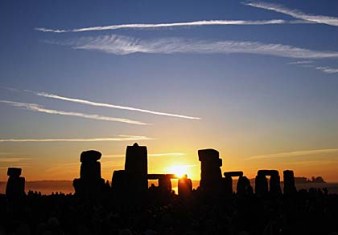
We know that man’s best friend is a dog, but archaeologists near Stonehenge have found that dates back 7,000 years!
A dig at Blickmead, a mile from the stone circle, has uncovered a dog’s tooth.
That particular breed would have been seen as a ‘prized prestige pet’
Scientists from the University of Buckingham and the University of Durham think the dog came from the York area, making it one of the longest known journeys to South Wiltshire ever recorded, at 250 miles.
The finding could also show that people visited the sacred area two millennia before the stone circle’s believed to have been built.
The dog is thought to be an Alsatian, at a time when prehistoric man was only just starting to tame animals and keep them as pets.
Archaeologist David Jacques said:
“The fact that a dog and a group of people were coming to the…
The area within a 2 mile radius around Stonehenge contains more than 300 Bronze Age burial mounds or “barrows”. Often these are clustered into what are termed “cemeteries” – groups of barrows that often occur along the ridgelines within sight of the stone circle. Almost all have been opened by investigators and treasure hunters prior to the 20th century and have had their grave goods removed.
The nearest ones to Stonehenge are within easy walking distance – 10 to 20 minutes away – and the views across the landscape are well worth the journey. Please don’t climb the barrows, tempting though it is, as they are easily eroded.
Less than a mile to the east lie the King Barrows under the beech trees on the horizon to the north of the A303 main road. These are amongst the very few barrows that have not been opened by antiquaries in…
Transformers 5 Stonehenge replica, photo by Rose Senior
This is it—the new standard for hengers everywhere! It is only a partial replica, but the part they did build captures the feel of the real—the right size, shapes, proportions, placement, colours, indentations, markings. Attention was paid to the real thing.
We don’t know what it’s made of or who made it, but we do know the why. It was created for scenes in the fifth and latest movie in the Transformers franchise, a film series based on, well, toys, not to put too fine a point on it. We laugh, but the Transformers series of movies is the: “4th highest-grossing when averaged to gross per film, behind the The Lord of the Rings, Harry Potter, and Pirates of the Caribbean film series.” So says Wikipedia. Big movie stars including Anthony Hopkins, Mark Wahlberg, and Stanley Tucci will be in…
The 2016 Autumn Equonox is September 22nd at 14:21 GMT
English Heritage are expected to offer short period of access, from first light or safe enough to enter the monument field (approximately 06.30am) until 08:30am. More details as we get them.(source)
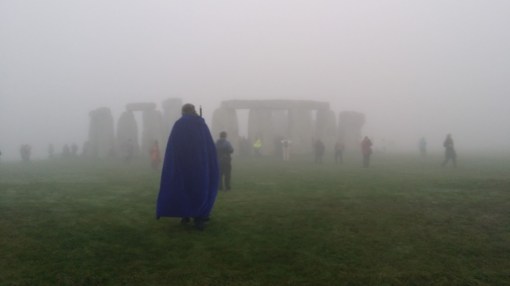
The Autumn Equinox (Mabon) It is the time of the autumn equinox, and the harvest is winding down. The fields are nearly empty, because the crops have been plucked and stored for the coming winter. Mabon is the mid-harvest festival, and it is when we take a few moments to honor the changing seasons, and celebrate the second harvest. On or around September 21st, for many Pagan and Wiccan traditions it is a time of giving thanks for the things we have, whether it is abundant crops or other blessings. It’s a time of plenty, of gratitude, and of sharing our abundance with those less fortunate.
University of Adelaide research has for the first time statistically proven that the earliest standing stone monuments of Britain, the great circles, were constructed specifically in line with the movements of the Sun and Moon, 5000 years ago.
The Callanish Stones were erected in the late Neolithic era. They are an arrangement of standing stones placed in a cruciform pattern with a central stone circle 13 metres (43 feet) in diameter, situated near the village of Callanish on the west coast of Lewis in the Outer Hebrides, Scotland. Image credit: Gail Higginbottom & Roger Clay / RCAHMS.
The research, published in the Journal of Archaeological Science: Reports, details the use of innovative 2-D and 3-D technology to construct quantitative tests of the patterns of alignment of the standing stones.
.
“Nobody before this has ever statistically determined that a single stone circle was constructed with astronomical phenomena in mind — it was all supposition,” says project leader and University of Adelaide Visiting Research Fellow Dr. Gail Higginbottom, who is also a Visiting Research Fellow at the Australian National University.
Examining the oldest great stone circles built in Scotland (Callanish, on the Isle of Lewis, and Stenness, Isle of Orkney — both predating Stonehenge’s standing stones by about 500 years), the researchers found a great concentration of alignments towards the Sun and Moon at different times of their cycles. And 2000 years later in Scotland, much simpler monuments were still being built that had at least one of the same astronomical alignments found at the great circles.
The stones, however, are not just connected with the Sun and the Moon. The researchers discovered a complex relationship between the alignment of the stones, the surrounding landscape and horizon, and the movements of the Sun and the Moon across that landscape.
“This research is finally proof that the ancient Britons connected the Earth to the sky with their earliest standing stones, and that this practice continued in the same way for 2000 years,” says Dr. Higginbottom.
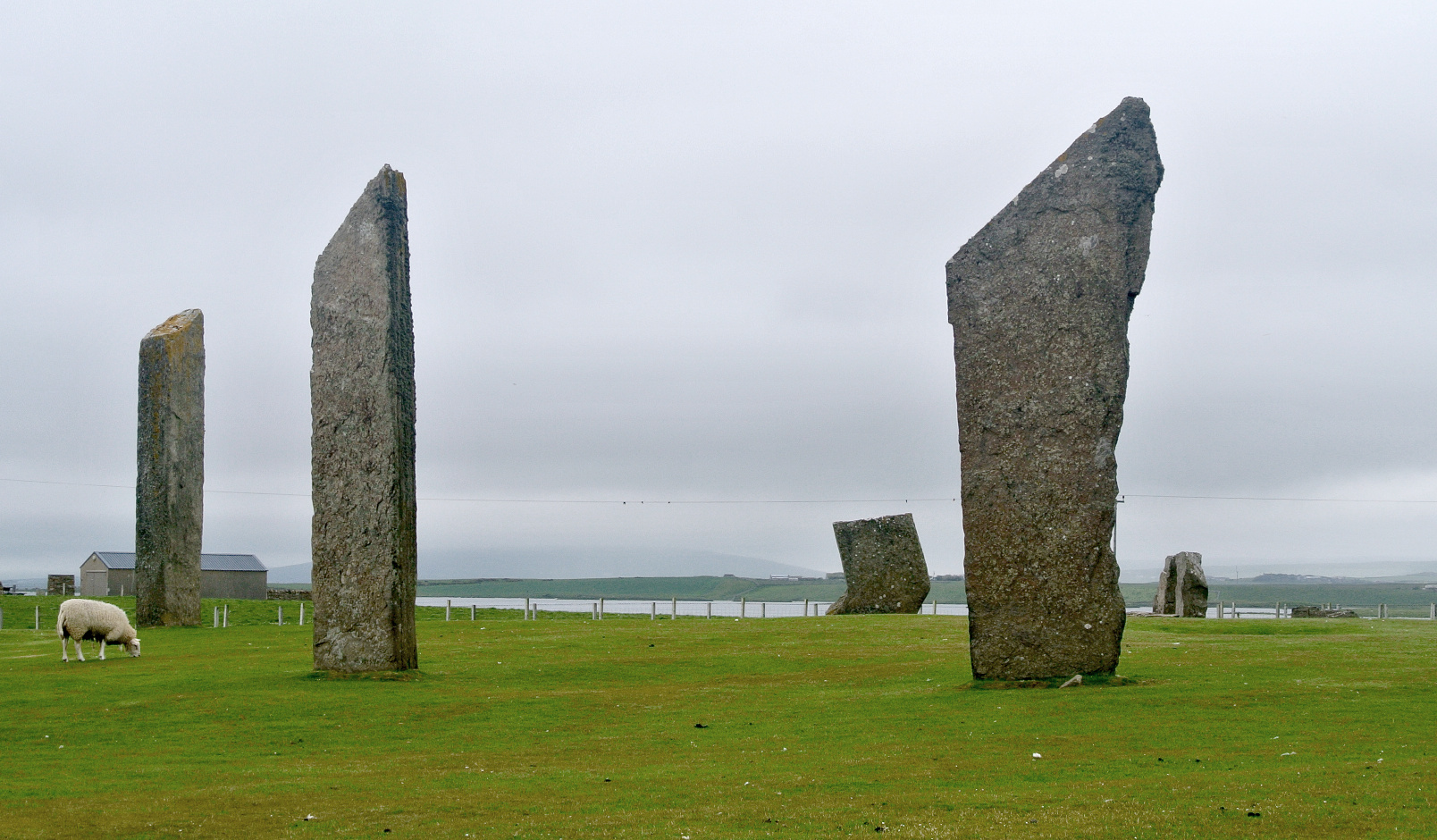
The Standing Stones of Stenness is another Neolithic monument — possibly the oldest henge site in the British Isles — located five miles northeast of Stromness on the mainland of Orkney, Scotland. The stone circle measures 32.2 x 30.6 metres (106 x 100 feet), surrounded by an earthen henge 45 metres (148 feet) in diameter. Image credit: Wikimedia Commons.
Examining sites in detail, it was found that about half the sites were surrounded by one landscape pattern and the other half by the complete reverse.
“These chosen surroundings would have influenced the way the Sun and Moon were seen, particularly in the timing of their rising and setting at special times, like when the Moon appears at its most northerly position on the horizon, which only happens every 18.6 years,” Dr Higginbottom says.
“For example, at 50 percent of the sites, the northern horizon is relatively higher and closer than the southern and the summer solstice Sun rises out of the highest peak in the north. At the other 50 percent of sites, the southern horizon is higher and closer than the northern, with the winter solstice Sun rising out of these highest horizons.
“These people chose to erect these great stones very precisely within the landscape and in relation to the astronomy they knew. They invested a tremendous amount of effort and work to do so. It tells us about their strong connection with their environment, and how important it must have been to them, for their culture and for their culture’s survival.”
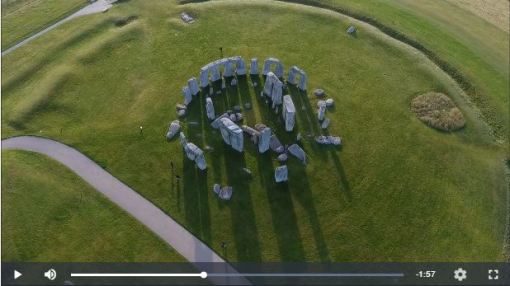
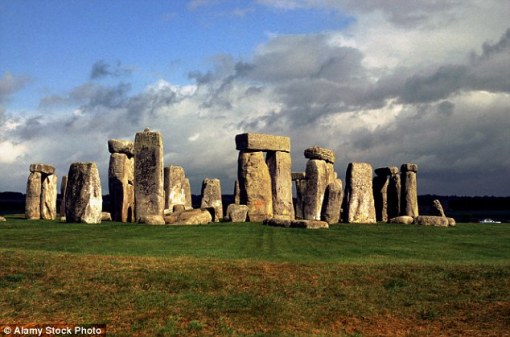
Stonehenge is perhaps the world’s most famous prehistoric monument. It was built in several stages: the first monument was an early henge monument, built about 5,000 years ago, and the unique stone circle was erected in the late Neolithic period about 2500 BC. In the early Bronze Age many burial mounds were built nearby. Today, along with Avebury, it forms the heart of a World Heritage Site, with a unique concentration of prehistoric monuments.
Once upon a time (until 1977, actually) it was possible to turn up and wander around the world-famous prehistoric monument of Stonehenge, touching ancient stones and experiencing wonderment at being in such an atmospheric place, often alone. Not any more – all those hands were contributing to erosion and today’s multitudinous visitors may look but not touch.
Stonehenge began as a circular ditch and earth bank constructed around 3100 BC, with the standing stone circle erected some nine centuries later. Research suggests that Stonehenge marked an important burial site, but this prosaic explanation is not accepted by everyone. The purpose of Stonehenge has long been passionately debated with diverse theories mooted – these include religious ritual, astronomical observation and assorted complex and often outlandish supernatural notions. Was it really a landing site for space travellers? Probably not.
Whatever the truth, the place retains an aura of mystery. It was…
Here’s everything you need to know about the longest day of the year and traditions surrounding the summer solstice
Party time: Druids, pagans and revellers take part in a winter solstice ceremony at Stonehenge
Every year, around this time, we start talking about the summer solstice.
Mostly it’s because it’s the longest day of the year, and there’s a very British pessimism that says the days will immediately start to shorten into winter from now on.
But there’s also the shenanigans at Stonehenge, general celebrations and a pause to celebrate the summer.
But what does it all mean?
What is it?
It’s generally understood to mark the middle of summer – even though some of us may feel like we haven’t really had the first half yet in the UK.
Technically, it’s when the tilt of Earth’s axis is most inclined towards the sun, and that’s why we get…
English Heritage is pleased to welcome people to Stonehenge to celebrate this year’s Summer Solstice. This is the 17th year that English Heritage has provided access to the stones and are looking forward to a peaceful celebration.
MONDAY 20th JUNE
Access to monument field – 7pm
Sunset – 9:26pm
TUESDAY 21st JUNE
Sunrise – 4:52am
Monument field closes – 8am
The Solstice Car Park opens at 7pm on 20th June with last admissions at 6am (or when full, if earlier) on 21st June. The car park will close at 12 noon on 21st June.Alcohol is not permitted in the monument field during Summer Solstice.Admission to the Summer Solstice at Stonehenge is free of charge, however please note that parking fees in the official car park apply – cars: £15, commercial coaches and minibuses: £50, motorcycles: £5.
Conditions of Entry
Amplified music is not permitted in or around the monument field. …
THIS BLOG claims no credit for any images posted on this site unless otherwise noted. Images on this blog are copyright to its respectful owners. If there is an image appearing on this blog that belongs to you and do not wish for it appear on this site, please E-mail with a link to said image and it will be promptly removed.
We do not operate any guided tours. This is 3rd party Blog and all posts are published by freelance independent bloggers with complimentary links to www.StonehengeTours.com Please contact us direct with any queries.
FREE BLOG TRAFFIC We create high-quality, long-form content optimized for search engines (SEO) and promote it across social media platforms and relevant online communities like Reddit and Quora and direct links to your website. We help build an email list to drive consistent traffic, and repurpose your content for different platforms such as YouTube or podcasts. Collaborating on relevant guest posts and being a guest on podcasts can also introduce your blog to new audiences, whatever the industry.

 That particular breed would have been seen as a ‘prized prestige pet’
 Transformers 5 Stonehenge replica, photo by Rose Senior
 The Autumn Equinox (Mabon)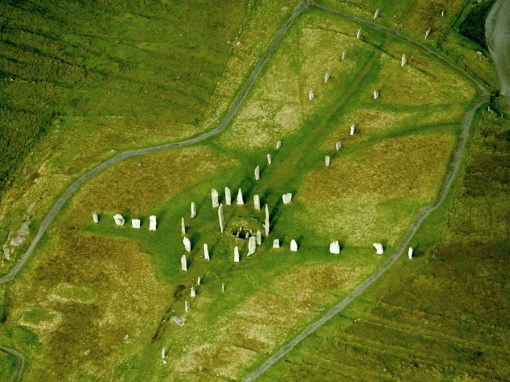

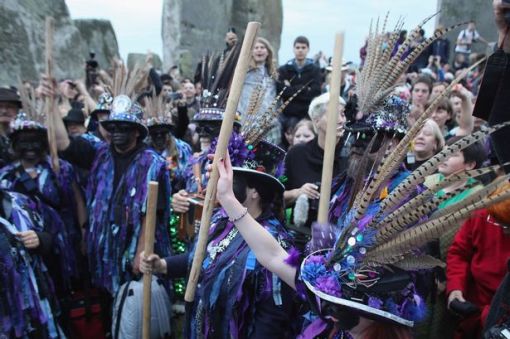 Party time: Druids, pagans and revellers take part in a winter solstice ceremony at Stonehenge