Aerial archaeologist Ben Robinson visits Amesbury in Wiltshire where excavations have revealed that the history of people living in this location dates back much further than previously thought.

Photo: English Heritage

Photo: English Heritage

New evidence from the dig, at a site called Vespasian’s Camp, has revealed traces of human settlement 3,000 years before nearby Stonehenge was built. A team of archaeologists has uncovered evidence of sustained hunter gatherer activity which dates to 8,000 years ago – long before Stonehenge
David Jacques explains why the discovery is of international importance and what it means in terms of unlocking the secrets of Stonehenge, located less than a mile away.

The Flying Archaeologist – Stonehenge is broadcast on Friday, 19 April at 19:30 BST on BBC One West and South. The series is broadcast nationwide from Wednesday, 1 May at 20:30 BST on BBC Four Watch a clip here: http://www.bbc.co.uk/news/uk-england-22019089

32-foot-tall stack of stones discovered

Stonehenge has some company in the department of mysterious stone structures: In a new paper, researchers are now revealing that an unusual rock formation was discovered via sonar in the Sea of Galilee a decade ago. Divers who have since gone down to inspect it say it’s a 32-foot-tall cone-shaped formation made of “unhewn basalt cobbles and boulders,” reports LiveScience, which describes it as a cairn—a stack of rocks piled on top of each other. Its diameter measures about 230 feet (double that of Stonehenge’s outer circle), and it’s estimated to weigh 60,000 tons.

Giant rock structure found under sea

Giant rock structure found under sea

Though the researchers admit they don’t know what the structure’s purpose was (LiveScience notes similar cairns have been used to mark graves), they have determined it was definitely made by humans, likely on land; a rising sea would have later submerged it. “The boulders have natural faces with no signs of cutting or chiseling,” researchers wrote in the International Journal of Nautical Archaeology. “Similarly, we did not find any sign of arrangement or walls that delineate this structure.” Up next: The team hopes to conduct an underwater archaeological expedition in order to mine for artifacts and pinpoint the age of the structure—which one researcher believes could date back more than 4,000 years.


Article by: By Ruth Brown,  Newser Staff
http://www.newser.com/story/165993/in-sea-of-galilee-a-mystery-bigger-than-stonehenge.html

Stonehenge News

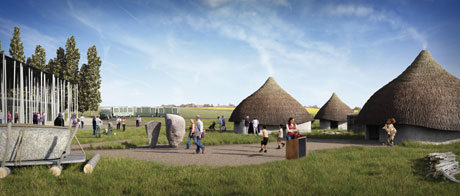
Work has just started to test build three Neolithic houses which will form the focal point of the outdoor gallery of the new visitor centre and complement the stunning permanent exhibition indoors to tell the story of Stonehenge in vivid detail.

Rare examples of ten Neolithic houses were discovered at Durrington Walls as part of the Stonehenge Riverside Project in 2006 and 2007. Although they provided a lot of archaeological evidence on which to base this project, the appearance of the houses above ground is not known and some educated guess work is needed to build the reconstructions.

Computer-generated image of how the new outdoor gallery will look

Computer-generated image of how the new outdoor gallery will look

In order to conduct various experiments to test things like roofing materials and construction techniques, around 60 volunteers are helping us to building prototypes of these houses at Old Sarum Castle, under the guidance of English Heritage and the Ancient Technology Centre experts.

Event at Old Sarum

We are holding three open days at Old Sarum Castle to allow the public to see the Neolithic house prototypes from Saturday 25 to Monday 27 May. If you fancy brushing up even further on your knowledge of prehistoric life, you can also join one of our tours. These last for 1 hour 30 minutes and include hands-on activities. Tickets can be purchased at the site on the day. For more information please contact 0800 333 1183.

Links Source: http://www.english-heritage.org.uk/daysout/properties/stonehenge/our-plans/project-update/

  • More than a million  people visit Stonehenge every year – but it has been roped off from the public  since 1977
  • A new £27million centre  nearby will contain a 360-degree cinema screen with a 100ft  circumference

Visitors to Stonehenge will again be able to  experience standing inside the ancient stone circle thanks to a 360-degree  cinema.

The battle for access to the World Heritage  site has been fought for many years, with campaigners wanting to be allowed into  the world-famous monument.

At last, protestors may partially get their  wishes, as English Heritage is developing a solution – a virtual visit in a  panoramic cinema
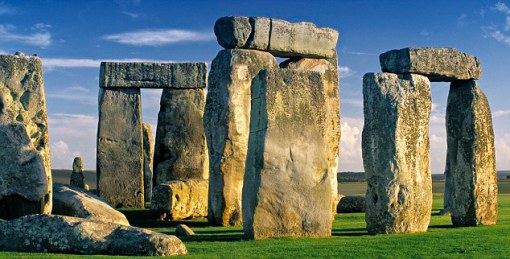
New evidence: Studies of cremated human remains show that a larger stone circle was erected at the same site as a community graveyard

New evidence: Studies of cremated human remains show that a larger stone circle was erected at the same site as a community graveyard

The picturehouse will be the jewel in the  crown of a new £27million centre and will include a 32ft landscape wall, on to  which computer generated images of the countryside around the circle and other  ancient earthworks will be projected.

The new auditorium’s 100ft circumference is  smaller than the actual stone circle, which is around 300ft. It’s expected to be  built just over a mile from the stones.

Also planned are films providing information  about the monument and prehistoric items, exploring theories over the uses of  Stonehenge.

The picturehouse will be the jewel in the  crown of a new £27million centre and will include a 32ft landscape wall, on to  which computer generated images of the countryside around the circle and other  ancient earthworks will be projected.

The new auditorium’s 100ft circumference is  smaller than the actual stone circle, which is around 300ft. It’s expected to be  built just over a mile from the stones.

Also planned are films providing information  about the monument and prehistoric items, exploring theories over the uses of  Stonehenge.

New studies of cremated human remains  excavated from the site suggest that about 500 years before the Stonehenge we  know today was built, a larger stone circle was erected at the same site as a  community graveyard, researchers said.

‘These were men, women, children, so  presumably family groups,’ University College London professor Mike Parker  Pearson, who led the team, said.

‘We’d thought that maybe it was a place where  a dynasty of kings was buried, but this seemed to be much more of a community, a  different kind of power structure.’

The virtual visits may not win over  all  campaigners including Pagans and Druids who want open access to  Stonehenge,  which was created about 5,000 years ago.

When it was first opened to the public, it  was possible to walk among and  even climb on the stones. However, they were  roped off in 1977 due to  problems with erosion.

However, English Heritage does permit access  during the summer and winter solstice, and the spring and autumn equinox.

British researchers have proposed a new  theory for the origins of Stonehenge:  It may have started as a giant burial  ground for elite families around  3,000 B.C.

By Fiona Keating Daly Mail: http://www.dailymail.co.uk/sciencetech/article-2298923/Panoramic-virtual-views-Stonehenge-wow-visitors-32ft-landscape-wall.html

STONEHENGE TOUR GUIDE
Visit Stonehenge nd here about the many recent new theories…………

StonehengeNews's avatarStonehenge Stone Circle News and Information

Archaeologists back conflicting theories on Britain’s greatest prehistoric monument

It already attracts more than a million visitors a year. Yet these numbers could be dwarfed once Stonehenge, one of the world’s greatest prehistoric monuments, completes its radical facelift

Over the next year, the nearby A344 will be closed and grassed over. A new visitor centre will be built a mile and a half from the monument and tourists will be encouraged to explore the ancient landscape around the 5,000-year-old complex.

The makeover falls short of plans, since scrapped, that would have seen all major thoroughfares in the area diverted through tunnels. Nevertheless Stonehenge should be returned to something like its past glory, it is hoped, and then attract even greater numbers of visitors seeking to understand the purpose of this vast, enigmatic edifice.

For centuries, historians and archaeologists have speculated about the reason for the monument’s construction. Suggestions have ranged…

View original post 970 more words

StonehengeNews's avatarStonehenge Stone Circle News and Information

Dating cremated bone fragments of men, women and children found at site puts origin of first circle back 500 years to 3,000BC

Centuries before the first massive sarsen stone was hauled into place at Stonehenge, the world’s most famous prehistoric monument may have begun life as a giant burial ground, according to a theory disclosed on Saturday.

More than 50,000 cremated bone fragments, of 63 individuals buried at Stonehenge, have been excavated and studied for the first time by a team led by archaeologist Professor Mike Parker Pearson, who has been working at the site and on nearby monuments for decades. He now believes the earliest burials long predate the monument in its current form.

The first bluestones, the smaller standing stones, were brought from Wales and placed as grave markers around 3,000BC, and it remained a giant circular graveyard for at least 200 years, with sporadic burials after…

View original post 673 more words

Thousands of people came from across Britain to help build Stonehenge, experts investigating the origins of the monument have said.

They said people travelled from as far afield as the Scottish Highlands.

The latest findings about Stonehenge come after a decade of research

The latest findings about Stonehenge come after a decade of research

Researchers from University College London said their findings overturned what was thought about the origins of the monument.

Until now it had been thought that Stonehenge was built as an astronomical calendar or observatory.

The latest findings, which came after a decade of research, suggested it was the act of building the monument rather than its purpose that was key.

The researchers believed as many as 4,000 people gathered at the site, at a time when Britain’s population was only tens of thousands.

‘Not all fun’

Analysis of animal teeth found at a nearby settlement suggested people travelled the length of the country to help with the building.

Professor Mike Parker Pearson, from University College London, said the scene would have resembled a cross between the Glastonbury Festival and a motorway building scheme.

He said a settlement at nearby Durrington Walls had about 1,000 homes, the “largest Neolithic settlement in the whole of northern Europe”.

Prof Parker Pearson said: “What we have discovered is it’s in building the thing that’s important. It’s not that they’re coming to worship, they’re coming to construct it.”

He added: “It’s something that’s Glastonbury Festival and a motorway building scheme at the same time. It’s not all fun, there’s work too.”

The academics suggested that Stonehenge was built about 200 years earlier than previously thought, some 4,500 years ago.

Their findings will be revealed in a Channel 4 documentary, Secrets of the Stonehenge Skeletons.

Full story: http://www.bbc.co.uk/news/uk-21724084

Stonehenge Tour Guide

Work on the new visitor centre at Stonehenge is ‘progressing well’, according to English Heritage.

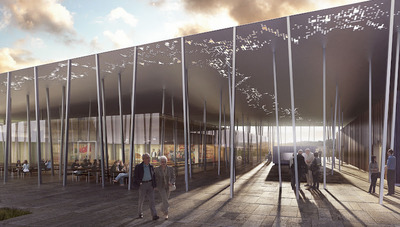
The new facility, set back from the famous stones, will feature two pods housing exhibitions, a dedicated education space, a bigger shop and cafe. When open it will be able to cater for 500 visitors.

visitor-centre-2The centre is part of a £27 million pound project almost entirely funded by English Heritage, and will be open to the public by the end of the year.

Plans for a new visitors area were first mooted over 20 years ago, when the current facilities – built in 1968 as a temporary measure – were branded a national disgrace. The current project has also faced difficulty – with the coalition withdrawing funding in 2010.

The new facility was designed by architectural firm Denton Corker Marshall and is being built by Vinci Construction.
Loraine Knowles is Stonehenge Director for English Heritage, she told Spire FM:

“I’m absolutely thrilled, because when you’ve worked four years on a project, to actually see it start, and to see the construction underway is thrilling, and it’s a tribute to all the hardwork people have put in.”

David Andrews, Chief Executive for Visit Wiltshire, told Spire FM how it might boost tourism in Wiltshire:

“What happens now of course is that lots of people come to Stonehenge for 20 minutes, and they jump off the coach, they take their photo, they zip down to Bath and they’ve gone. They’re not spending any money in Wiltshire.”

“This means people will have to stay here longer, they’ll be thinking maybe I have to stay here overnight. So I think this is going to have a big impact in terms of people staying overnight in Wiltshire, coming back to Wiltshire, and of course, spending money in Wiltshire.”

Link source: http://www.spirefm.co.uk

Stonehenge News

Work on a multimillion-pound visitor centre at Stonehenge is progressing well, English Heritage has said.

The £27m scheme, which includes grassing over the road alongside the ancient monument, is due to be complete by the end of the year.

Car and coach parks have been laid out and the visitor centre’s roof is ready to be installed, the charity said.

Stonehenge director Loraine Knowles said the building was “just one aspect in transforming” the site.

Work on the new galleries and facilities, being built about a mile-and-a-half (2.4 km) west of the stones, began in July.

Two “single-storey pods” covered by a canopy roof are being built to house an exhibition and education space, cafe, shop and toilets.

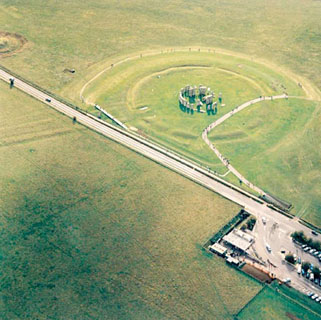
A section of the A344, which runs next to the World Heritage Site, is due to be closed at the end of June and grassed over.

The remainder of the A-road will be closed to traffic in late 2013, to allow a shuttle to operate between the visitor centre and the stones.

‘Uplifting experience’

“The way in which people visit Stonehenge in the future will change,” said Ms Knowles.

The new visitor building for Stonehenge​ The visitor centre is expected to open in late 2013
“The construction of the visitor building is just one aspect in transforming what is widely agreed to be an unsatisfactory tourist and cultural experience.

“We will be uplifting the whole experience to a level that befits this extraordinary and important monument, not just upgrading the visitor facilities, important though those are.”

Stonehenge, constructed between 3,000 BC and 1,600 BC, is thought to have been used for a variety of religious ceremonies.

It attracts around 900,000 visitors a year – about 70% come from abroad.

Full story: http://www.bbc.co.uk/news/uk-england-wiltshire-21499114

Stonehenge News

Starting in Salisbury head north to Salisbury Plain along NCN route 45 and enjoy the unusual atmosphere at famous Stonehenge.

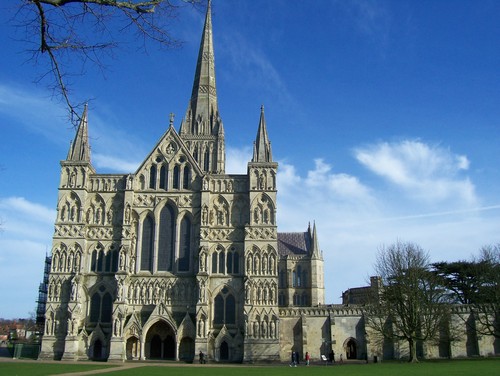
salisbury-toursYou start at the beautiful Salisbury Cathedral and head through the north gate before joining the River Avon which you follow to the outskirts of the town. The route then passes the ancient settlement of Old Sarum before rejoining the river to West Amesbury via Woodford Bridge. A short on road stretch then takes you to Stonehenge, part of the National Trust’s Stonehenge Landscape

Salisbury to Stonehenge Ordnance Survey Map – view and print off detailed OS map
Salisbury to Stonehenge Aerial Photo View Map – view photos and points of interest

http://www.gps-routes.co.uk/routes/home.nsf/RoutesLinksCycle/salisbury-to-stonehenge-cycle-route#

The Stonehenge Cycle Challange is this September 2013.  Starting at the Preseli Hills in the Pembrokeshire National Park and ending inside the stone circle at Stonehenge with a celebratory glass of champagne, this really is a monumental ride of a lifetime.  More

Stonehenge News Team