As the eclipse plunges Wiltshire and other places into darkness this Friday (March 20th), two other rare if less spectacular celestial events will be taking place, too: the Spring equinox and a Supermoon. Friday will see three rare celestial events and this will be the first time in living memory that the Spring equinox, a solar eclipse, and a supermoon are all taking place on the same day in the UK.
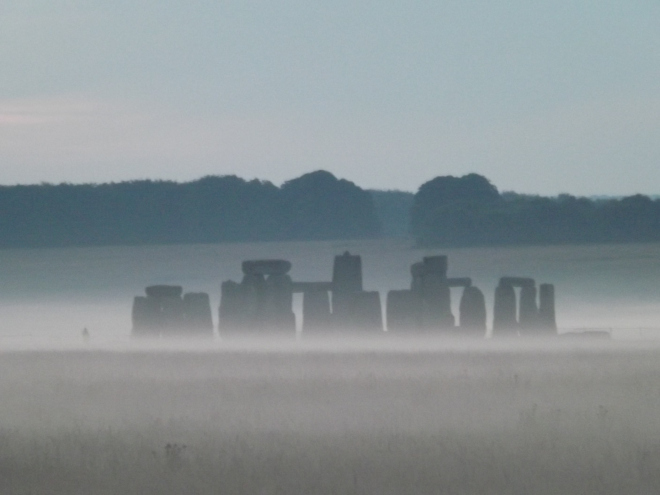
One of the most intriguing mysteries in the world is the Stonehenge. Nobody knows who built the mysterious Stone Circle in Wiltshire, or what its purpose was exactly. There are many theories associated with Stonehenge and archaeologists have been debating for ages to determine why it was built. Most experts believe that Stonehenge is actually an ancient astronomical calculator.
Eclipses have long been feared as bad omens, but the equinox is celebrated as a time of renewal
Buzz Aldrin, the second man to set foot on the moon, has sent a “message to the Red Planet” from Stonehenge.
(Buzz Aldrin was the second man to set foot on the surface of the moon, after Neil Armstrong, in July 1969)
English Heritage said a number of people had questioned whether the image had been doctored. Copyright James O, Davis
The 85-year-old donned a T-shirt urging travel to Mars as he was snapped striking a Superman pose in front of the pre-historic monument.
Following his Wiltshire visit, he tweeted: “While at Stonehenge I decided to send a message to the cosmos.”
The veteran astronaut has called for renewed efforts to not only send a manned mission to Mars but colonize it.
Jessica Trethowan, from English Heritage, said there had been several enquiries about whether the image was real.
“Someone asked if it had been Photoshopped it, but it is real,” she said.
“It was a private visit for him and his family. We were told about it a week or so ago and everyone was very excited about meeting him.”
After a tour of the ancient site, the charity said Aldrin had asked “where we hide the aliens”.
Article Source: BBC – http://www.bbc.co.uk/news/uk-england-wiltshire-31920141
English Heritage will welcome people to Stonehenge to celebrate the Spring (Vernal) Equinox on Saturday 21st March.
Expect a short period of access, from first light (approximately 05:45am) until 08:30am.
• Access to Stonehenge will cease at 0830h and the cooperation of all of visitors in ensuring the monument is vacated at this time would be most appreciated. Please note that, in previous years, access for the Equinox ceased earlier at 0800h, however English Heritage has permitted an additional half an hour within the monument for our visitors.
• Temporary toilets (Porta-Loos) will be available at the monument once the site is open for public access. This includes a provision for those with disabilities.
•The Cafe and Shop at the new Visitor Centre at Airmans Cross should be opening for visitors from approximately 0800h on the morning of Saturday 21st March. Please note that the toilets at this location will…
What do we know about Wiltshire? we asked one another as we headed off for a weekend break.
And, to our shame, the answer was little.
The World Heritage Site of Stonehenge near Salisbury in Wiltshire
As one of the country’s lesser known counties, Wiltshire had us stumped for its list of attractions much beyond Stonehenge.
But there are parts of the county you’ll already know well, even if you don’t know their names.
From the chocolate-box village of Lacock– location for Meryton in the BBC adaptation of Pride and Prejudice – to Mompesson House in Salisbury – used in the Emma Thompson film of Sense and Sensibility – there are places period drama fans at least will know very well.
Other draws – not just Stonehenge, but Swindon, Salisbury Cathedral, the sweet little village of Bradford on Avon, and stately homes aplenty – are here too, making Wiltshire a perfect destination for an attractions-packed short break.
We were taking in the county from the stress-free comfort of a coach, safe in the knowledge negotiating a route and finding somewhere to park would be taken care of for us, and we’d be able to really see the scenery, not just the road ahead.
A packed itinerary made for a whistlestop tour – quite literally at our first stop, Swindon and the Great Western Railway Museum STEAM, where our guide spoke with such passion about the heyday of the railway you could almost hear the pistons and smell the coal.
It was here thousands of men once toiled, making Swindon the locomotive manufacturing capital of the world – and where, tragically, all that now remains is a poignantly moving museum, and replica period platforms with carriages from through the ages to wander through and explore.
Onwards to Stonehenge we explored history of an altogether vintage.
We were surprised by the 4,500-year-old stone circle’s scale – smaller than we had imagined – and a little underwhelmed by its acclaimed new ‘world class’ English Heritage open air visitor centre which, on the wet and blustery day we were there, allowed the rain to lash in.
But we could not fail to be impressed by Stonehenge’s enduring enigma – and, as a British ‘must see’, we were pleased to have seen it.
There was history of yet another kind at Salisbury Cathedral – home to the finest of the four surviving original 1215 Magna Carta documents, marking their 800th year in 2015. A major new anniversary exhibition explores one of the most celebrated documents in English history and it was spine-tingling to see the parchment skin and tightly-packed Latin script up close.
Salisbury has been ranked the seventh best city in the world to visit during 2015 – and the Magna Carta is one reason for that, but there are plenty of others too.
The cathedral itself is full of interest, explained to us by an extremely enthusiastic guide. Afterwards we found Chorister’s Green, the beautiful lawned square outside the cathedral, to be the city’s prettiest spot.
It was here scenes for Sense and Sensibility were filmed in 1995, at the calm and elegant Mompesson House – a Queen Anne townhouse of perfect proportions and symmetry, its interiors decorated as they might have been in the 1700s.
A few doors along, we visited Arundells, the home of former Prime Minister Sir Edward Heath, whose wish was ‘for the public to share the enjoyment’ of his house after his death. We were given a tour by his clearly devoted former landscape gardener, now the house’s manager and curator, whose personal anecdotes added a unique intimacy and depth to rooms still furnished with Sir Edward’s furniture, ornaments, ceramics and books.
In the National Trust village of Lacock we wandered pretty winding streets, popped into perfect pubs and gazed at timber-framed 13th century cottages so unspoilt by the modern age it’s obvious why they were chosen as a backdrop for Pride and Prejudice and the Harry Potter films.
10-day exploration of ancient sites from Stonehenge to the Aran Islands.
Across the lush landscapes of England and Ireland lie some of the most important and intriguing prehistoric monuments in the world. In the company of local archaeologists, authors, and historians, uncover the stories of Neolithic and Bronze Age civilizations—and the mysteries of their legacies—as we make our way from Stonehenge to Ireland’s Bend of the Boyne, the Aran Islands, and more. –
National Geographic Trip Highlights
Take an insider’s tour of legendary Stonehenge and its adjacent sites with a local expert.
Explore the boglands of Céide Fields, a 6,000-year-old site excavated by archaeologist Seamus Caulfield.
Delve into the heritage of the Aran Islands with the director of the islands’ college.
Take a walking tour of the Burren National Park with a local author and discover Bronze Age sites amid this otherworldly limestone landscape.
This superb 10 Day Expedition Tour includes:
Avebury and Stonehenge(Day 3)
Step back thousands of years among remarkable megalithic monuments at the UNESCO World Heritage site of Avebury and Stonehenge. At Avebury, stroll around the largest stone circle in the world, excavated in the early 20th century by archaeologist Alexander Keiller. Examine the site’s standing megaliths with a local expert, and examine artifacts found here at the Alexander Keiller Museum. Walk past Silbury Hill, Europe’s largest man-made, prehistoric mound, on the way to the Neolithic chambered tomb at West Kennet Long Barrow, which predates Stonehenge by some 400 years. Then head to legendary Stonehenge for an insider’s tour with local expert Pat Shelley. Visit the adjacent sites of Woodhenge and Durrington Walls, where the site’s builders are believed to have lived, and learn about recent discoveries that have shed light on the mysteries surrounding these sites. –
Learn about prehistoric civilizations with a seasoned archaeologist
2015 Tour departures:
June 06th – 15th
June 13th – 22nd
September 05th – 14th
For people from overseas visiting England, or even English people that want to experience something different, the summer solstice is a big draw. For anybody in or near to Salisbury on 20th and 21st June (every year), I strongly recommend a visit to Stonehenge which is a UNESCO World Heritage Site along with it’s neighbour Avebury.
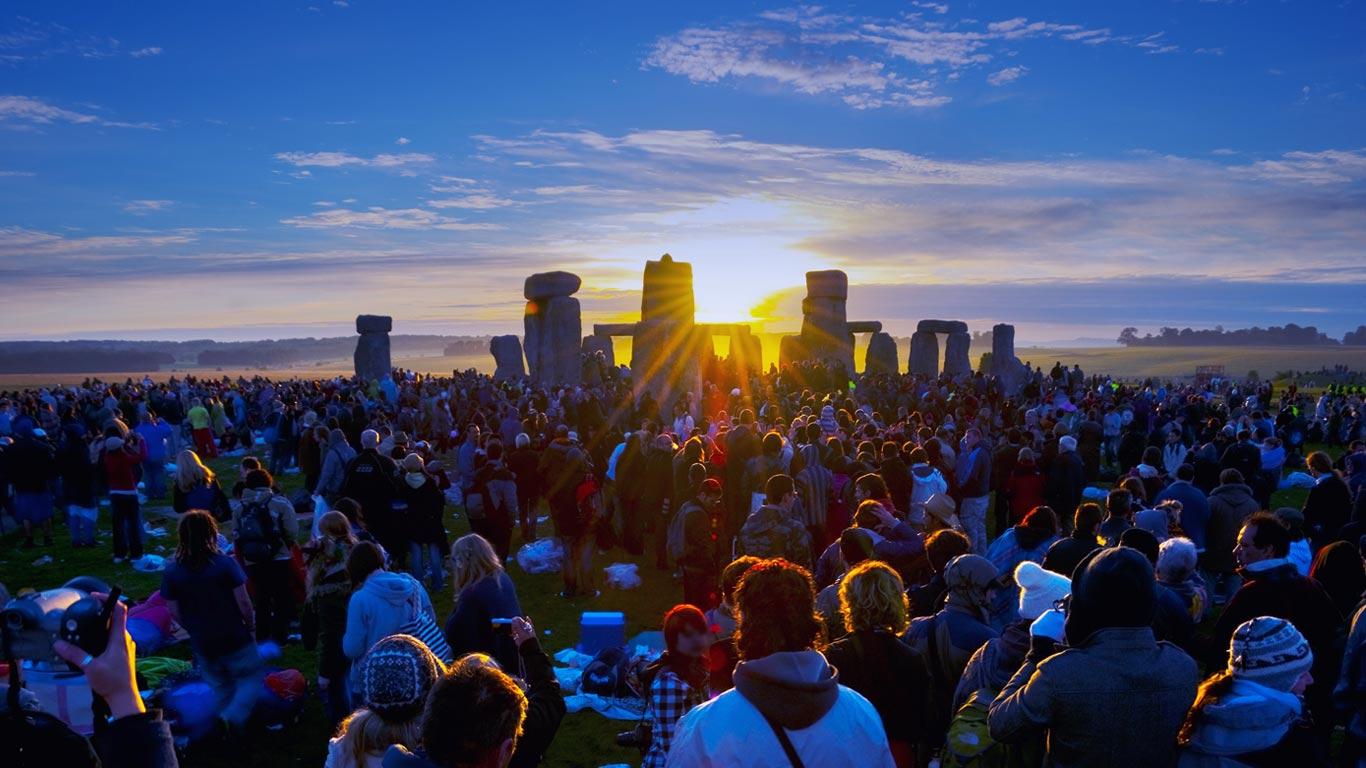
The story of Stonehenge is still not 100% known, there are many theories ranging from an alien landing site to an ancient temple. While some theories hold more weight than others, none have been confirmed to be 100% true yet. However the National Trust (the body that looks after Stonehenge) has allowed for the site to be open each summer solstice, at the request of druid and other pagan communities. This is to allow the druids to celebrate the sunrise of the longest day, but the opening is not restricted to just druids, over 20,000 people attend the event each year and it really is a great atmosphere. There are acoustic instruments, dancing, hula hooping and just about any other natural form of entertainment you can think of. There are food stalls to cater for all of the hungry attendees and portable toilets around the area. With police and st. John’s ambulance in attendance people will be happy to know that they are safe. The venue usually opens at 7pm on 20th June and closes at 7am on 21st June. I have been 6 times before and I would strongly recommend this to anybody in the area.
The Winter Solstice, which takes place on 21st December in the Northern Hemisphere, is celebrated in various forms all over the world. In astronomical terms, this is the shortest day of the year, when the sun is at its lowest in the sky. After the solstice, the days begin to get longer again, and it is for this reason that it was celebrated as the beginning of a new year by pagan cultures.
I celebrated the winter solstice at Newgrange, a Neolithic passage tomb in Co. Meath, Ireland. This monument is an astounding feat of engineering: dating from around 3,200 B.C. (that’s older than the Pyramids!) it is aligned exactly with the rising of the midwinter sun. Above the entrance to the tomb there is an opening called the roof-box. On 21st December, the light of the rising sun passes through the roof-box and travels up the narrow passage, illuminating the inner chamber.
Entry to the chamber on the morning of the solstice is decided by a lottery. Alas, I was not one of the lucky few chosen. Indeed, further misfortune was in store as, after having dragged myself out of bed at 6am and trekked across narrow country lanes, the weather was cloudy and the sun barely visible.
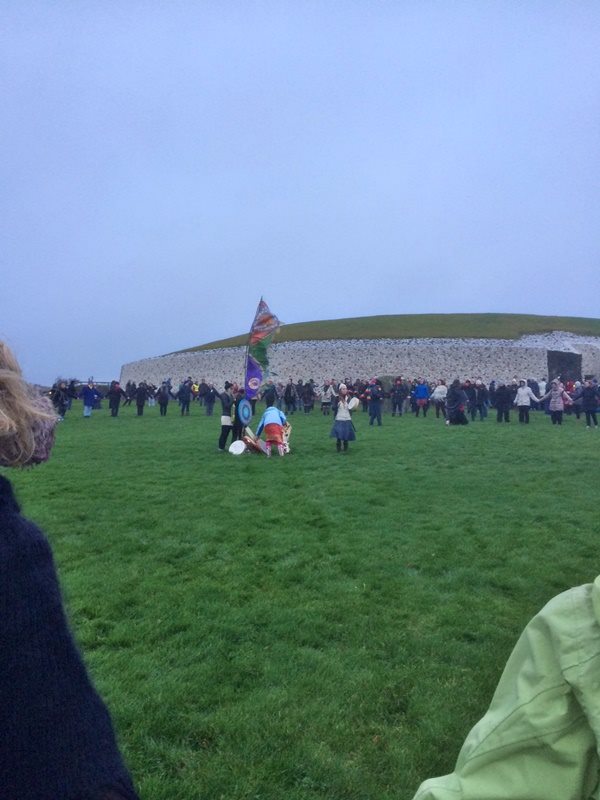
But the unlikelihood of a clear sunrise (this is Ireland, after all) did not deter the hundreds of people who turned out to welcome the new year. We were an eclectic bunch, ranging from the mildly curious to the deeply spiritual.
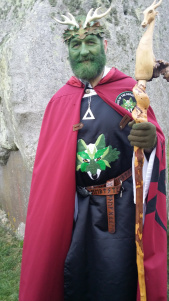
Dedicated believers, dressed in long cloaks with wreaths of leaves and twigs on their heads, led the welcoming of the sun. They banged drums and chanted, softly at first, the volume rising in a crescendo as the sky got gradually lighter.
Another group were gathered in a circle taking part in a guided meditation as part of a two-day retreat. As the drum-banging unofficial leaders of the celebration shepherded bemused bystanders into an enormous circle, the meditation group moved into the centre and stood facing out. Eventually they moved out to join the larger circle as the chanting reached its height, and the revellers greeted the sun (still hidden behind a cloud) with whoops and cries of ‘Happy Solstice!’
It would be difficult to find someone less spiritual than myself, and I’ll admit to finding most of the celebrations frankly a bit odd. Yet there was something undeniably refreshing about standing in that field at dawn, waiting to mark the most natural sign of the new year. It was definitely more enjoyable than the repetitive and ultimately disappointing festivities of the 31st.
Similar celebrations take place at Stonehenge, Britain’s most famous prehistoric monument, which is also aligned with the rising and setting of the sun. Huge crowds gather there annually for exuberant solstice festivities.
There is a lot of wisdom to be found in prehistoric pagan cultures. Not only have they given us some of the most awe-inspiring architectural accomplishments in the world, but they have also left us a legacy of spiritualism which has survived the advance of scientific understandings of the world.
If you come to visit Newgrange or Stonehenge just for the views and the guided tours, you might end up leaving with a new and perhaps more optimistic perspective on the coming year. Even if the sun fails to make an appearance. By Naoise Murphy Photograph: Naoise Murphy
Source: http://www.palatinate.org.uk/?p=53515
Gain a rare and fascinating insight into the famous World Heritage Site with an exclusive tour around the site led by one of English Heritage’s experts. The event starts with exclusive early morning access to the stone circle at Stonehenge accompanied by our expert.
Following a light breakfast, we will then go on to explore key archaeological sites including Durrington Walls, Woodhenge and The Cursus to learn more about the archaeological landscape and investigate work that has taken place in recent years.
There is plenty of walking, sometimes over uneven ground on this tour, so we have graded it as moderate access.
15th January 2015 SOLD OUT 9th February 2015 SOLD OUT 9th March 2015
Heaven and Earth Tours Special evening bookable tour learning about the stars and planetary movements and how early man may have utilised them.
From Pagan festivals to fire ceremonies and medieval football matches, all of these winter celebrations are keeping our ancient traditions alive – and are much more stimulating than the Christmas sales …
Stonehenge winter solstice, Wiltshire: December 21st 2020
Solstice celebrations – marking the shortest day and longest night of the year – happen right across the UK. But one of the focal points for the festivities will always be the prehistoric monument of Stonehenge. Each year, thousands descend on this field in Wiltshire to see the sun rise above the stones. Expect to see the druid and pagan communities out in full force, dressed in magnificent costumes and singing incantations within the circle. This year, the solstice takes place on 21st December, and you’ll be able to arrive at the monument as soon as the light begins to break.
• english-heritage.org.uk
Burning the Clocks, Brighton
21 December A contemporary winter solstice celebration (and the most modern event on this list), the Burning the Clocks festival was conceived in Brighton in 1994 as a community event to be enjoyed, regardless of faith, and it takes place on the beach. Around 20,000 spectators turn up to witness the procession of light, which consists of a parade of luminous willow lanterns that are passed into a blazing bonfire. The event concludes with a huge fire show and firework display that lights up the seafront. •Parade starts 6.30pm, samesky.co.uk
Kirkwall Ba game, Orkney
25 December and 1 January The Ba is an annual custom in which hundreds of men and boys take to the streets to embark on a medieval football match. It has been described as more like a “civil war” than a game. Windows are boarded up in preparation for the self-refereed melee in Kirkwall, capital of the Orkneys. The two teams – the Uppies and the Doonies – battle for control of the leather “ba’”, attempting to wrestle it towards the areas of the town designated as the goals. Ribs have been broken in the scrum, but the event has a festival spirit that unites the entire town. •Starts at the Mercat Cross on Kirk Green, free, discover-orkney.co.uk/the-ba
Grantchester barrel rolling, Cambridgeshire
26 December One of many bizarre British Boxing day traditions, the Grantchester barrel rolling race is, well, pretty much as you’d imagine. Four local teams roll large wooden barrels up and down the street in a relay race, which is followed by the “County Championship” race between teams from Grantchester and nearby villages of Barton, Coton and Newnham. Founded in the 1960s, the race fell out of favour until it was revived in 2003 and, in keeping with most trivial pursuits, concludes with a booze-up at the local Rupert Brooke pub. • Coton Road, Grantchester, free, grantchester.org.uk
Keynsham Mummers play, Somerset
26 December A bit like pantomimes, mummers plays are comic folk performances that have been performed around Europe since the Middle Ages. The tradition is kept alive by the likes of the Bristol Morris Men, who have performed the play every Boxing Day in the town of Keynsham since the idea was revived in the late 1970s (though records suggest the play originated in the town in the early 19th century). Expect melodrama, sword fighting and colourful costumes. •11am at St John’s Church, 11.30am at Keynsham Library, midday at the New Inn, bristolmorrismen.co.uk
Fishermen vs Fireman football match, North Yorkshire
26 December Nothing brings out the competitive spirit like a game against the local rivals. In Scarborough, the Boxing Day football match is a chance for local fishermen and firemen to thrash it out – in fancy dress – on the beach. One of the town’s oldest surviving customs, there’s evidence of the match taking place on the South Bay beach back in 1893. It started as a way of raising money for the families of four fishermen lost at sea, and now supports elderly or unwell people in the community. •South Bay Beach, 10am, free, discoveryorkshirecoast.com
Stonehaven Fireballs, Aberdeenshire
Photograph: David Robertson / Alamy/Alamy
31 December
As this Stonehaven Fireball Association states proudly on its website, come rain, snow or storm “we have never cancelled”. This hardy 150-year-old fire ceremony is held on Hogmanay in Stonehaven, and is watched by thousands. When the Town House bell strikes midnight, the ceremony begins, with firedancers, known as “swingers”, making their way down the street, led by drummers and the Stonehaven Pipe Band and finishing with a firework display on the harbour. •Free, stonehavenfireballs.co.uk
Allendale Tar Barl festival, Northumberland
Photograph: Matthew Lloyd/Getty Images
31 December Setting whisky barrels full of tar alight is certainly one way to warm up on a winter’s evening. In existence since the dark ages, the Allendale Tar Barl festival is another fiery event, consisting of a Pagan ceremony led by “guisers” – an hereditary team of 45 barrel carriers in traditional costumes. Whisky barrels filled with flaming tar are paraded across the town, before being thrown on to a huge bonfire. •Free, visitnorthumberland.com
The Haxey Hood, Lincolnshire
Smoking the Fool … a fire is lit under the Fool who makes a welcome speech before officially starting the Haxey Hood.Photograph: Christopher Thomond/the Guardian
6 January And on the 12th day of Christmas … a man with a feathery hat tried to smuggle a leather tube into his local pub. The event, in the parish of Haxey, north Lincolnshire, is not unlike the mass rugby/football games that take place in various parts of the country where there are far more participants than rules – a large, chaotic match in which locals try to manoeuvre the leather “hood” to one of four pubs. The game, which can go on well into the evening, ends once the hood arrives at a pub, where it remains until the following year. •Free, wheewall.com/hood
Whittlesea Straw Bear festival, Cambridgeshire
9-11 January If anything is going to help lift the spirits above the dreary grind of January, it’s a man dressed head to toe in straw, dancing to folk music. This Cambridgeshire festival includes barn dances and concerts, as well as a procession through the streets on Saturday with teams of Morris dancers and, of course, the belle of the ball: the straw bear. Come Sunday, however, the bear costume will go up in smoke during the “bear burning” ceremony, a symbolic act to leave the way open for the new harvest … and a new bear. •Concert and barn dance £10, daytime events free, strawbear.org.uk
A new breed of fixers for the itchy-footed are offering made-to-measure trips tailored to a client’s pocket, pace and passions, writes Tim Pile
United States President Barack Obama takes an unscheduled stroll through prehistoric Stonehenge, in Wiltshire, England, in September. Photos: AFP; Corbis; Morukuru Ocean House – South Africa
On his way home from a recent Nato summit in Wales, Barack Obama made an unannounced stop at Stonehenge. The prehistoric monument closed early so that the president of the United States could soak up the atmosphere without being gawked at by day-trippers. He was given a personal tour by an English Heritage curator before continuing his helicopter journey to London. Describing the ancient stone circle as “cool”, Obama told reporters that he had “knocked it off his bucket list“.
The president’s sightseeing sortie might seem beyond the reach of ordinary mortals but his stopover was merely a high-profile example of a global tourist trend.
A growing number of tour operators specialise in putting together one-of-a-kind adventures. Like buying a tailor-made suit, discerning clients – many of whom have been there, done that, and bought the vineyard – are willing to pay for a “made-to-measure” experience. Add a whiff of one-upmanship and it’s easy to understand why this sector of the tourism industry is becoming increasingly popular.
The high-end holiday market encompasses a pigeonhole-defying range of possibilities. A customised itinerary can mean gaining entry where doors are usually closed while neatly sidestepping the tourist herds. The best companies can fix up tee times on a Ryder Cup golf course or charter you a steam train in India. They’ll arrange for a historian to accompany you around first world war battlefields or set up a meeting with the president of the Maldives to hear how climate change is affecting the low-lying archipelago.
Firms that put together special-interest programmes usually give clients the opportunity to unpick and reassemble itineraries to suit individual tastes. Perhaps you’re fed up with arriving at all the best sights at midday, leaving you with overexposed, washed-out photos. Someone a phone call away will be happy to tweak the tour so that you arrive in Vienna for sunrise and Budapest for sunset.
THIS BLOG claims no credit for any images posted on this site unless otherwise noted. Images on this blog are copyright to its respectful owners. If there is an image appearing on this blog that belongs to you and do not wish for it appear on this site, please E-mail with a link to said image and it will be promptly removed.
We do not operate any guided tours. This is 3rd party Blog and all posts are published by freelance independent bloggers with complimentary links to www.StonehengeTours.com Please contact us direct with any queries.
FREE BLOG TRAFFIC We create high-quality, long-form content optimized for search engines (SEO) and promote it across social media platforms and relevant online communities like Reddit and Quora and direct links to your website. We help build an email list to drive consistent traffic, and repurpose your content for different platforms such as YouTube or podcasts. Collaborating on relevant guest posts and being a guest on podcasts can also introduce your blog to new audiences, whatever the industry.

 Eclipses have long been feared as bad omens, but the equinox is celebrated as a time of renewal