Gain a rare and fascinating insight into the famous World Heritage Site with an exclusive tour around the site led by one of English Heritage’s experts. The event starts with exclusive early morning access to the stone circle at Stonehenge accompanied by our expert.
Following a light breakfast, we will then go on to explore key archaeological sites including Durrington Walls, Woodhenge and The Cursus to learn more about the archaeological landscape and investigate work that has taken place in recent years.
There is plenty of walking, sometimes over uneven ground on this tour, so we have graded it as moderate access.
15th January 2015 SOLD OUT 9th February 2015 SOLD OUT 9th March 2015
Heaven and Earth Tours Special evening bookable tour learning about the stars and planetary movements and how early man may have utilised them.
From Pagan festivals to fire ceremonies and medieval football matches, all of these winter celebrations are keeping our ancient traditions alive – and are much more stimulating than the Christmas sales …
Stonehenge winter solstice, Wiltshire: December 21st 2020
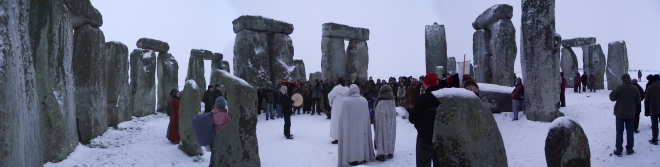
Solstice celebrations – marking the shortest day and longest night of the year – happen right across the UK. But one of the focal points for the festivities will always be the prehistoric monument of Stonehenge. Each year, thousands descend on this field in Wiltshire to see the sun rise above the stones. Expect to see the druid and pagan communities out in full force, dressed in magnificent costumes and singing incantations within the circle. This year, the solstice takes place on 21st December, and you’ll be able to arrive at the monument as soon as the light begins to break.
• english-heritage.org.uk
Burning the Clocks, Brighton
21 December A contemporary winter solstice celebration (and the most modern event on this list), the Burning the Clocks festival was conceived in Brighton in 1994 as a community event to be enjoyed, regardless of faith, and it takes place on the beach. Around 20,000 spectators turn up to witness the procession of light, which consists of a parade of luminous willow lanterns that are passed into a blazing bonfire. The event concludes with a huge fire show and firework display that lights up the seafront. •Parade starts 6.30pm, samesky.co.uk
Kirkwall Ba game, Orkney
25 December and 1 January The Ba is an annual custom in which hundreds of men and boys take to the streets to embark on a medieval football match. It has been described as more like a “civil war” than a game. Windows are boarded up in preparation for the self-refereed melee in Kirkwall, capital of the Orkneys. The two teams – the Uppies and the Doonies – battle for control of the leather “ba’”, attempting to wrestle it towards the areas of the town designated as the goals. Ribs have been broken in the scrum, but the event has a festival spirit that unites the entire town. •Starts at the Mercat Cross on Kirk Green, free, discover-orkney.co.uk/the-ba
Grantchester barrel rolling, Cambridgeshire
26 December One of many bizarre British Boxing day traditions, the Grantchester barrel rolling race is, well, pretty much as you’d imagine. Four local teams roll large wooden barrels up and down the street in a relay race, which is followed by the “County Championship” race between teams from Grantchester and nearby villages of Barton, Coton and Newnham. Founded in the 1960s, the race fell out of favour until it was revived in 2003 and, in keeping with most trivial pursuits, concludes with a booze-up at the local Rupert Brooke pub. • Coton Road, Grantchester, free, grantchester.org.uk
Keynsham Mummers play, Somerset
26 December A bit like pantomimes, mummers plays are comic folk performances that have been performed around Europe since the Middle Ages. The tradition is kept alive by the likes of the Bristol Morris Men, who have performed the play every Boxing Day in the town of Keynsham since the idea was revived in the late 1970s (though records suggest the play originated in the town in the early 19th century). Expect melodrama, sword fighting and colourful costumes. •11am at St John’s Church, 11.30am at Keynsham Library, midday at the New Inn, bristolmorrismen.co.uk
Fishermen vs Fireman football match, North Yorkshire
26 December Nothing brings out the competitive spirit like a game against the local rivals. In Scarborough, the Boxing Day football match is a chance for local fishermen and firemen to thrash it out – in fancy dress – on the beach. One of the town’s oldest surviving customs, there’s evidence of the match taking place on the South Bay beach back in 1893. It started as a way of raising money for the families of four fishermen lost at sea, and now supports elderly or unwell people in the community. •South Bay Beach, 10am, free, discoveryorkshirecoast.com
Stonehaven Fireballs, Aberdeenshire
Photograph: David Robertson / Alamy/Alamy
31 December
As this Stonehaven Fireball Association states proudly on its website, come rain, snow or storm “we have never cancelled”. This hardy 150-year-old fire ceremony is held on Hogmanay in Stonehaven, and is watched by thousands. When the Town House bell strikes midnight, the ceremony begins, with firedancers, known as “swingers”, making their way down the street, led by drummers and the Stonehaven Pipe Band and finishing with a firework display on the harbour. •Free, stonehavenfireballs.co.uk
Allendale Tar Barl festival, Northumberland
Photograph: Matthew Lloyd/Getty Images
31 December Setting whisky barrels full of tar alight is certainly one way to warm up on a winter’s evening. In existence since the dark ages, the Allendale Tar Barl festival is another fiery event, consisting of a Pagan ceremony led by “guisers” – an hereditary team of 45 barrel carriers in traditional costumes. Whisky barrels filled with flaming tar are paraded across the town, before being thrown on to a huge bonfire. •Free, visitnorthumberland.com
The Haxey Hood, Lincolnshire
Smoking the Fool … a fire is lit under the Fool who makes a welcome speech before officially starting the Haxey Hood.Photograph: Christopher Thomond/the Guardian
6 January And on the 12th day of Christmas … a man with a feathery hat tried to smuggle a leather tube into his local pub. The event, in the parish of Haxey, north Lincolnshire, is not unlike the mass rugby/football games that take place in various parts of the country where there are far more participants than rules – a large, chaotic match in which locals try to manoeuvre the leather “hood” to one of four pubs. The game, which can go on well into the evening, ends once the hood arrives at a pub, where it remains until the following year. •Free, wheewall.com/hood
Whittlesea Straw Bear festival, Cambridgeshire
9-11 January If anything is going to help lift the spirits above the dreary grind of January, it’s a man dressed head to toe in straw, dancing to folk music. This Cambridgeshire festival includes barn dances and concerts, as well as a procession through the streets on Saturday with teams of Morris dancers and, of course, the belle of the ball: the straw bear. Come Sunday, however, the bear costume will go up in smoke during the “bear burning” ceremony, a symbolic act to leave the way open for the new harvest … and a new bear. •Concert and barn dance £10, daytime events free, strawbear.org.uk
A new breed of fixers for the itchy-footed are offering made-to-measure trips tailored to a client’s pocket, pace and passions, writes Tim Pile
United States President Barack Obama takes an unscheduled stroll through prehistoric Stonehenge, in Wiltshire, England, in September. Photos: AFP; Corbis; Morukuru Ocean House – South Africa
On his way home from a recent Nato summit in Wales, Barack Obama made an unannounced stop at Stonehenge. The prehistoric monument closed early so that the president of the United States could soak up the atmosphere without being gawked at by day-trippers. He was given a personal tour by an English Heritage curator before continuing his helicopter journey to London. Describing the ancient stone circle as “cool”, Obama told reporters that he had “knocked it off his bucket list“.
The president’s sightseeing sortie might seem beyond the reach of ordinary mortals but his stopover was merely a high-profile example of a global tourist trend.
A growing number of tour operators specialise in putting together one-of-a-kind adventures. Like buying a tailor-made suit, discerning clients – many of whom have been there, done that, and bought the vineyard – are willing to pay for a “made-to-measure” experience. Add a whiff of one-upmanship and it’s easy to understand why this sector of the tourism industry is becoming increasingly popular.
The high-end holiday market encompasses a pigeonhole-defying range of possibilities. A customised itinerary can mean gaining entry where doors are usually closed while neatly sidestepping the tourist herds. The best companies can fix up tee times on a Ryder Cup golf course or charter you a steam train in India. They’ll arrange for a historian to accompany you around first world war battlefields or set up a meeting with the president of the Maldives to hear how climate change is affecting the low-lying archipelago.
Firms that put together special-interest programmes usually give clients the opportunity to unpick and reassemble itineraries to suit individual tastes. Perhaps you’re fed up with arriving at all the best sights at midday, leaving you with overexposed, washed-out photos. Someone a phone call away will be happy to tweak the tour so that you arrive in Vienna for sunrise and Budapest for sunset.
Regardless of background, age, nationality or any other individual feature, it’s up to every one of us to do our part in limiting mankind’s carbon footprint and subsequent impact on the environment. This means really thinking about how we use energy and which companies we give our business to; typically, these slight changes of lifestyle begin at home – but they should also be considered when you’re planning your holiday.
A visit to Stonehenge fits in well in conjunction with an eco-holiday. After all, although the details of how and why Stonehenge was built remain largely a mystery, the site seems to somehow be in tune with the earth, as if the monument speaks to an age when mankind lived in harmony with the natural world rather than actively harming it to irretrievable levels. This is why the recent Stonehenge includes using the site as a place for Pagan worshippers to celebrate the natural world. Since the 1870’s, the site has been visited by Neo-Druids who revere the earth as the giver of life. If you visit Stonehenge during the summer solstice you’ll see followers of all faiths who worship nature; Stonehenge, it seems, is one of the best places in Europe to really feel the power of the natural world.
With that in mind, we thought we’d put together some information that will enable you to make your trip to Stonehenge as ecologically conscience as possible.
Getting Here
A welcome fact about eco-holidays is that they’re rarely as expensive as you might think; they just need to be researched a little more thoroughly than a traditional vacation. To begin with, it’s worth noting that travelling by cruise is actually more damaging to the environment than flying (though cruise ships are trying to improve). Flying is also damaging, but improvements to aircrafts and less travel time means the impact is reduced, at least.
If you’re travelling to the UK specifically to see Stonehenge, then the most logical way to reduce your carbon footprint is to fly into one of the airports and prevent any need to a long drive to the site. Southampton Airport is only 26 miles, whilst the larger Bristol Airport is 53 miles away. The closest airport in London is Heathrow, which is 73 miles away.
If possible, reduce your carbon footprint by traveling to Stonehenge on our tours that depart from London. This way, there’s no need to rent multiple vehicles, which could be both expensive and unnecessarily damaging to the environment, especially if there is more than 5 of you on the tour.
Where to Stay
The hotel industry has made a big effort in recent years to implement strategies that would reduce environmental damage. The result is a whole host of modern hotels that feature innovative designs that don’t compromise on comfort but do protect the environment. When booking your accommodation, have a look at hotel’s environmental policy; if they don’t have one, consider giving your busy to one that does – hotels that lag behind will soon catch up if their lack of policy negatively affects business.
There are a number of hotels near Stonehenge that are considered “green”. The Holiday Inn Salisbury, for instance, holds a Silver Award from Green Tourism, while the Fairlawn Hotel is just 10 minutes from Stonehenge and has worked out to make sure their as eco-friendly as they can be, by implementing policies such as using local suppliers, recycling and reducing paper, and using compost in the garden.
Alternatively, those visitors who love the outdoors might find that camping is the best accommodation for them. Staying at Stonehenge Campsite means you’re just 5 miles from Stonehenge and as in tune with the natural environment as you can be prior to visiting the monument.
Respect the Environment
Not all tour operators treat Stonehenge with considered respect. With Stonehenge tours, you can rest assured that you’re travelling with a company that respects the values of Stonehenge and the environment at large.
But that doesn’t mean you don’t have a role to play. The best way to protect the environment – whilst in it – is to be vigilant about your interaction with it. This means taking your litter with you, being mindful of the delicacy of the infrastructure, and making sure that Stonehenge remains a sacred place. Generally, the best policy to adopt is: ‘take nothing but photographs, leave nothing but footprints’.
Be at Home
The most basic method of being ecologically minded when visiting Stonehenge – and elsewhere, for that matter – is to follow the same fundamental rules that you’d follow at home. This means switching off lights and other electrical items in your hotel room when not in use, timing your showers to limit water use, and using the air-conditioning/heating responsibly.
From Neolithic stone circles to gothic cathedrals, history is all around us. So hit the road and get up close to the ancestors
Stonehenge is an important stop on any tour of historic sites. Photograph: Getty Images
There is no substitute for seeing where history took place. Sure, you can read about events past, but bringing them to life can only really be done in situ. So why not hit the road and pay a visit to some of the UK’s most significant historic sites? Here’s our pick of the best itineraries.
Early civilisation Next year marks the 800th anniversary of the signing of Magna Carta at Runnymede in 1215, the basis of our modern democracy. Only four copies remain of the Great Charter, one of which is in Salisbury cathedral. Start your journey here and climb the country’s tallest spire. Walk out into the Meadows to gaze back at the cathedral as John Constable did when he painted Salisbury Cathedral from the Meadows in 1831.
It’s a short drive out into the Wiltshire countryside to Stonehenge. The ancient stone circle has a new visitor centre, which explores the many theories surrounding its mysterious creation, possibly as long ago as 2500BC. Don’t miss the nearby village of Avebury, which is surrounded by three circles of standing stones, and the Neolithic chambered tomb of West Kennet Long Barrow, which dates from about 3650BC.
Drive on to Bath, your final stop, to see the Roman Baths and experience the healing geothermal waters for yourself at the fabulous Thermae Spa. Here you’ll find an open-air rooftop pool to contemplate it all from.
Visit the longest continuous section of Hadrian’s Wall still standing.Photograph: Getty Images
Along the wall Carlisle has long been strategically important, close to the border with Scotland, and was once on the very outermost edge of the Roman Empire. As a result there is plenty of history here. See the city’s timber-framed Guildhall and visit the 12th century cathedral, one of England’s smallest, before taking a walk around Carlisle Castle, which has 1,000 years of military heritage and is also where Elizabeth I kept Mary, Queen of Scots, as her “guest” in 1568.
Drive out of the city on the A69, which hugs Hadrian’s Wall all the way to Newcastle upon Tyne. Stop first at Birdoswald Roman Fort, where you can see a model of the wall as it appeared when complete, as well as the longest continuous section of it still standing today. Next up is Vindolanda, home to the Vindolanda tablets, the oldest surviving handwritten documents in Britain, and a world-class museum of Roman objects.
From here, it’s just 45 minutes to Newcastle upon Tyne, with its 12th century castle keep and ancient cathedral. It is better known, though, for its vibrant cultural scene, so don’t miss Baltic, a contemporary art gallery housed in a converted flour mill.
The ancient village of Skara Brae on Orkney.Photograph: Getty Images
Ancient treasures History doesn’t get more potent than on Orkney, where a cluster of hugely important Neolithic sites stand against a dramatically beautiful landscape.
Pick up a car in Kirkwall and make the short drive out to Maeshowe, the most impressive Neolithic burial chamber in a landscape dotted with them. The guided tour is fascinating, with tales of 12th-century Viking raids (and graffiti) and the jaw-dropping explanation of how at the winter solstice the tomb is aligned perfectly to the rays of the sun.
The nearby lochs of Stenness and Harray are separated by promontories that once formed the heart of Orkney’s Neolithic ceremonial complex. Today the standing stones of Stenness remain, along with the Ring of Brodgar – originally 60 stones, now 27.
Drive on west to the Bay of Skaill and the amazingly well-preserved village of Skara Brae. This 5,000 year-old settlement was buried until a fierce storm uncovered it in 1850, revealing dwellings with everything from beds to fireplaces, cupboards to tables. Add a roof and you could happily live here.
Oxford is home to some of England’s finest architecture.Photograph: Getty Images
Spires and spies Oxford is known for its “dreaming spires” and the university city is home to some of England’s finest architecture. Top pick is Christ Church College, where Christopher Wren’s imposing Tom Tower lords it over the city’s largest quad, surrounded by honey-hued stone buildings that are photogenic from any angle. Don’t miss seeing the Radcliffe Camera, an 18th-century rotunda that forms part of the Bodleian Library, the country’s largest after the British Library.
From Oxford, it’s an easy drive to Bletchley Park, once Britain’s best-kept secret and today home to the world’s largest collection of Enigma code-breaking machines. Explore the Second World War code-breaking huts and discover the life and work of pioneering computer scientist Alan Turing in the exhibition.
Drive on to Cambridge, where yet more spires and college quads await. The most imposing is King’s College, where the chapel represents the zenith of gothic architectural design, with four spiky turrets and copious stained-glass windows.
Stonehenge Winter Solstice Tour:
Each year in December visitors from around the world gather at Stonehenge early in the morning to mark the Winter solstice and to see the sunrise above the stones. The sunrise on the 22nd of December at 8.04am. We will be there for sunrise!
The Winter Solstice is the most important day of the year at Stonehenge and a truly magical time to be there. It’s an ad hoc celebration that brings together England’s New Age Tribes (neo-druids, neo-pagans, Wiccans) with ordinary families, tourists, travellers and party people – 100’s of them! http://stonehengetours.com/stonehenge-winter-solstice-tour.htm
English Heritage will once again welcome people to Stonehenge to celebrate the Winter Solstice. Sunrise is just after 8am on Monday 22nd December and visitors will be able to access the monument as soon as it is light enough to do so safely. Conditions of entry will be posted shortly.
Please be aware that parking is very limited and there is a thirty minute walk, in low light, from the parking areas to the monument.
Why 22nd December?
Many people – not least diary manufacturers – believe that the Winter Solstice always falls on 21st December. But the celebration of the winter solstice at Stonehenge is not fixed to a specific calendar date – this is because of a mismatch between the calendar year and solar year. (The actual time of the Winter Solstice this year is on December 21st at 23:03 GMT)
Visitors to Stonehenge are being invited to step through the doorways of its Neolithic houses and into prehistory this winter as expert-led events and demonstrations are offered for the first time.#
Full programme of events and demonstrations:
Making Musical instruments
Sat 15 – Sun 16 Nov & Sat 24 – Sun 25 Jan, 10am–4pm
See Corwen Broch as he creates instruments from natural materials and demonstrates the sounds
of the Neolithic period.
Prehistoric Pottery
Sat 22 – Sun 23 Nov and Sat 20 – Sun 21 Dec, 10am–4pm
Using a handling collection of replica pots, tools and artefacts, Graham Taylor will show you how to make your own pottery tool kit, decorate replica pots as well as how to fire them using authentic prehistoric methods.
Fire & Life
Sat 6 – Sun 7 Dec, Sat 10 – Sun 11 Jan and Sat 14 – Sun 15 Feb, 10am–4pm
Don’t forget that your daylight saving time ends tomorrow, 2nd November, at 2am local time. Here in Britain the clocks went back last Sunday. Sad to say our Druid and Megalithic Clock Adjusters are still rearranging some of our larger stone circles. Meanwhile, the debate intensifies as to whether or not to stay on British Summer Time all year-round or to continue being plunged into darkness at around 5pm for the next few months.
Now You Can Explore the Sights and Sounds of Stonehenge on Your iPhone
Stonehenge has been mystifying people for quite a long time, but getting to the massive circle of standing stones could pose a problem for many. Happily, the Stonehenge Experience app for iOS tackles this problem with gusto, aiming to bring you the sights and even the sounds of Stonehenge regardless of where you may be.
The app was released earlier this month for iPad, iPhone, and iPod touch by Ribui Ltd. Once activated, the app goes through several interactive vignettes explaining the arrangement of the stones, when they were erected, how we think the pillars were constructed, and so on. It’s sort of like a virtual tour of the site, being narrated by an unseen woman with a fabulous British accent.
Though the idea of a tour-in-your-pocket might sound disappointing, each “section” of the tour is interactive in some way. You can pinch and slide your view around all of the presentations, and scrub the slider back and forth to advance. In some cases, this moves time backward and forward on screen, causing stones to rise up out of the ground or the sun to move across the sky. You can also jump straight to a menu that allows you to access each segment at your leisure.
In addition to the stones themselves, the app also encompasses several nearby sites, including burials and earthworks. These are presented, Google Maps fashion, from the menu page. While light on information, the app lets you “excavate” some of these sites by swiping your finger across the screen. This is kind of silly, but does introduce the user to some of the region’s permanent residents.
By far, the most impressive feature of the app is a 360º view of the stones from within the circle. It’s designed to deliver an alternate-reality experience, where moving your phone or iPad around changes the view. That’s pretty neat, but the Stonehenge Experience goes a step further and uses your device’s built-in microphone to deliver what the app’s creators claim is the sensation of hearing what it’s like within the stones. One of the apps designers explains:
This is by far the most fun part of the app, which seems kind of silly since it’s just an audio filter. However, it adds a level of interaction that’s surprisingly fun
Having never been to Stonehenge, I can’t say if the app lives up to its claims of faithfully recreating the entire experience. However, I can say that I had an enjoyable time playing around with it. The actual educational content of the app seemed pretty on-mark, although I am far from an expert. That said, the $2.99 price point might seem a bit steep for a little toy like this, with limited re-use value.
If you’re looking to experience Stonehenge on a phone, I am not sure you can do much better.
We are now taking bookings for December 2014. We have our regular classic Christmas sightseeing coach tours and some new exclusive trips on offer this festive season. Some day tours are now including the fabulous Salisbury Christmas market and carols in Salisbury Cathedral this year. Other tours include Bath, Windsor, The Cotswold’s and some include traditional pub lunches. While the weather may be getting cooler, London’s Christmas season is just warming up. England acquires a special sparkle around Christmas time. The weather is frosty and the Christmas lights are twinkling. England is a truly magical place to explore at Christmas
Stonehenge Sunrise Access Viewing Tour – December 19th 2014
We have arranged with English Heritage for you to experience a unique guided visit to this ancient sacred site – beyond the fences and after the crowds have gone home. Walk amongst the stones and experience the magical atmosphere within the inner circle. Include’s Bath and Lacock. Click here
Stonehenge Solstice Sunset Viewing Tour – December 21st 2014 The Winter Solstice is the most important day of the year at Stonehenge and a truly magical time to be there. Exprience the new English Heritage visitor centre and witness the sun setting plus Avebury Stone Circle and Salisbury Catthedral / Christmas Market. Click here
Stonehenge Winter Solstice Sunrise Access Tour – December 22nd 2014 The Winter Solstice is the most important day of the year at Stonehenge and a truly magical time to be there. Witness the sun rising from within the inner circle of Stonehenge at dawn. Click here
Stonehenge, Windsor Castle and the Roman Baths – Christmas Eve (24th) See the ancient monoliths at Stonehenge, visit the magnificent Windsor Castle and the Georgian City of Bath, where we visit the Roman Baths. Click here
Stonehenge, Windsor and Bath with traditional pub lunch – Christmas Day
Luxury coach tour with professional guide
Explore the heart of England on Christmas day & see Royal Windsor, historic Stonehenge and Georgian Bath. Plus enjoy a festive lunch in a classic British country pub with Roast Turkey and all the trimmings! Includes festive pub lunch – Click here
Stonehenge and Bath with fish and chips pub lunch – Boxing day(26th) December 2014 With Champagne reception and lunch included
See Windsor, Stonehenge, Salisbury and Bath all in a day. Includes Champagne reception at Windsor, fast track entrance at Stonehenge and a classic country pub lunch. Fast track entrance at Stonehenge –Click here
Stonehenge, Windsor and Bath – NEW YEARS DAY(1st January 2015)
All entrance fees included
Prehistoric Stonehenge, Elegant Bath and Royal Windsor all lined up for a fabulous New Year! Includes Festive Lunch – Click here
27th – 31st December Tours
During this festive period between the 27th and 31st of December, we are pleased to provide our full range of tours whether its a London sightseeing tour or a visit to Stonehenge
THIS BLOG claims no credit for any images posted on this site unless otherwise noted. Images on this blog are copyright to its respectful owners. If there is an image appearing on this blog that belongs to you and do not wish for it appear on this site, please E-mail with a link to said image and it will be promptly removed.
We do not operate any guided tours. This is 3rd party Blog and all posts are published by freelance independent bloggers with complimentary links to www.StonehengeTours.com Please contact us direct with any queries.
FREE BLOG TRAFFIC We create high-quality, long-form content optimized for search engines (SEO) and promote it across social media platforms and relevant online communities like Reddit and Quora and direct links to your website. We help build an email list to drive consistent traffic, and repurpose your content for different platforms such as YouTube or podcasts. Collaborating on relevant guest posts and being a guest on podcasts can also introduce your blog to new audiences, whatever the industry.







 Stonehenge Guided Tours