Uncategorized


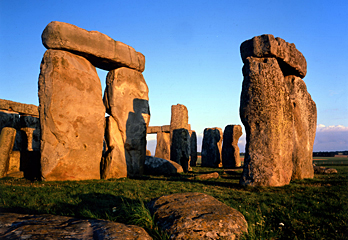
>STONEHENGE has been given a £10m boost, thanks to the Heritage Lottery Fund, it has been revealed.

The grant will support work to remove the existing visitor facilities allowing the experience of the stones to be more naturally integrated with its ancient processional approach and the surrounding landscape.

These improvements will give people the chance to explore what the site would have been like thousands of years ago.

The project aims to improve the visitor experience, including the creation of a new carefully designed visitor centre which will include education and exhibition spaces to help people learn more about Stonehenge’s history.

The project will also support training opportunities and a new volunteering programme.

Dame Jenny Abramsky, Chair of the Heritage Lottery Fund, said: “Stonehenge is one of the archaeological wonders of the world. It demonstrates the vital role heritage plays within the UK’s tourism industry as well as being a great example of our fascinating history.
“This Heritage Lottery Fund investment will help transform this site and give people a much greater understanding of why it is so significant.”

http://www.english-heritage.org.uk/
http://www.stonehenge-stone-circle.co.uk/


Stonehenge Tourist Guide

>The English Heritage Travel Collection – 2011 Ancient Wessex Tour
Dates: May 6–8, 2011
Erected between 3000 and 1600 BC, Stonehenge is the most eloquent testimony to the once dominant civilisations of the Stone and Bronze Ages. And what better way to unravel the mysteries of Stonehenge’s innermost circle than on a private tour in the company of an expert from English Heritage?

Stonehenge inner circle tour

Working in partnership with English Heritage, ACE has developed an exclusive portfolio of historical tours and cruises in Great Britain and Europe. Each tour offers a unique blend of cultural sight-seeing and explanatory talks, all under the guidance of an expert and experienced course director.

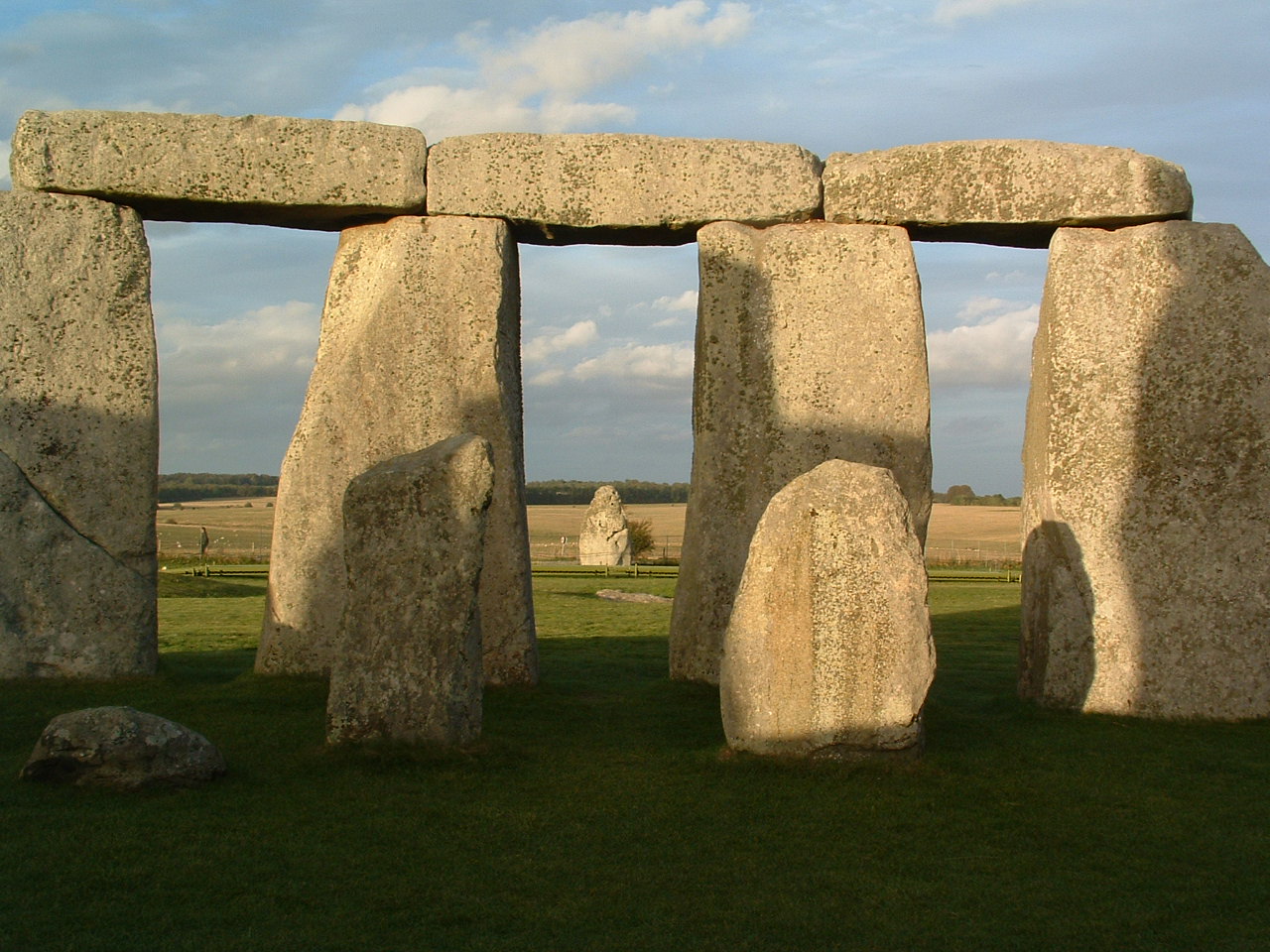
As well as inspecting Stonehenge’s antique trilithons at close hand, our early morning visit will reveal how recent excavations have radically altered interpretations about this most monumental of temples.

The ceremonial landscape that lies around Stonehenge is richly suggestive of Wessex’s ancient patrimony: we will explore the Great Cursus, the henges of Durrington Wall and Woodhenge, and a handful of the great Bronze Age barrows that bestride the surrounding hills.

The majestic façade of West Kennet chambered long barrow, framed by two enormous quarry ditches, was constructed around 3650 BC – some four centuries before the first stones were raised at Stonehenge. Immediately to the west lies Avebury, the world’s largest pre-historic stone circle, further graphic confirmation of the outstanding engineering skills of our megalithic ancestors.

We stay in Salisbury at the 17th century three-star White Hart Hotel overlooking the famous mediaeval cathedral.

Itinerary

Day 1 Course assembles 1600 for two nights at Mercure White Hart Hotel, Salisbury. Evening: sherry reception followed by course introduction.
Day 2 Early morning privileged visit to Stonehenge (inner circle) followed by Neolithic henge monuments of Durrington Walls and Woodhenge, Stonehenge Cursus, King Barrows (unexplored Bronze Age barrows), Stonehenge Avenue (ceremonial approach). Evening talk.
Day 3 Avebury Henge (huge earthwork enclosing three stone circles), Silbury Hill (largest man-made mound in Europe), West Kennet long barrow (early Neolithic chambered tomb). Course disperses 1700 at hotel.

Cost
Cost of £490 includes: accommodation based on sharing a twin or double bedded room, drinks reception, breakfast, two packed lunches & two dinners, special entry to Stonehenge, excursions & admissions (except English Heritage properties for non-members).

Click here for further details and to make a reservation:

@import “http://www.partner.viator.com/modules/widgets/css/niftycorners.css”;@import “http://www.partner.viator.com/modules/widgets/css/widgets.css”;#viatorWidgetDiv_1ed1e7cd { color: #ffffff; font-family: ‘Arial’; font-weight: bold; }#viatorWidgetDiv_1ed1e7cd .widget_header { background-color: #e4d8be; color: #141414; font-family: ‘Arial’; font-weight: bold; }#viatorWidgetDiv_1ed1e7cd .widget_body { background-color: #141414; }#viatorWidgetDiv_1ed1e7cd .widget_horizontal .widget_entry { background-color: #141414; width: 131px; }#viatorWidgetDiv_1ed1e7cd .widget_product_title{ color:#ffffff; }#viatorWidgetDiv_1ed1e7cd .widget_more_info{ color:#ffffff; }

initViatorWidgetDiv(‘1ed1e7cd’);

For other similar tours you could try The Stonehenge Tour Company or for private guided tours you could try HisTOURies UK based in Salisbury and Bath.  For more information on Stonehenge try The Stonehenge Stone Circle Website

Stonehenge Tour Guide

>

Stonehenge Access Tours – A unique opportunity!

2011 Stonehenge Private Access Dates released.If you are planning to visit Stonehenge Stone Circle in 2011 then plan ahead and book a special ‘inner circle’ access tour

Book an exclusive private viewing of Stonehenge. Stepping inside the “inner circle of stones” is a once-in-a-lifetime opportunity. Tickets are limited and each group consists of 26 (morning) or 40 (afternoon) with your own guide. With a choice of sunrise or sunset viewings, and private access to the inner circle of stones, your visit to Stonehenge is sure to be a memory you’ll cherish. As an added bonus, you’ll avoid the huge crowds.


Private Viewing of Stonehenge – Click here to book

Most visitors to Stonehenge are not allowed direct access to the stones. On this special day trip from London, you’ll be invited to enter the stone circle itself, and stand beside the mysterious rocks towering above you. Your guide will unlock the secrets of this ancient UNESCO World Heritage Listed monument. Enjoy the peace, away from the crowds, as you experience Stonehenge at its atmospheric best at sunrise or sunset. Availability is strictly limited so book early, as private viewings regularly sell out and operate on selected days in 2010/2011 only.

Lacock
Lacock is one of England’s most picturesque villages, dating back to the Saxon era. The village has provided the setting for many movies and television dramas, including Jane Austen’s Pride and Prejudice and Harry Potter and the Philosopher’s Stone. Take a walk before enjoying an early evening meal (or breakfast for sunrise departures) in the George, a vintage English pub built in 1361. Note, meals are at your own expense.

Bath
Bath is beautiful Georgian city, and also on the UNESCO World Heritage List. Its most celebrated resident is Jane Austin, and Bath was her birthplace and inspiration for several novels. You’ll have time to visit Bath Abbey and the magnificent Roman Baths, or simply shop and explore. You also have the option of taking a walking tour to see where Charles Dickens lived and worked as a young man, and to sample fresh cheeses from the local dairy

@import “http://www.partner.viator.com/modules/widgets/css/niftycorners.css”;@import “http://www.partner.viator.com/modules/widgets/css/widgets.css”;#viatorWidgetDiv_a5029e4d { color: #ffffff; font-family: ‘Arial’; font-weight: bold; }#viatorWidgetDiv_a5029e4d .widget_header { background-color: #ffc61f; color: #000000; font-family: ‘Arial’; font-weight: bold; }#viatorWidgetDiv_a5029e4d .widget_body { background-color: #666666; }#viatorWidgetDiv_a5029e4d .widget_horizontal .widget_entry { background-color: #666666; width: 450px; }#viatorWidgetDiv_a5029e4d .widget_product_title{ color:#ffffff; }#viatorWidgetDiv_a5029e4d .widget_more_info{ color:#ffffff; }

initViatorWidgetDiv(‘a5029e4d’);

If you prefer not to travel as part of a group you could always organise a private tour that include access into Stonehenge inner circle – ideal for families and small groups.   The ‘StoStonehenge Tour Company’ have an excellent record with many years experience – click here

Stonehenge Tourist Guide

>ONE of the world’s leading experts on Stonehenge discovered his passion for archaeology as a child in his Cheltenham back garden.

Professor Timothy Darvill has been awarded an OBE, in this year’s Queen’s Birthday Honours List, for services to archaeology. He is a leading expert on prehistoric Britain.

He said it was a “great privilege” to receive the honour from the Queen earlier this month at Windsor Castle and thanked his colleagues, friends and family.

“I have always been passionate about archaeology and feel fortunate to have contributed to so many amazing projects that have revealed such a great deal about our nation’s history and heritage,” he said.

Born and bred in Cheltenham, Prof Darvill has been passionate about archaeology since he was a child, according to his mother Win Darvill.

“He has always been interested from when he was a small boy. He used to dig holes in the garden all the time,” she said.

“His father, who was a civil engineer, was interested in fossils and passed it all on to Timothy and it went from there.”

The family lived in the Battledown area and Mrs Darvill now lives in Pittville.

Timothy Darvill is now a professor at Bournemouth University.

Mrs Darvill said: “When he was in his teens he was always either involved in archaeology in Cirencester or on field walks. It has always been his passion. I could not believe it when he was awarded the OBE but I am so proud.”

She said her son grew up in the right area to find all kinds of interesting landscapes.

But he developed an interest in Stonehenge from a young age too.

“He has done a lot of work on it and written many books about it. I read them but I wouldn’t like to write an essay on them,” she said.

The author of more than 20 books and 200 papers and articles, Mr Darvill famously co-directed the first excavations within the stone circle at Stonehenge for more than 40 years in April 2008.

His work featured in a BBC Timewatch programme, which examined the theory that Stonehenge was a prehistoric centre of healing.

After completing a PhD at Southampton University on the Neolithic of Wales and the west of England, he worked with the Western Archaeological Trust and the Council for British Archaeology before establishing a private practice offering consultancy services in the field of archaeological resource management.

In October 1991, he was appointed to the chair of archaeology in the newly-established archaeology group at Bournemouth University and led the Monuments at Risk survey commissioned by English Heritage in the mid 1990s and has worked in Russia, Malta, Greece, and Germany. He is chairman of the board of directors of Cotswold Archaeology, one of the top archaeological companies in the UK, and vice-president of the Society of Antiquaries of London.

Stonehenge Tourist Guide

>There are a number of operators offering sightseeing coach and bus tours this Christmas and New Year 2010 / 2011. Please see below for a list of discounted trips.

@import “http://www.partner.viator.com/modules/widgets/css/niftycorners.css”;@import “http://www.partner.viator.com/modules/widgets/css/widgets.css”;#viatorWidgetDiv_3cd87065 { color: #ffffff; font-family: ‘Arial’; font-weight: bold; }#viatorWidgetDiv_3cd87065 .widget_header { background-color: #ff0000; color: #FFFFFF; font-family: ‘Arial’; font-weight: bold; }#viatorWidgetDiv_3cd87065 .widget_body { background-color: #666666; }#viatorWidgetDiv_3cd87065 .widget_horizontal .widget_entry { background-color: #666666; width: 42px; }#viatorWidgetDiv_3cd87065 .widget_product_title{ color:#ffffff; }#viatorWidgetDiv_3cd87065 .widget_more_info{ color:#ffffff; }

initViatorWidgetDiv(‘3cd87065’);

Stonehenge Tourist Guide

>English Heritage claims it owns every single image of Stonehenge, ever………………

SteveMars sez, “Every photo image library got this by email today. ‘We are sending you an email regarding images of Stonehenge in your fotoLibra website. Please be aware that any images of Stonehenge can not be used for any commercial interest, all commercial interest to sell images must be directed to English Heritage.’ Here is one image library’s response:”
It’s kind of them to think of us, but this raises a number of questions.
Firstly, what legitimacy do they have for this claim? Is there any law that states that it is illegal to use images of Stonehenge for any commercial interest? Can someone direct me to it?

Secondly, if an image of Stonehenge is so used, how could they possibly police the usage? A quick browse through a number of rights-managed and royalty-free online picture libraries produced the following:

iStockPhoto (a US owned company) has 513 images of Stonehenge
Fotolia (US) has 648 images of Stonehenge
Dreamstime (US) has 670 images of Stonehenge
Shutterstock (US) has 737 images of Stonehenge

All the above sites sell images on a royalty free, unrestricted usage basis. If anyone buys a royalty free image from one of these suppliers then he’ll be using it as, where and when he likes, without asking English Heritage’s permission. How will they stop that?

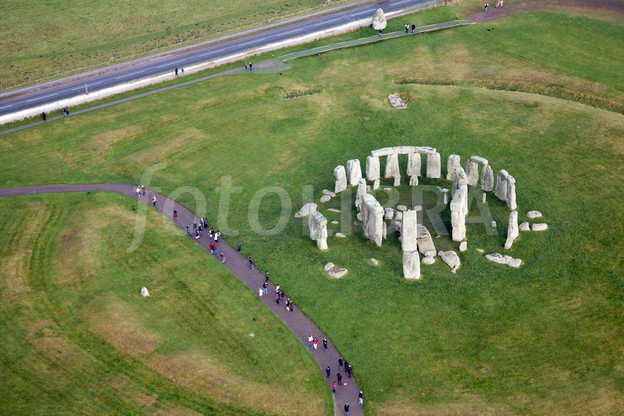
What if we photograph the place from the air? What law can we possibly be breaking here?

While we’re looking at Clive‘s photograph, who built that ugly tarmac footpath cutting through the sacred ring?

Stonehenge Tourist Guide

>Visit the Big Dig!

Wednesday October 13th 2010

Where: Avon Fields: Former MoD Headquarters ,Netheravon Road, Durrington, Witshire

The village of Durrington is well known for its early archaeological heritage, including the largest Neolithic henge in Britain at Durrington Walls and nearby Woodhenge, both over 4500 years old. However, excavations by Wessex Archaeology in advance of the construction of new housing by Persimmon Homes South Coast on the former Ministry of Defence estate offices have started to uncover the remains of a late Iron Age/ Romano-British settlement.

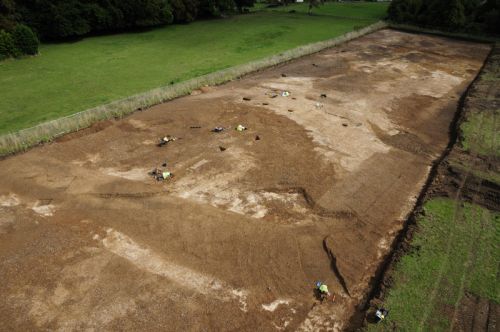
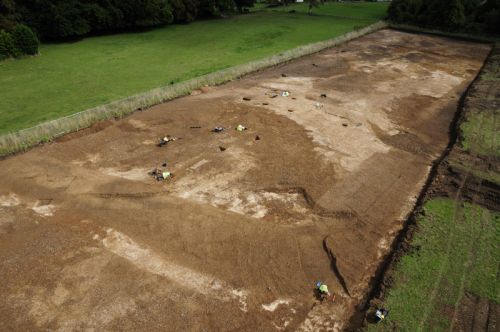
Aerial view of the late Iron Age/ Romano-British settlement at Durrington, Wiltshire

This settlement lies within the north-west corner of the modern village of Durrington and at one time appears to have been surrounded by an enormous ditch over 6m in width and up to 4m in depth. The full extent of the enclosed settlement has yet to been determined, although it is possible- and further work will confirm this- that the enclosed settlement may be of a very substantial size.

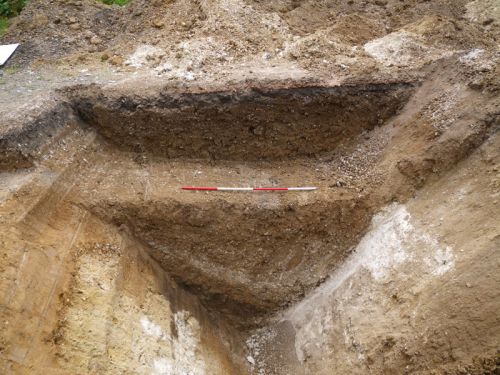
The 6m wide enclosure ditch at Durrington

The excavations appear to be located at the southern edge of the settlement. Although the excavations are at an early stage, a wealth of archaeological features have been found including part of the enclosure ditch, possible granaries, large storage and quarry pits, cremation burials and a corn-drying kiln, as well as traces of earlier prehistoric activity within the site. The excavation is due to continue over the next year and will investigate the nature of this previously unknown settlement, which continued in the later Romano-British period and into the fifth century AD and may have been the first steps in the formation of the medieval estates at Durrington and the origin of the present village.

Come and see what they have found and find out more about the heritage of Avon Fields.

Free site tours Wednesday October 13th 2010 at 3.00pm and 5.00pm.

No booking required.
Please wear boots or sturdy shoes.
For more information please contact Andrew Manning or Margaret Bunyard 01722 326867 begin_of_the_skype_highlighting 01722 326867 end_of_the_skype_highlighting a.manning@wessexarch.co.uk

Stonehenge Tour Guide

>This artcle written by Malanie Philips (Daily Mail) is sure to anger Pagans and the Druid Order
Will someone please tell me this is all a joke. Until now, Druids have been regarded indulgently as a curious remnant of Britain’s ancient past, a bunch of eccentrics who annually dress up in strange robes at Stonehenge to celebrate the summer solstice.

However, according to the Charity Commission, they are to be recognised as a religion and, as a result, afforded charitable status, with the tax exemptions and other advantages that follow.
After a four-year campaign, the Commission says it accepts that the Druids worship nature and that they also believe in the spirits of places such as mountains and rivers, as well as in ‘divine guides’.
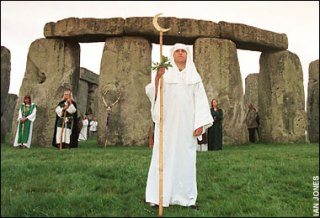
This, apparently, makes them qualify as a religion.
Can it be long before the BBC transmits Stones Of Praise, or solemnly invites listeners to Radio 4’s Thought For The Day to genuflect to a tree?
Some might shrug this off. After all, the Druids don’t do any harm to anyone. What skin is it off anyone else’s nose how they are categorised?
CULT ?
Well, it actually matters rather a lot. Elevating them to the same status as Christianity is but the latest example of how the bedrock creed of this country is being undermined. More than that, it is an attack upon the very concept of religion itself.
This is because Druidry is simply not a religion. Now, it’s true that religion is notoriously difficult to define. But true religions surely rest on an established structure of traditions, beliefs, literature and laws.
Above all, they share a belief in a supernatural deity (or more than one) that governs the universe

By these standards, Druidry is surely not a religion but a cult — a group defined merely by ritual practices but which stands outside mainstream religion.

Nor does it seem to conform to the definition of a religion according to charity law.

When Radio 4’s Sunday Programme suggested yesterday morning to Phil Ryder, chairman of the Druid Network, that the legal definition of religion included a ‘significant belief in a supreme being or entity’, he saw no contradiction. Druids, he said cheerfully, might venerate many gods, inanimate objects or nature.

How very inclusive of them! But the key point is surely that none of these beliefs involves a ‘supreme’ being that exists beyond the Earth and the universe. On the contrary, Druids worship what is in or on the earth itself.

When asked further how Druidry benefited the public interest — the key test for charitable status — Mr Ryder burbled that its ethical framework consisted of forming ‘honourable and sustainable relationships’ with everything in the world, including animals, people and nature.

But there are many who subscribe to no belief system at all and who would say they, too, want to live in harmony with the earth and everything in it. Are they, therefore, also to be regarded as religious folk and given charitable status?

Maybe Prince Charles, who famously talks to his plants, could register himself on that basis as the founder of a new religion? Duchy Devotions, anyone?

If the Druids qualify as a religion, can other cults such as the Scientologists be far behind?
Can it be long, indeed, before the wise and learned theologians of the Charity Commission similarly grant charitable status to sorcery, witchcraft or even the Jedi — the fictional Star Wars ‘religion’ which the 2001 census recorded as having no fewer than 390,127 adherents in England and Wales.
The whole thing is beyond absurd. But it is also malevolent. For it is all of a piece with the agenda by the oh-so politically correct Charity Commission to promote the fanatical religious creed of the Left — the worship of equality.
The Commission was primed by Labour for this attempt to restructure society back in 2006, when charity law was redrawn to redefine ‘public benefit’ as helping the poor.
This put the independent schools in the front line of attack, since education was no longer itself considered a benefit — as it had been since time immemorial — but only insofar as it furthered the ideology of ‘equality’.

Extraordinary

Thus, we have arrived at the extraordinary situation where some of these schools, which have delivered such inestimable benefit to the nation, face the loss of their charitable status, which is to be given instead to people who dance naked around stones and worship the sun.
But the new respectability of paganism cannot be laid entirely at the Charity Commission’s door. For in recent years, pagan practices have been rapidly multiplying, with an explosion of the occult: witchcraft, parapsychology, séances, telepathy and mind-bending cults.
Astonishingly, around 100 members of the Armed Forces now classify themselves as pagans, and a further 30 as witches.
There are thought to be about 500 pagan police officers. A Pagan Police Association has even been set up to represent officers who ‘worship nature and believe in many gods’.
They have been given the right to take days off to perform rituals, such as leaving food out for the dead, dressing up as ghosts and casting spells, or celebrating the sun god with ‘unabashed sexuality and promiscuity’.
Britain’s prison authorities are equally hospitable to the occult: under instructions issued to every prison governor, pagan ‘priests’ are allowed to use wine and wands during ceremonies in jails. Inmates practising paganism are allowed a hoodless robe, incense and a piece of religious jewellery among their personal possessions.

Political correctness gone mad or what? As one disgusted police officer exploded: ‘What has it come to when a cop gets time off so he can sit about making spells or dance around the place drinking honey beer with a wand in his hand?’

Barking
How on earth has our supposedly rational society come to subscribe to so much totally barking mumbo-jumbo?
In part, it developed from the New Age embrace of Eastern beliefs in the inter-connectedness of everything in the universe. The defining characteristic of such faiths is a spirituality which is concerned with the self rather than the world beyond the individual.

These beliefs were, therefore, tailor-made for the ‘me society’ which turned against Biblical constraints on behaviour in the interests of others. They were subsequently given rocket fuel by environmentalism, at the core of which lies the pagan worship of ‘Mother Earth’.
And they were then legitimised by the doctrines of equality of outcomes and human rights — which, far from protecting the rights of truly religious people, aim to force Biblical morality and belief out of British and European public life altogether.
This is because human rights and equality of outcomes are held to be universal values. That means they invariably trump specific religious beliefs to impose instead equal status for all creeds.

But if all creeds, however absurd, have equal meaning then every belief is equally meaningless. And without the Judeo-Christian heritage there would be no morality and no true human rights.
There is nothing remotely enlightened about paganism. It was historically tied up with both communism and fascism, precisely because it is a negation of reason and the bedrock values behind Western progress.
The result is that, under the secular onslaught of human rights, our society is reverting to a pre-modern era of anti-human superstition and irrationality. From human rights, you might say, to pagan rites in one seamless progression.
Anyone who thinks radical egalitarianism is progressive has got this very wrong. We are hurtling backwards in time to a more primitive age**

**Is that such a bad thing ?  Food for though!
Stonehenge Tour Guide

http://www.stonehenge-stone-circle.co.uk/

>

TESTS on teeth from a skeleton of a teenager found buried near Stonehenge suggest they came from someone who grew up around the Mediterranean Sea.

The remains of the youngster – estimated to have died 3,550 years – were found with a distinctive amber necklace.

The conclusions come from analysis of different forms of the elements oxygen and strontium in the skeleton’s tooth enamel.
The teenager, known to archaeologists as the boy with the amber necklace, was found in 2005 about 5km south east of Stonehenge on Boscombe Down.
It was discovered next to a Bronze Age burial mound while roadworks were being carried out.
The findings indicate that a diverse range of people who came to Stonehenge from across Europe.
The findings will be discussed at a science symposium in London to mark the 175th anniversary of the British Geological Survey (BGS).

Stonehenge Tour Guide

>

There’s just time (until the end of the month) to have your say on a formal British document to be submitted to UNESCO laying out, inter alia, how Stonehenge and Avebury ought to be managed.

See http://consult.wiltshire.gov.uk/portal/spatial_planning/consultee_documents/avebury_whs/ (see below)

(You can send your views direct to strategiclandscape@wiltshire.gov.uk )

We have our own views on the matter and here is the submission we have made:

“We note that: “The process of producing the Statement of OUV is not an opportunity to change or add to the reasons for inscription but a chance to distil them into a single document which will be key [to] the World Heritage Property’s protection. It is however possible to reflect challenges which have emerged over the last 25 years as well as changes in the management and protection context.“

In that case, we would like to say that a very obvious “change in the management and protection context“ which has emerged over the last 25 years is the fact that there has been a vast growth, due to the internet, in the number of people nationally and internationally who have a strong personal interest in the WHS and make frequent repeated visits to it and these now comprise the overwhelming preponderance of stakeholders – yet their needs are not addressed in a way which reflects that fact.

Even the introductory remarks of this consultation exercise betray a failure to recognise this reality: “This consultation provides an opportunity for local people, community groups and other organisations to comment on its Statement of Outstanding Universal Value”. The clear message is that unless you are local or a member of a community group or other organisation this consultation is not for you.
Involving and informing the local community or specially favoured groups first and leaving the wider community effectively ignored or disenfranchised is no longer appropriate. In our submission the need to rectify this matter goes to the very heart of both the management and protection of the World Heritage Site and a step-change is overdue.”

** Stonehenge, Avebury and Associated Sites World Heritage Property Statement of Outstanding Universal

This consultation is being hosted on behalf of the Stonehenge and Avebury Steering Committees of which Wiltshire Council is a member.

The Stonehenge, Avebury and Associated Sites World Heritage Property is one of Wiltshire’s greatest assets. This consultation provides an opportunity for local people, community groups and other organisations to comment on its Statement of Outstanding Universal Value. This Statement sets out formally why Stonehenge and Avebury are internationally important and what qualifies them to appear on the World Heritage List. It also sets out how requirements for management and protection of these qualities are being met.

This document is important for the protection of what makes Stonehenge and Avebury internationally significant. It defines the World Heritage Site’s Outstanding Universal Value (OUV). The United Kingdom signed up to protect the OUV of its World Heritage Sites when it ratified the United Nations Educational, Scientific and Cultural Organisation (UNESCO) Convention Concerning the Protection of the World Cultural and Natural Heritage (1972).

The planning system has a very important role in this protection. Planning Circular 07/2009 states clearly the need to protect the Outstanding Universal Value of World Heritage Sites, while the guidance accompanying the new Planning Policy 5 on the Protection of the Historic Environment (2010) identifies the Statement of OUV as a critical resource for local planning authorities in plan-making and reaching decisions relating to the significance of World Heritage Sites. The document will also inform all management decisions which should prioritise the protection OUV as defined in the Statement. Your comments on the Statement of OUV could therefore contribute to protecting the very special qualities of Stonehenge and Avebury for this and future generations.

Since 2007 UNESCO has required a Statement OUV for all new World Heritage Properties. Stonehenge and Avebury were inscribed in 1986. All sites inscribed prior to 2007 are now required to submit retrospectively a Statement of OUV. This must be based on the original reasons for inscription set out in evaluation and decision documents from 1986. The process of producing the Statement of OUV is not an opportunity to change or add to the reasons for inscription but a chance to distil them into a single document which will be key the World Heritage Property’s protection. It is however possible to reflect challenges which have emerged over the last 25 years as well as changes in the management and protection context.

The original documents submitted to UNESCO during the nomination of the Stonehenge, Avebury and Associated Sites World Heritage Property in 1986 can be accessed via this link to the UNESCO website: http://whc.unesco.org/en/list/373/documents/

The Statement of OUV consists of four sections:

Statement of Significance

Statement of Integrity

Statement of Authenticity

Requirements for Management and Protection

The first section, the Statement of Significance, was agreed by UNESCO’s World Heritage Committee in 2008 after a period of consultation and sign off by the Stonehenge and Avebury Steering Groups representing key local and national stakeholders.

We are now due to submit the final three sections:

2. Statement of Integrity
3. Statement of Authenticity
4. Requirements for Management and Protection
We would appreciate your comments to assist us in shaping a robust and comprehensive document.

Please note comments are sought only on the last three sections: integrity, authenticity and management and protection. The first section, the Statement of Significance, has already been agreed by UNESCO’s World Heritage Committee.
Guidance on the UNESCO definitions of authenticity and integrity can be found the World Heritage Operational Guidelines (paras 79 – 89 and Annex 4) which can be found at http://whc.unesco.org/en/guidelines/ Further background information can be found in the management plans for the two halves of the World Heritage Site. They include sections summarising integrity and authenticity as well as the provisions for management and protection

You can access the Stonehenge Management Plan on the English Heritage website via this link http://www.english-heritage.org.uk/daysout/properties/stonehenge/world-heritage-sites/stonehenge-management-plan/

You can access the Avebury Management Plan on the Wiltshire Council website via this link http://www.wiltshire.gov.uk/leisureandculture/museumhistoryheritage/worldheritagesite/aveburyworldheritagesitemanagementplan.htm

Local Wiltshire Tour Guide

« Previous PageNext Page »