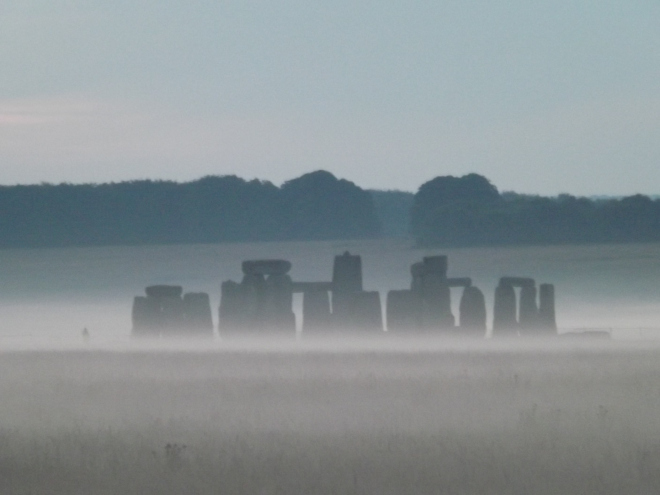
At first it was a blur on the horizon, a small, grey silhouette rising softly into the haze. Grassy meadows dotted with cowslips and grazing sheep rolled around me.
As this prehistoric monument prepares for the summer solstice, Ellie Ross joins a new tour offering an authentic view of the site

As this prehistoric monument prepares for the summer solstice, Ellie Ross joins a new tour offering an authentic view of the site

The silence was broken only by birdsong and the occasional scuff of our boots. The path dipped down into a valley before veering left – and the blur came into focus as that familiar stone circle and one of Neolithic man’s most astonishing achievements, Stonehenge.

Standing proud on the skyline, it was magnificent to behold as I followed the remnants of a parallel pair of ditches and banks. I was walking up The Avenue, the ancient ceremonial approach which once connected Stonehenge to the River Avon and which is aligned with the sunrise of the summer solstice. This is the view people would have seen more than 4,000 years ago, when they trekked up here on the final leg of their journey.

My own journey on foot had begun eight miles south, in the Woodford Valley, where the River Avon criss-crosses verdant wheat fields and dense forest. I had arrived with a group of four other walkers accompanied by David Howell, guide and local historian from the walking specialist Foot Trails.

“We’re out here to enjoy the countryside,” he said, hoisting on a hefty backpack as we prepared to embark on Journey to the Stones, a new monthly guided walk. “Please switch off your phones.”

Within moments my surroundings seemed to burst into life – the smell of wet nettles, the chirrup of skylarks, a butterfly flitting next to my elbow. We crossed a footbridge over the Avon, a tranquil, blue-black stretch that flows from Salisbury Plain to Christchurch in Dorset, 38 miles away.

“The river was an important transport route for ancient man, and played a vital role in the construction of Stonehenge,” David explained.

Not only was the Avon a highway for transporting fish, it is believed the river was used to carry the dolerite bluestones of the inner ring, which came from Wales. Although the exact origins and purpose of Stonehenge have been lost, theories as to why it was built range from human sacrifice to astronomy. But what remains is not what the original builders would have seen, as it is at least the third monument that has stood on this site.

Around 2150BC, it changed from a henge – a ditch and bank of earth – to a monument of growing importance, featuring the bluestones and later huge Sarsens from the Marlborough Downs. Work stopped around 1500BC, leaving the stone circle roughly as it is today.

Shadowing the river, we dropped into dense forest peppered with wild garlic, crossed Lower Woodford with its pretty cottages and thatched cob walls, then paused beside a field of flint.

“There was something special about the position of Stonehenge,” David said, offering around a tin of barley sugars. “We are in a chalk landscape – the flint in these fields is compressed chalk. In prehistoric times, it was easier to travel on the chalk downs than in dense valleys. Stonehenge is a natural junction for England’s chalk downs, where you can move in all directions, but remain high. Being at the heart of this superhighway meant it was an ideal meeting point for people who were dispersed around the landscape.”

We pressed on, taking in views of Lake House, the Elizabethan home of Sting, who recorded “Fields of Gold” there after apparently being inspired by the surrounding barley fields. Climbing steadily, we entered what David called the “sacred heart of the landscape”, punctuated with barrows, or burial mounds, which would once have been white.

As we climbed, a dozen grassy lumps rose out of the downs around us, expanding and contracting as our perspective shifted. Then, a gap on the horizon opened to reveal the distant but unmistakable outline of Stonehenge, bathed in sunlight, about half a mile away. The monument is false-crested, set slightly below the summit, to make it visible both from the valley and from afar.

fter half a day on David’s route, avoiding the busy national trails, we had passed no other walkers, and now I felt like we had the stones all to ourselves. It was the perfect spot for a picnic.

“Most people go straight to the stones or simply drive past them on the A303,” David said, producing a blanket and wonderful bread, cheeses, tea and cake from his backpack. But you don’t see the significance of these barrows without walking through them. As a monument, Stonehenge is so much about its landscape. It was designed to be seen from afar, as well as from inside the stone circle.”

Refuelled, we skirted a wide semi-circle around the stones to see them at different angles. Each time I paused and looked towards them, they appeared different, first short and fat, then tall and thin. But all the while they were mesmerising, a dramatic display of human ingenuity that took more than 30 million hours of labour to create.

After a busy but brief crossing of the unavoidable A303, we traversed a field to join The Avenue bending up from the Avon, turning south-west for our final approach.

Standing in the stone circle, as the shadows hugged the ground, I looked out towards the fields with their lumpy barrows, and down the chalk-strewn Avenue, where the sun will soon rise, marking the summer solstice.

Walking there

Foot Trails (01747 820626; foottrails.co.uk) offers ‘Journey to the Stones’ on the first Thursday of every month, until 6 October. The guided day walk costs £75, including return transfers from Salisbury railway station, picnic lunch, entrance to Stonehenge, the services of a guide – and the occasional fortifying barley sugar. Private guided tours can be organised on request.

More information

Article source: http://www.independent.co.uk/travel/uk/stonehenge-walking-tour-sunrise-and-stones-on-the-horizon-10331290.html

english-heritage.org.uk/stonehenge

The Independent travel offers: Discover a world of inspiring destinations

Stonehenge Guided Tours
The Stonehenege Experts

Book your 2015 sunset or sunrise tour in advance

2015 Stonehenge Access Tours

Stonehenge Special Access tours are available most but not all months of the year, (no visits available in October and November and are not available on and around the Summer Solstice). Evening Special Access is only available in the summer months.

Demand for Stonehenge access tours far exceeds supply, dates are often sold out many months in advance. Do not expect to get tickets without ordering well in advance. Register your interest now by simple sending us your email address and we will offer you 2015 tours before they are published online, giving you the opportunity to secure your preferred travel date. These will include all operators and all itineraries with departures from London, Salisbury and Bath.

Email: Experts@StonehengeTours.com

2015 Private Group Tours
We specialise in arranging customised Stonehenge tours to suit your requirements. Our door to door service will take you wherever you want to go…….at the time and pace to suit you. Our personalised service gives you the ultimate freedom and flexibility without the worry of driving so you can all relax and enjoy the day.

Email: PrivateGuidedTours@StonehengeTours.com

Visit our website for details:

Stonehenge Guided Tours
The Stonehenge Experts
http://www.StonehengeTours.com

Stonehenge Sunset and Sunrise Tour – 2014 Solstice Celebrations

The most famous prehistoric monument in the world, and now a world heritage site, Stonehenge stands alone in the vast empty tract of Salisbury plain. Its origins date back nearly 5,000 years and it has been home to pagan religion and spiritual worship, not to be mention public debate ever since. What was this vast collection of stones intended for? Was it observatory of the moon, a temple to the sun, or an elaborate cemetery? Who were the people who carried and carved these 40 ton rocks? Come and unlock the secrets for yourself and marvel at this remarkable and mysterious feat of ancient engineering and design, as we enjoy the wonderful celebrations that take place to mark the summer solstice.

The Sunset tour :

Mid Summer Sunset

Mid Summer Sunset

Join our Solstice Tour that departs London at lunchtime and heads west towards the site, taking time to enjoy the ancient stones at Avebury, before heading to picturesque Lacock for an early evening supper, included in the price. From here we journey to Stonehenge itself arriving at roughly 7pm, as it begins it’s annual celebration of the summer solstice. Huge crowds gather and there will be plenty of time to soak up the atmosphere of this historic event, walk amongst the stones, and observe the pagan rituals and ceremonies that take place at varying intervals throughout the evening. Please note there are two twenty to thirty minute walks involved during the day in order to see the celebrations at Avebruy and Stonehenge.

The Sunrise Tour:

Join our Premium Tour that departs London at 1am on the 21st June 2013 and heads directly to Stonehenge arriving at roughly 3am. The annual celebration of the summer solstice will be well under way by then as the atmosphere builds towards the sunrise, and the climax of the event. Huge crowds gather and there will be plenty of time to soak up the atmosphere of this historic morning, walk amongst the stones, and observe the pagan rituals and ceremonies that take place at varying intervals throughout the evening. Please note there is a twenty to thirty minute walk involved in order to get from the coach park to the event.

Summer solstice:

The solstice itself is an astronomical event that occurs twice each year as the Sun reaches its highest or lowest excursion relative to the celestial equator, with the sun appearing to have reached its highest or lowest annual altitude in the sky above the horizon.

The word solstice is comes from the Latin sol (sun) and sistere (to stand still), because at the solstices, the Sun, as seen from earth stands still in declination before reversing it’s direction. Thus after the summer solstice the sun does not appear as high in the sky and daylight reduces. The solstice is therefore seen as the midpoint of summer in many cultures and is cause for celebration.

Pagan celebrations:

Like other religious groups, Pagans are in awe of the strength of the sun and the divine powers that create life. For many pagans, they believe that the Goddess took over the earth from the horned God at the beginning of spring and she is now at the height of her power and fertility. The summer solstice marks the marriage of the God and Goddess and see their union as the force that creates the harvest’s fruits. To celebrate many Pagans and non Pagans head to ancient religious sites including Avebury and Stonehenge, to conduct fascinating and colourful ceremonies throughout the night enjoying the last sunset and sunrise before the sun alters it’s direction once more.

Additional information:

Please note that as a responsible tour operator we have a duty of care towards the places we visit and in this case we ask you to be take great care when visiting the historic site. It is important that Stonehenge and its surrounding Monuments are preserved for future generations and we ask you not to touch the stones, and not to leave any litter at the site.

Visitors are requested to dispose of their rubbish carefully at the designated recycling and rubbish points located in the Solstice Car Park and at Stonehenge. Clear recycling bags will also be handed out on arrival.. Please do not drop litter – bag and bin your rubbish so the recycling team can gather them up. It is a very sensitive landscape and still used by local farmers so please respect their crops and livestock.

There are authorised catering facilities on the site and some personal food and drink is allowed to be brought onto the site. Please bring them in a small bag – large rucksacks are not permitted. Glass is not permitted and will be confiscated – many people walk barefoot and the livestock graze in the area throughout the year. A small amount of alcohol is permitted on the site amounting to no more than one bottle of wine, or 4 500ml cans of beer or cider. Please note consumption of alcohol on the coach is not permitted. Due to the large numbers of people who attend the vent, naked flames are strictly forbidden. Small ground sheets and blankets are allowed.

Please note that there will be a lot of walking on grass involved and we recommend bringing warm clothing, sensible footwear and a small umbrella if rain is forecast.

*Due to the nature of this special event, we cannot guarantee exact arrival or departure times from Stonehenge so all timings are approximate.

Limited spaces so book early

Visit our website for full details: www.StonehengeTours.com

Stonehenge Guided Tour