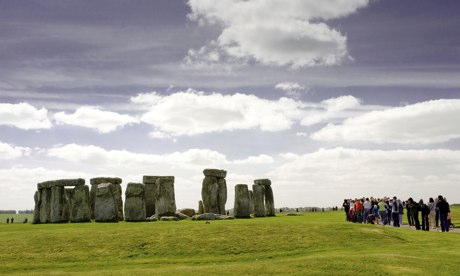
A great article by Professor of Archaeology, UCL – Mike Parker Pearson:

I led the team of researchers that discovered that Stonehenge was most likely to have been originally built in Pembrokeshire, Wales, before it was taken apart and transported some 180 miles to Wiltshire, England. It may sound like an impossible task without modern technology, but it wouldn’t have been the first time prehistoric Europeans managed to move a monument.

Archaeologists are increasingly discovering megaliths across the continent – albeit a small number so far – that were previously put up in earlier monuments.

Other ‘second-hand’ monuments

The best example of such a structure outside the UK is La Table des Marchand, a Neolithic tomb in Brittany, France, built around 4000BC. The enormous, 65-ton capstone on top of its chamber is a broken fragment of a menhir, a standing stone, brought from 10km away. The original menhir may be 300 years (or more) older than the tomb. Another fragment of this same menhir was incorporated into a tomb at Gavrinis, 5km away. This menhir, originally weighing over 100 tons, is actually one of the largest blocks of stone that we know of to have been moved and set up by Neolithic people.

La Table des Marchand. Myrabella/wikimedia, CC BY-SA

Another example of a standing stone reused in a megalithic monument is an anthropomorphic menhir – a standing stone carved in the form of a human figure – incorporated as the capstone of another tomb at Déhus on Guernsey. Another megalithic tomb, La Motte de la Jacquille in western France, is built of dressed stones that have been rearranged into a new tomb but it is not known if they came from a different location or were an earlier version of the tomb rebuilt on the same spot.

Archaeologists have known for many years that some of Stonehenge’s bluestones (the shorter stones in the monument) were reused. Two are lintels reused as standing stones, and two others have vertical grooves that show they were part of a wall of interlocking standing stones. Until now it was thought that these were evidence of reuse just within Stonehenge which was first built around 2900BC and rebuilt circa 2500BC (at this point, large local sandstones known as “sarsen” were erected). It was then rebuilt again in around 2400BC and 2200BC.

However, we identified the actual quarries in Pembrokeshire, Wales (around 3400BC and 3200BC) that the bluestones came from. This is a period before prehistoric people were building stone circles (normally dating from 3000BC onwards) so we also think it is very likely that the bluestones originally formed a rather different type of monument from a stone circle.

People in western Britain and Ireland at this time were building Neolithic stone tombs known as passage tombs – Newgrange in Ireland is the best known example. So it is just possible that there is a dismantled passage tomb somewhere near the bluestone quarries. That’s what we will be looking for in 2016.

Stonehenge – an unusual distance

An interesting outcome from a recent conference in Redondo, Portugal, on prehistoric megaliths and “second-hand monuments” is that – while some megalithic stones for monuments in Portugal and elsewhere were brought as far as 8km from their sources – the vast majority of Neolithic stone monuments throughout Western Europe were built less than 2km to 3km away from their stone quarries. So Stonehenge is a major exception to this rule, as its bluestones were dragged around 290km. This makes it unique for prehistoric Europe.

How the stones were moved from Wales to Stonehenge is something of a mystery but our excavations at one of the Welsh quarries reveals that the trackway leading from the outcrop was too narrow for rollers to have been used. Instead, we think that monoliths were loaded onto wooden sledges and dragged over logs and branches laid rail-like in front of the sledge.

Some archaeologists have speculated that Stonehenge’s bluestones must have been thought to have had special properties – as musical “gongs” or healing stones – for them to have been sought out from so far away.

But we think it is far more likely that the bluestones were derived from quarries in close proximity to each other – within 2km to 3km – and brought together to build a local monument in Pembrokeshire. Scientific analysis of strontium isotopes in the teeth of people buried in the Stonehenge area reveals that many of them have values consistent with growing up in western Britain. So the stones may have been brought by people migrating from Wales, bringing their ancestral monument as a symbol of their history and identity. Strontium isotope analysis is currently being carried out on the people actually buried at Stonehenge when the bluestones were erected, and we await the results to see if they show a similar picture.

It’s also possible that the bluestones were put up somewhere on Salisbury Plain before they arrived at Stonehenge. For example, one of the bluestones never quite made it to Stonehenge and was dug out in 1801 from the top layer of a Neolithic burial mound called Boles Barrow, near Warminster, also in Wiltshire.

Although this tomb was first built around 3700BC, it seems to have gone through modifications, of which adding a layer of large stones (mostly local sarsen stones and this one bluestone) happened at the end of its use. So we don’t know precisely when it got there but it may have been set up as a burial marker before the rest of the bluestones were erected at Stonehenge.

Rebuilding tombs and other megalithic structures as second-hand monuments is only now turning out to be recognised in various parts of western Europe as archaeologists start to look more closely at the detailed aspects of construction. Simple expediency of finding suitable stone does not explain sites such as Stonehenge and the Table des Marchand – they were most likely incorporating aspects of the past which had rich historical resonance for them.

Mike Parker Pearson

Professor of Archaeology, UCL

Stonehenge Guided Tours
The Stonehenge Experts
http://www.StonehengeTours.com
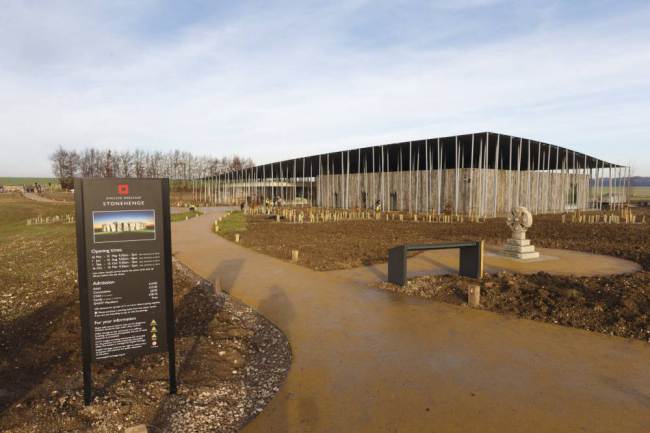
The experience of visiting Stonehenge has been transformed and greatly improved.  The time it takes to visit Stonehenge and the new visitor centre is also much longer, at around 2 hours which is at least twice as long as previous years.

The reason for this radical change is the building of a brand new visitor centre where you start your visit just over 1 mile from the Stonehenge monument. Before you parked adjacent to Stonehenge and walked directly into the monument using the old tunnel.new-stonehenge-visitor-centre

For such a visited monument, facilities before 2014 were an embarrassment. Just a small gift shop far too small for the numbers visiting, turnstiles and toilets in portable buildings and no exhibition or educational facilities. An audio guide provided was your only way of making sense of what you saw before you.
It is now possible to download the Stonehenge Audio Guide in advance: https://itunes.apple.com/us/app/stonehenge-audio-tour/id771690237?mt=8

The old facilities and car parks have been demolished and grassed over. The new English Heritage visitor centre is a purpose built structure with topical exhibits and facilities so you can be orientated on what Stonehenge is all about and information about the Neolithic people that built Stonehenge and discoveries in the Wiltshire area

To get to Stonehenge itself you now take a small shuttle Land Rover ‘train’  for the 10 minute journey to the Stones themselves

Stonehenge Entrance Prices & Opening Times

From February 1st 2014 you  have to pre-purchase tickets in advance from Stonehenge.

Advance booking is the only way to guarantee entry on the day and at the time of your choice.
Please visit the English Heritage website to book advance tickets: Stonehenge Official Ticketing Facility
English Heritage Members MUST also book in advance using the same link.

The reason for this is that you need to book your timed slot on the shuttle between the visitor centre and Stonehenge.
(Last admission time is 2 hours before the advertised closing time)

Please visit the new English Heritage Stonehenge website for 2014 prices and opening times: http://www.english-heritage.org.uk/daysout/properties/stonehenge/prices-and-opening-times

Stonehenge Special Access Visits

During normal opening hours you cannot walk up to the stones.  The nearest you will get to the stones is about 15 yards, the monument is roped off by a low barrier.

However it is possible to walk up to and among the stones at Stonehenge outside public opening hours. These are called Special Access visits. During these sessions of one hour duration, only a handful of people are allowed into Stonehenge going beyond the barriers and walking amongst the stones.

The Special Access Visits are also immensely popular, demand far outstrips supply and they are often sold out many months in advance.
Please visit our Stonehenge Private Access Tour page or the English Heritage Special Access page

Private guided Stonehenge access tours from London, Bath or Salisbury can sometimes be arranged for families and small groups.

Scheduled Stonehenge coach tours from London have pre-booked  tickets and enjoy priority ‘fast track’ entrance

Stonehenge Tour Guide

New research suggests stones came from Carn Goedog in Pembrokeshire – almost a mile from site of excavations

One of the mysteries of Stonehenge is how some of its stones were brought from Pembrokeshire in Wales to Wiltshire. Photograph: I Capture Photography/Alamy

One of the mysteries of Stonehenge is how some of its stones were brought from Pembrokeshire in Wales to Wiltshire. Photograph: I Capture Photography/Alamy

For almost a century archaeologists have been braving the wind and rain on an exposed Welsh hillside in an attempt to solve one of the key mysteries of Stonehenge.

But new research about to be published suggests that over the decades they may have been chipping away at the wrong rocky outcrop on the Preseli Hills in Pembrokeshire.

The work in the hills is a crucial element in the understanding of Stonehenge because it is generally accepted that the bluestones that form part of the ancient Wiltshire monument came from this remote spot in south-west Wales. One of the many huge puzzles remains how the bluestone from Wales travelled 190 miles to the heart of south-west England.

Since the 1920s much of the work in Preseli has focused on a spot known as Carn Meini. Now researchers are claiming that in fact the Stonehenge bluestones actually came from Carn Goedog – almost a mile away.

Richard Bevins, keeper of geology at the National Museum of Wales and one of those involved in the study, suggested he was not going to be terribly popular with some fellow experts.

“I don’t expect to be getting Christmas cards from the archaeologists who have been excavating at the wrong place over all these years,” he said.

The celebrated geologist Herbert Henry Thomas linked the Stonehenge bluestones with Preseli in 1923 and pinpointed the tor on Carn Meini as the likely source. Over the years teams worked assiduously on the spot searching for evidence of a Stonehenge quarry.

Two years ago there was excitement when a burial chamber was found, leading to speculation that this could be the resting spot of an architect of Stonehenge.

Now, using geochemical techniques, Bevins and his colleagues have compared samples of rock and debris from Stonehenge with data from the Preseli site and concluded the bluestones in fact came from Carn Goedog.

Bevins, who has been studying the geology of Pembrokeshire for over 30 years, said: “I hope that our recent scientific findings will influence the continually debated question of how the bluestones were transported to Salisbury Plain.”

There are different theories about how the bluestone may have got to Wiltshire. Some believe it was laboriously transported by man but there is another theory that it could have been swept east by glaciers.

Rob Ixer, of University College London, who also took part in the new research, said: “Almost everything we believed 10 years ago about the bluestones has been shown to be partially or completely incorrect. We are still in the stages of redress and shall continue to research the bluestones for answers.”

Bluestones are believed to have arrived at Stonehenge about 4,500 years ago. Some experts believe the bluestones – rather than the much larger sarsen stones that give Stonehenge its familiar shape – were the real draw because they were believed to have healing powers.

The paper setting out the discovery is to be published in the Journal of Archaeological Science.

: theguardian.com http://www.theguardian.com/culture/2013/nov/20/archaeologists-stonehenge-origins-wrong-place

Guest Blogger
Stonehenge Tour Guide

A druid who has lost his second legal bid to get human remains reburied at Stonehenge has said he will fight on.

King Arthur Pendragon lost a High Court bid to have the bones reburied in 2011

King Arthur Pendragon lost a High Court bid to have the bones reburied in 2011

King Arthur Pendragon claims the cremated bones discovered in 2008 are the remains of members of the royal line and wants them re-interred.

Having lost a High Court bid to have the bones reburied in 2011, permission to take the case to a full judicial review has also been refused.

But the druid leader said it was “by no means the end of the campaign”.

The cremated remains of more than 40 bodies, thought to be at least 5,000 years old, were removed from the burial site at the ancient stone circle in Wiltshire in 2008.

‘Broken up Weetabix’

But Mike Pitts, one of the archaeologists who found the remains, said they did not uncover “individual burials” but bone fragments that were “very small and damaged”.

“What we’re attempting to do is to isolate individual people, to recognise bits of bone that came from individuals, within this mass of bone that was just dumped in a mass like broken up Weetabix at the bottom of this pit,” he said.

“So studying these is an extremely detailed, time consuming and forensic process.”

Ministers gave permission to allow the bones to be examined at Sheffield University until 2015.

But Mr Pendragon has vowed he will continue his fight to have the remains reburied.

“The judge in refusing to let me take this particular case did say that if they [the remains] do not go back in the ground in 2015 – which the current licence says they’ve got to be – that I will take another case against them,” he said.

“And the judge has given me permission to do that.”

Source: http://www.bbc.co.uk/news/uk-england-wiltshire-22558293

Stonehenge Tourist Guide, Salisbury