>THE first crop circles of the year in Wiltshire have appeared at Old Sarum and Stonehenge.

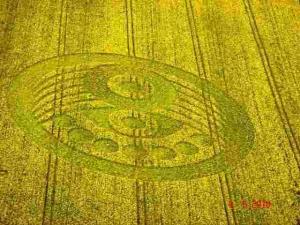
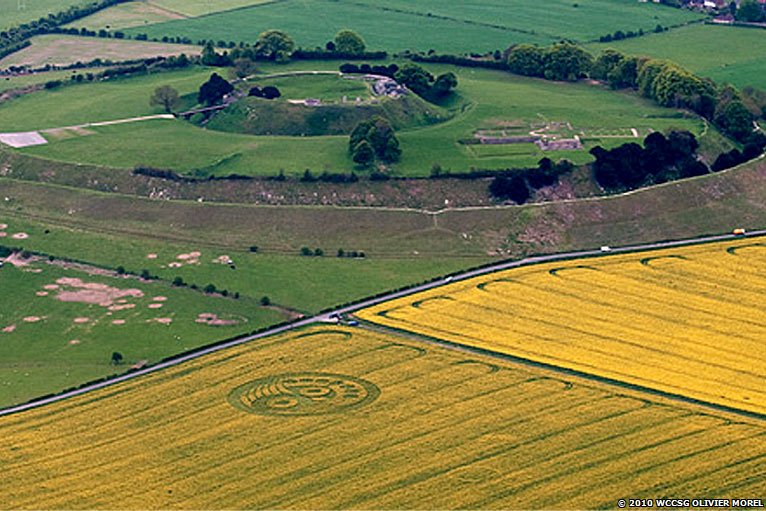
The one at Old Sarum was discovered in a field that is part of Little Durnford Farm last Tuesday.

Estate manager Philip Simmonds said it had been created overnight, but people living in former farmworkers’ cottages nearby did not see or hear anything unusual.

Since then enthusiasts from across Europe have been travelling to Salisbury to see the intricate design, photographed by Old Sarum flying instructor Mark McClelland.

“People have come from Holland, and this morning two ladies arrived from Austria,” Mr Simmonds said on Saturday. “On Thursday evening we had a Dutch film crew, and we’ve had an approach from a Californian film crew to film here next week. It’s all over the internet.”

The circle is in a 110-acre field of oil seed rape, owned by Lord and Lady Chichester.

“I’ve not seen one in a rape field before,” said Mr Simmonds, “although we did have a simple circle in the adjoining field, in a crop of barley, about five years ago.”

Unfortunately for Mr Simmonds the circle has caused £1,000 worth of damage to his crop, so to recoup his loss he is charging visitors to view it close up.

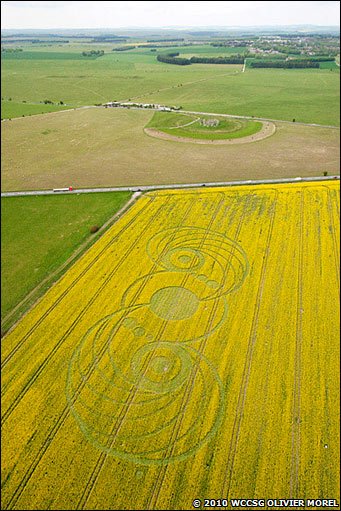
Excitement grew with the discovery of the second circle – or rather three swirling interlinked circles – across the A303 from Stonehenge at 9am on Monday.

Wiltshire Crop Circle Study Group sent up photographer Olivier Morel to take aerial pictures of the design, estimated at 350ft long.
According to the group’s website http://www.wccsg.com, another circle appeared in the same field in 1996.

Salisbury crop circle researcher and lecturer John Bannister, who has been fascinated by the phenomenon ever since seeing his first circle in a 1950s newspaper article, said: “The geometry of these things is inch-perfect. And no two are ever the same. We send soil samples from the circles away for analysis and they show significant changes.
“We usually get between 60 and 70 in Wiltshire each year because we have got so many ancient sites and ley lines.”

HisTOURies UK, a tour operator based in Salisbury have already started taking private tours to the circles.  The manager, Tim quoted “this is great for tourism in Wilsthire” and looks forward to a bumper year of mysterious crop circles.

David
Stonehenge Tour Guide

>

A Histouries UK tour guide has just sent this information through.  The very first crop circle in Britain for 2010, see image below.  We have also been sent an aeriel image of a crop circle next to Old Sarum hillfort – 8 miles southj of Stonehenge, we will add more details as we get them.  A big thank you to Histouries UK for keeping us up to date, keep up the good work!

David – Stonehenge Tour Guide Private Stonehenge and Crop Circle Tours
Crop Circle Tours and private guided tours of Salisbury and Stonehenge – click here (Histouries UK)

>London coach tour operator Evan Evans launches new Stonehenge tour that includes a sunrise viewing beyond the fences and before the site is open to the public.  Many would say that their itinerary is a little ambitious (see below) and that they are just copying other companies offering such tours.  Anway I have included their itinerary below and there are links on my blog to book them if you desire.  I will aslo add some alternative links below:

A PRIVATE VIEWING OF THE INNER CIRCLE AT STONEHENGE – a later start gives the opportunity to visit the state apartments of Windsor Castle, a walking tour of Oxford and a private visit to the inner circle of Stonehenge.

Included Highlights

Entrance to Windsor Castle and a tour of the State Apartments and St George’s Chapel


Walking tour of Oxford


Visit Christ Church college (where Harry Potter was filmed)


Private Visit ot the Inner Circle of Stonehenge at Sunset


First-class luxury Motor-coach and the services of a Professional Guide
Windsor Castle

Our day starts with a visit to Windsor Castle, the largest and oldest occupied Castle in the world and the home of the Royal Family for 900 years. Its proud, strong walls dominate the delightful town that has grown around the castle over the years. You’ll see the lavishly decorated State Apartments containing priceless furniture in glorious colours and St George’s Chapel, home to the 14th Century Order of the Royal Garter, our senior chivalric order
Oxford

The colleges in Oxford date back to the 13th century and among its famous students were Bill Clinton, C.S. Lewis, J.R.R. Tolkien and Lewis Carroll. We take you on a fascinating walking tour, which includes visiting the Great Hall in Christ Church, where many scenes from Harry Potter were filmed. We’ll also see the Bodleian Library and the picture perfect college courtyards for which Oxford is famous.
Private Viewing of Stonehenge

Most visitors to Stonehenge are not allowed direct access to the stones. On this special day trip from London, you’ll be invited to enter the stone circle itself, and stand beside the mysterious rocks towering above you. Your guide will unlock the secrets of this ancient World Heritage site. Enjoy the peace, away from the crowds, as you experience Stonehenge at its atmospheric best at sunset.

Departures April to September 2010
Days of operation: Monday, Friday

Tour Starts: 10.30am, Royal National Hotel

Tour Finishes: 9.00pm, Victoria Train Station

Departs from:

10.30am Royal National Hotel, Russell Square


10.45am, Guoman Thistle Marble Arch


11.00am, Grosvenor Victoria


11.15am, Millennium Gloucester


11.30am, Kensington Hilton
Adults: £84.00 Children (3-16): £74.00


Seniors (60+)/Students (with ID): £79.00

Other recommended Stonehenge Tour Companies:
The Stonehenge Tour Company – click here

Premium Tours – Click here
International Friends – Small group tours – Click here

Histouries UK Tours based in Salisbury – click here

David
Stonehenge Tour Guide
The Stonehenge Stone Circle Website

>

In the latest rather, er, unique bid to boost tourism, an Australian town is planning to build a life-size replica of the famous 4,000 year-old rock formation Stonehenge – so let’s check out if this is a rock-solid plan or a rather rocky road to disaster…

Twilight Beach in Esperance, Western Australia, is the planned venue for the ‘new’ Stonehenge.

The controversial plan aims to recreate the ancient Wiltshire monument on a hillside overlooking the beach, 740km southeast of Perth. More than 100 stones are to be erected, with the largest stone standing more than seven metres high and weighing in at more than 50 tonnes.

The plan was originally announced back in 2008, when local businessman Ross Smith ordered the granite blocks. But, his £850,000 project collapsed after the proposed development went into the hands of liquidators.

Now, the plan has been raised from the dead and the quarry has offered the stone blocks to the town of Esperance for £180,000. A further £545,000 is needed for site works, a car park and tourism facilities.

The project, to be called The Henge, will include 101 granite stones arranged in an inner and outer circle and a central altar.

Unlike the original Stonehenge, guests will be encouraged to play around the new monument, which will also have an interpretive centre and a children’s playground.

Mr Smith said The Henge would be a business venture, to be hired out for weddings and other events.
A small team of quarry workers has spent the past five months drilling and blasting the stones into shape.

The ‘REAL’ Stonehenge Stone Circle website

>What is a ‘Henge’ monument

Stone Henge – What is one?

Definition:

A henge is the term given to a large prehistoric earthwork, usually but not always circular, whether of stones, wood, or earth.

This word, interestingly, is a back-formation from Stonehenge. Additionally some spell it stone henge or stonehedge even though that is incorrect. Stonehenge was the Saxon name for the famous monument on the Salisbury plain, and the “henge” part is Old English for “hang,” not earthwork. Nonetheless, the term henge is in wide use in both popular and scientific literature to refer to megalithic monuments of the Neolithic and Bronze ages.

Whether you are thinking stone henge or Stonehenge, both are basically Megaliths. Megaliths are single large stones, or a group of “standing stones” usually arranged in a circular or semi-circular formation, and that archaeologists believe were religious temples or monuments. The earliest sites are thought to date back to the millenia. The word, “megalith” itself has Greek origins: “mega” meaning “great” and “lithos” meaning “stone”. Certain megalith sites, and there are thousands of them all around the world, were also known burial sites. England seems to have the greatest concentration of megaliths that carry names like Avebury, the Hurlers, the Merry Maidens, and the Rollright Stones. The most famous of these is, of course, Stonehenge.

People do commonly mistake the words stone henge for Stonehenge and should learn the difference so they may find the correct information.

The Stonehenge Web Site

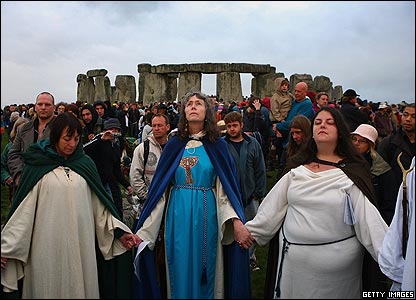
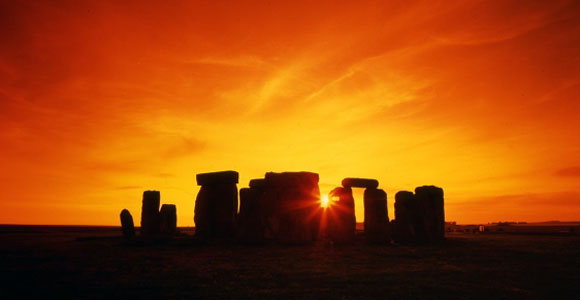
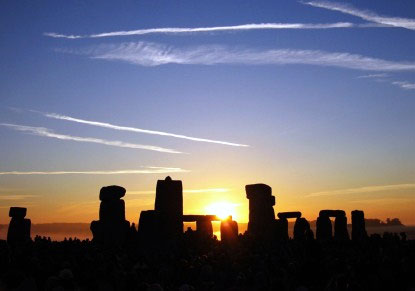
>”The sun rises over Stonehenge as druids celebrate the Spring Equinox at Stonehenge near Amesbury, Wiltshire, England. Several hundred druids and pagans were granted special access to the ancient monument to mark the date in the calender when the length of the day and the night are equal (this happens twice a year, at Spring and Autumn Equinox). To the druids Spring Equinox celebrates the renewed life of the Earth that comes with spring and attribute the changes that are going on in the world to an increase in the powers of their God and Goddess.”

>2010
Vernal Equinox: The Morning of Saturday March 20th – Sunrise is at 6:03 am. Gates will open around 5:30 am *
 
This Saturday marks the point at which the sun rises directly over the equator – the Spring Equinox. And while most of us will be wrapped up warm in bed at 5am, up to five thousand hardy souls will be braving the Wiltshire weather to welcome in the equinox at Stonehenge – including us.

We will be at the stone circle bright and early for two special Ancient World in London videos, speaking to Druids (including the inimitable King Arthur Pendragon), archaeologists and revellers as the sun rises over Britain’s best-known ancient landmark.

But what can we expect to see on the day? Here’s a video of sunrise last year taken by everyone in the office:

From a technical standpoint the Vernal Equinox is an astronomical event, it’s one of the four quadrature days of the Earth’s orbit. However for people both modern and ancient, the Vernal Equinox marked the transition from winter into spring. The Vernal Equinox occurs on March 20th or 21st and is one of two days during the year when there are 12 hours of daylight and 12 hours of darkness, the other day is the Autumnal Equinox.

People have been marking and celebrating the Vernal Equinox for thousands of years. The Great Sphinx which was constructed over 4500 years ago on the Giza Plateau in Egypt, faces due east on the Vernal Equinox. The monoliths located at Stonehenge, which are estimated to be over 3000 years old, mark the position of the rising sun on the Vernal Equinox. In Central America the Ancient Mayan Caracol Tower and Temples of the Sun and Moon also have alignments that coincide with the sun’s position on the Vernal Equinox.

Most historians believe that this knowledge was important to ancient cultures in choosing a time to plant their crops. In Iran they celebrate Norouz (which roughly translates to “new day”) on the Vernal Equinox. In China they celebrate Chunfen on the Vernal Equinox. In ancient Europe they celebrated the arrival of the goddess of spring Ostara on this day. Ostara was also known as Ostera and Eostre in different parts of Europe. Many historians believe the Christian holiday Easter gets its name from Eostre, as she had an enchanted rabbit that could lay eggs. In more modern times the Vernal Equinox marked the first Earth Day celebration in 1971.

One of the odd traditions that that occur on the Vernal Equinox is egg balancing. The story goes that it is possible to balance a raw egg on its oblong end on this day. There is no truth to this rumor it’s just as easy (or hard) to balance an egg on its end on this day as it is any other day. This story is perpetuated by the media who usually run a small segment on it, during news shows on this day.

Stonehenge Stone Circle

>

Im going to start adding Stonehenge film clips – this 1954 film is a classic – click here

>The first of our new series of weekly walks, provided by the National Trust, is a ramble around mysterious Durrington Walls in Wiltshire, with views towards Stonehenge.

View Durrington Walls: Walk of the week in a larger map
THE EXPERT’S VIEW

Mike Dando, Head Warden: “The walk starts at the largest henge monument in the country and takes you past ancient monuments such as Round Barrows and the ‘Cuckoo Stone’ where it is easy to imagine the landscape as it was some 4,000 years ago. The walk takes in beautiful grazed grassland, strips of mature Beech trees and offers fantastic views across the Stonehenge Landscape.

Download an OS map of this walk

“My favourite part of this walk would have to be walking past the New King Barrows, the large Bronze Age burial mounds. A stop here on a warm summers’ day, listening to the skylarks and the beech leaves rustling, is hard to beat, especially on top of the view over to Stonehenge itself.

“Unique to this walk is the sense of being in an ancient and sacred place; the combination of the natural and historic sights is simply spectacular. My top tip for first time walkers would be to bring binoculars to take in the wildlife and views.”

ESSENTIALS
Start: Woodhenge car park
Grid ref: SU151434
Map: OS Landranger 184

Getting there
Bike: National Cycle Network route 45 runs south-east of the property. See http://www.sustrans.org.uk

Bus: Wilts & Dorset 5 or 6, between Salisbury, Pewsey, Marlborough and Swindon. Service 16 from Amesbury, request stop at Woodhenge

Rail: Salisbury station, 9 miles from Woodhenge car park

Road: Woodhenge car park is 1¾ miles north of Amesbury, follow signs from A345

Distance, terrain and accessibility

4 mile (6.4km) across open access land, including Rights of Way, with gates, at several points. The ground is uneven in places, with a few short, steep slopes. Sheep graze the fields and there are ground-nesting birds, so please keep dogs under control.

Local facilities
Picnic area (not NT) and information panel at Woodhenge car park
WCs
Outdoor café
Picnic area (not NT) at Stonehenge car park, 0.75 miles from this walking route.
THINGS TO LOOK OUT FOR

Durrington Walls: The largest complete henge in Britain is 500m in diameter and encloses a natural valley. It once contained timber circles and what appear to have been shrines. The area outside the ditch and bank was once a settlement, perhaps containing hundreds of houses, making Durrington Walls potentially the largest village in north-west Europe at the time. People travelled for miles to feast and take part in ceremonies, probably at the midwinter solstice. Woodhenge stood nearby as an impressive timber circle surrounded by a bank and ditch.

The Cuckoo Stone: This standing stone now lies on its side, but over millennia it has been a focus for Bronze Age urn burials, an Iron Age boundary line and Roman remains. It is made of sarsen, a kind of sandstone, the same as the largest stones in the Stonehenge stone circle. The reason for its name remains a mystery.

The Stonehenge Avenue: A two mile long ceremonial way linking Stonehenge with the River Avon and crossing King Barrow Ridge. Interestingly, Durrington Walls is also connected to the river, leading experts to believe the Avon symbolically linked the two monuments, forming part of a ritual journey; maybe leading to the afterlife.

DIRECTIONS

Download an OS map of this walk

1. At Woodhenge car park, go through the gate nearest to you and into a field. Walk downhill into Durrington Walls (taking care of rabbit holes).

2. At the centre of Durrington Walls, looking around you, you can appreciate the nature of the henge as an enclosed valley. Standing here 4,500 years ago, you would have been viewing several “shrines” around the slopes. Next, turn left and walk to the corner of this field. Pass through gates either side of the road, heading towards a low rock.

3. The Cuckoo Stone is one of very few stones in the area that is made from sarsen – most local rock is chalk or flint. From here, continue forwards to the next gate.

4. You are now on the route of the old military railway between Amesbury and Larkhill; turn right and follow the path.

5. When you reach a crossroads and National Trust sign to King Barrow Ridge, turn left and follow the shaded bridleway.

6. At the junction, turn right through a gate to continue along the ridge, crossing the Stonehenge Avenue on your way to a line of 200-year-old beech trees and a fine view of Stonehenge. At winter solstice, Neolithic people may have marked the occasion of the midwinter sunset at Stonehenge, before travelling to Durrington Walls to celebrate the new sunrise.

7. Continue forward to New King Barrows, a fine row of Early Bronze Age burial mounds, originally capped in white chalk so they would have been visible from a far distance. Return to point 6, turn right and follow the stony track to point 8.

8. Take a left turn through a gap in the hedge, to join the old military railway once more. This leads back to the gate in the corner of the Cuckoo Stone field.

9. Head across the grassland to Woodhenge and back to Woodhenge car park.

STONEHENGE STONE CIRCLE

>Ive had a number of questions recently about ‘Radio carbon dating at Stonehenge’ Here is a comprehensive anwser:
Radio carbon dating determines the age of ancient objects by means of measuring the amount of carbon-14 there is left in an object. A man called Willard F Libby pioneered it at the University of Chicago in the 50’s. In 1960, he won the Nobel Prize for Chemistry. This is now the most widely used method of age estimation in the field of archaeology.

How it works

Certain chemical elements have more than one type of atom. Different atoms of the same element are called isotopes. Carbon has three main isotopes. They are carbon-12, carbon-13 and carbon-14. Carbon-12 makes up 99% of an atom, carbon-13 makes up 1% and carbon-14 – makes up 1 part per million. Carbon-14 is radioactive and it is this radioactivity which is used to measure age.

Radioactive atoms decay into stable atoms by a simple mathematical process. Half of the available atoms will change in a given period of time, known as the half-life. For instance, if 1000 atoms in the year 2000 had a half-life of ten years, then in 2010 there would be 500 left. In 2020, there would be 250 left, and in 2030 there would be 125 left.

By counting how many carbon-14 atoms in any object with carbon in it, we can work out how old the object is – or how long ago it died. So we only have to know two things, the half-life of carbon-14 and how many carbon-14 atoms the object had before it died. The half-life of carbon-14 is 5,730 years. However knowing how many carbon-14 atoms something had before it died can only be guessed at. The assumption is that the proportion of carbon-14 in any living organism is constant. It can be deduced then that today’s readings would be the same as those many years ago. When a particular fossil was alive, it had the same amount of carbon-14 as the same living organism today.

The fact that carbon-14 has a half-life of 5,730 years helps archaeologists date artefacts. Dates derived from carbon samples can be carried back to about 50,000 years. Potassium or uranium isotopes which have much longer half-lives, are used to date very ancient geological events that have to be measured in millions or billions of years.