>

A South African grandmother has spent R300, 000 to publish her book, which she believes proves that Stonehenge in the UK was a prehistoric calendar

Booysen, 66, said this week she examined various ancient structures to prove her theory, including the Chichen Itza Pyramid in Mexico and the world’s largest stone circle, The Great Circle at Avebury, in Wiltshire, England.

Booysen said the physical make-up of the various structures, whether the number of steps or the placement of rocks, all added up to 365, representing the number of days in a year.
Archeologists believe Stonehenge was built in three stages but, over the millenniums, the original structure suffered damage as a result of bad weather and pillaging.
Experts have theorised that Stonehenge, about 150km west of London, may be a calendar, a burial ground or a temple.
Booysen has long been fascinated by stone monuments.
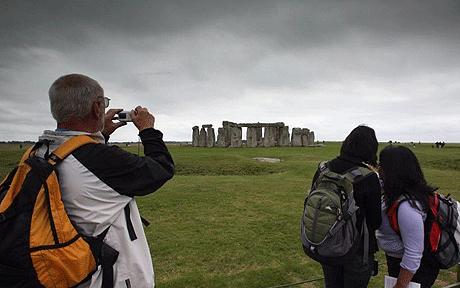
“I love a mystery. I’ve always had an interest in Stonehenge and, for my 50th birthday, my husband sent me to England and I finally saw it. Booysen joined a ‘special access’ tour with the Stonehenge Tour Company
“It was wonderful. I just knew that it must have some significance. Why would those people drag those stones all the way there?”
Booysen said her interest in a book on Stonehenge peaked after watching a documentary in June 2006 in which it was reconstructed from polystyrene.
She said she hoped her book, available via her website as an e-book, would appeal to academics and those interested in Stonehenge.
She said the book was very technical and contained calculations and diagrams to explain her theory.
“I’d like people to understand that the people who built this monument were absolutely brilliant. It’s not just a pile of rocks.”

Stonehenge Tour Guide

http://rcm.amazon.com/e/cm?t=stonehengetours-21&o=1&p=8&l=bpl&asins=0500051550&fc1=000000&IS2=1&lt1=_blank&m=amazon&lc1=0000FF&bc1=000000&bg1=FFFFFF&f=ifrhttp://rcm.amazon.com/e/cm?t=stonehengetours-21&o=1&p=8&l=bpl&asins=1850749264&fc1=000000&IS2=1&lt1=_blank&m=amazon&lc1=0000FF&bc1=000000&bg1=FFFFFF&f=ifrhttp://rcm.amazon.com/e/cm?t=stonehengetours-21&o=1&p=8&l=bpl&asins=0816037205&fc1=000000&IS2=1&lt1=_blank&m=amazon&lc1=0000FF&bc1=000000&bg1=FFFFFF&f=ifrhttp://rcm.amazon.com/e/cm?t=stonehengetours-21&o=1&p=8&l=bpl&asins=B0015XHR66&fc1=000000&IS2=1&lt1=_blank&m=amazon&lc1=0000FF&bc1=000000&bg1=FFFFFF&f=ifrhttp://rcm.amazon.com/e/cm?t=stonehengetours-21&o=1&p=8&l=bpl&asins=0500284679&fc1=000000&IS2=1&lt1=_blank&m=amazon&lc1=0000FF&bc1=000000&bg1=FFFFFF&f=ifr

>In August 2008 HeritageAction wrote on The Modern Antiquarian that-

In the current edition of British Archaeology there is a two page article by Mike Pitts entitled The Stonehenge Olympics. The first page of the article contains a review of recent plans to improve the visitor facilities at Stonehenge and the second page is a summary of English Heritage’s latest Public Consultation initiative (see http://www.stonehengeconsultation.org/ for details). Mike Pitts makes an interesting point when he says –

“The government announced it was scraping the approved roads scheme on the grounds of cost last December. The day before, the DCMS said it was to give Tate Modern £50m towards its gallery extension, a gesture, it was hoped, that would ensure its opening in time for the Olympics. Now that seems unlikely, as fundraising gets tough, Tate director Sir Nicholas Serota is happy to say that his extension may not be ready till 2014.”
Note the word ‘happy’. Why is Serota happy? Couldn’t be could it that it gives the Tate the necessary time to get the extension right?

I’ve never been happy with tying in new visitor facilities at Stonehenge with the Olympic deadline of 2012 – it seems an impossible objective to achieve in only four years. English Heritage are expected to have their plans in for government scrutiny by the end of this year. The proposals then have to be approved by the government, and planning permission then has to be granted for the preferred site. Each of the sites proposed for the new facilities contain, or are close to, sites of archaeological importance; are these sites to be hurriedly excavated just to meet the government’s deadline for the 2012 Olympics?
Along with billions of other people I watched the opening ceremony of the Beijing Olympics on television yesterday; pretty impressive, lots of people enjoying themselves – and why not. I couldn’t help thinking however that it was more than a bit ‘staged’ for world approval. While the Chinese authorities were claiming that this was a ‘green’ Olympics (hmm…) and the unfolding digital scroll showed the progress of the Olympic torch around the world, it somehow managed to omit displaying any of the ‘obstacles’ the torch had encountered along the way. This is nothing more than a selective interpretation of the truth.
What I’m getting at here is that the ongoing shenanigans at Stonehenge seem to have a similar, not to say uncomfortable, feel to them – re: the ‘manipulation’ of public approval. One idea after another for new Stonehenge visitor facilities, tossed out at the obscene expense of the British taxpayer, has achieved nothing to date. Nothing, that is, until now when reputations and personalities are coming under the national and international spotlight of the 2012 Olympic Games.
Stonehenge, perhaps our most important and iconic Neolithic monument, deserves a great deal more than the passing whim of the present (indeed of any) government, let alone the fleeting reputations of those in the political and sporting worlds. It certainly deserves far more than the timeframe dictated by the big Olympic party scheduled for 2012. Let’s take a leaf out of Nicholas Serota’s book and say we’d be happy not to have anything ready for Stonehenge for the Olympics in four years time, but what we will eventually have will be something which Stonehenge, and the people of Britain, deserve and can be rightfully proud of.
It gives me no pleasure to say, “I told you so” but if you read Mike Pitts blog here – http://mikepitts.wordpress.com/ that’s what it’s come to. Mike Pitts writes –
“Also in November English Heritage, having lost the £10m promised by the previous government for the proposed new visitor centre, regained it from the Heritage Lottery Fund. Hopefully now EH will be able to raise the rest of the money it needs: but Stonehenge won’t be ready for the 2012 Olympics, the politicians’ original claim, and instead if all goes well, at that time Stonehenge will be a bit of a building site.”

So, now that the Olympic pressure is off let’s do two things without further delay:

1) Secure finances for first class improvements at Stonehenge.

2) As there is no Olympic deadline to meet anymore let’s get it right. Right being the immediate closure of the A344. Right being a well-designed and aesthetically pleasing Visitor Centre. Right being a practical, and also an aesthetically pleasing, transport system from the Visitor Centre to the Monument.
There can be no more excuses and no more delays – the time has come this time to really get it Right!

Stonehenge Tour Guide

>Walk Among The Stones At Stonehenge Without The Crowds

When you visit Stonehenge during public hours you have to keep behind a small rope fence about two foot off the ground. For most people this is perfectly adequate.

For those who are really, really interested in Stonehenge it is possible to go beyond the rope fence and walk among the stones.
These visits are called Special Access visits and take place outside public opening hours. This is the only time you will be able to walk amongst the stones at Stonehenge.

Stonehenge Special Access Visits – Key Facts– Special Access visits are available most but not all months of the year, (no visits in October and November and are not available on around the midsummer’s day).

– Demand for tickets far exceeds supply, dates are often sold out months in advance. Do not expect to get tickets without ordering well in advance.
– Special access visits take place at quite unsociable hours, commonly between 05:30 and 08:00 in the morning and after 18:30 in the evening.
– Factor in that its almost 2 hours traveling time between London hotels and Stonehenge and you can see such a visit entails a very early start or late finish for those based In London.
– There are no audio guides available and the gift shop and catering outlet are also closed. Only the toilets are open. There is nobody there to tell you anything about Stonehenge and no information is provided – though you can preorder a glossy guide book on ordering your tickets. On morning visits you can wait a little until Stonehenge opens for the public when the gift shop, refreshment kiosk are open and audio guides become available.  Otherwise buy them before – see below
 – The only people there apart from a maximum of 26 Special Access ticket holders are a few security guards who will not provide any information about Stonehenge. They are just there to make sure you get up to no mischief.


Scheduled Special Access Tours From London and Salisbury

A couple of tour companies in London offer tours that include Special Access. This overcomes the logistical problems of getting to Stonehenge early morning or evening when there is no public transport to Stonehenge.

However, its still a very early start or a late return to London and these companies cannot get enough tickets for their needs. As a result dates are very sporadic. Most days there will not be a tour running and they will normally sell out well in advance on those days the tour runs – don’t leave it until you arrive in London or you will be disappointed.
The Stonehenge Tour Company have by far the best reputaion and were the original operator to offer this itinerary.  You could try local companies HisTouries UK Tours or Salisbury Guided Tours who opearte bespoke private guided tours.  Needless to say the big group coach companies offer similar tours; Premium Tours, Golden Tours and Evan Evans and you can book discounted tickets here;
http://www.stonehenge-stone-circle.co.uk/coach-tours.htm

IMPORTANT:  The Stonehenge English Heritage shop is closed during these private access visits and you will not be able to purchase guide books or souvenirs so you are wise to buy before.  Needless to say if you do some research before it will certainly enhace your visit, I have listed the the most popular guide books etc below.

http://rcm.amazon.com/e/cm?t=stonehengetours-21&o=1&p=8&l=bpl&asins=0853727104&fc1=000000&IS2=1&lt1=_blank&m=amazon&lc1=0000FF&bc1=000000&bg1=FFFFFF&f=ifrhttp://rcm.amazon.com/e/cm?t=stonehengetours-21&o=1&p=8&l=bpl&asins=B0015XHR66&fc1=000000&IS2=1&lt1=_blank&m=amazon&lc1=0000FF&bc1=000000&bg1=FFFFFF&f=ifrhttp://rcm.amazon.com/e/cm?t=stonehengetours-21&o=1&p=8&l=bpl&asins=1426305990&fc1=000000&IS2=1&lt1=_blank&m=amazon&lc1=0000FF&bc1=000000&bg1=FFFFFF&f=ifrhttp://rcm.amazon.com/e/cm?t=stonehengetours-21&o=1&p=8&l=bpl&asins=0500051550&fc1=000000&IS2=1&lt1=_blank&m=amazon&lc1=0000FF&bc1=000000&bg1=FFFFFF&f=ifrhttp://rcm.amazon.com/e/cm?t=stonehengetours-21&o=1&p=8&l=bpl&asins=0060956852&fc1=000000&IS2=1&lt1=_blank&m=amazon&lc1=0000FF&bc1=000000&bg1=FFFFFF&f=ifr

>A total lunar eclipse will take place on December 20/21, 2010 Sadly it will not be visible oin Britain? It will be visible after midnight Eastern Standard Time on December 21 in North and South America. The beginning of the total eclipse will be visible from northern Europe just before sunrise. The end of the total eclipse will be visible rising at sunset for Japan and northeastern Asia, it also appears very visible to the Philippines just after sunset (as in Partial lunar eclipse). It will be the first total lunar eclipse in nearly 3 years, the last being on February 20, 2008.

 It is also called the Christmas lunar eclipse.

External links:
http://www.timeanddate.com/eclipse/lunar-eclipse-december-21-2010.html
http://blog.stonehenge-stone-circle.co.uk/2010/12/07/full-moon-this-winter-solstice-2010/
http://eclipse.gsfc.nasa.gov/OH/OH2010.html

Stonehenge Guide

>It might seem far too early to mention this but it’s a fair bet all the available places will be snapped up very quickly. There is to be an evening walk to Stonehenge led by David Dawson, Director of the Wiltshire Heritage Museum, on 8th June 2011 and a second one on 13th July.

“This is a wonderful opportunity to inspect (but no touching) and photograph (for non-commercial purposes) the stones closely, and see the inscriptions, including the famous ‘daggers’ believed to date from prehistoric times. Wander at will inside the circle and enjoy the landscape. ”
But we were rather struck by this request on the Museum’s website:

“Note – please do not touch or climb on the stones, picnic or play music whilst in the monument”

…since halfway between 8th June and 13th July comes the summer solstice when, as everyone knows, a large number of people have been allowed to ignore all four of those matters year after year. So we have a couple of dozen ultra-respectful paying customers acting one way, thousands of non-paying revellers acting in the opposite way then back to paying ones acting in the first way, all in the space of five weeks! BOTH sets of behaviour can’t be right, surely?

It’s very confusing. Which IS the right way to act at the stones? Or, much more pertinently, which way should those who are in charge of an event at the stones ensure people act? Is the strict version just something the Wiltshire Heritage Museum has formulated? Or was it imposed on them by English Heritage as a condition of them being allowed to take people there? And what would happen if a percentage of the Museum’s customers defied the Museum’s rules and climbed on the stones on 8th June? Would EH give them one more chance and tell them that if they failed to control all their paying customers and protect the monument a second time on 13th July they shouldn’t come back next year? Or would they accept an excuse from the Museum, year after year after year, “we do always ask people to behave, honest, but it’s definitely not our fault if they don’t….“
See also here – the only way out of the dilemma that we can think of, and a way of saving EH lots of money as well.

External links:
http://heritageaction.wordpress.com/
http://www.histouries.co.uk/ – Stonehenge Walking Tours
http://www.stonehengetours.com/

Stonehenge Tour Guide

>Its going to be crisp beautiful winter weekend.  Get your hiking shoes on and get some fresh air!  Here is a great DIY walk at Avebury Stone Circle.  Sunday roast at the Red Lion ?
While this walk does not come across any bits of Diplodocus or Tyrannosaurus Rex it does include relics from communities who lived over 5,000 years ago.

Avebury in mid-Wiltshire lies some six miles west of Marlborough, and this walk not only takes in Europe’s largest stone circle but passes Europe’s largest man-made hill, Britain’s largest burial tomb, a 5,000-year-old temple site, and follows an ancient trackway. It also provides superb views over delightful Wiltshire countryside and downland on good paths and tracks.

From Avebury’s village car park alongside the recreation ground on the A4361 turn right along the road for a short distance before following a path on the left through a double gate and signed West Kennet and Longbarrow. Walk through a small enclosed area, another gate and along a path beside a very small River Kennet.

To the right and ahead can be seen the unusual shape of Silbury Hill. Dating from 2,800 BC, and standing almost 140 ft high it is Europe’s largest man-made mound but after centuries of research its original purpose is still not known.
To the left is rising downland as you pass through a gate to continue along the fenced path on the right-hand edge of the field. Negotiate two stiles and a gate before reaching the A4.
1. At the road turn left for a short distance then turn right through a metal, kissing gate to follow a gravel path along the left edge of an uncultivated field.
Cross a small brick-edged bridge go through a metal, kissing gate and follow the fenced path left before entering and keeping to the left edge of a large field. At this point a path to the right leads up to the West Kennet Long Barrow, constructed about 3700 BC, and used as a burial tomb for well over a 1,000 years.

At the end of the field go through a metal gate and along a grass track before crossing a tarmac lane and stile to follow the right- hand edge of a small meadow. As you near the end of the meadow look for and cross a stile to  follow a hedge-lined path. At a T-junction of paths turn left and almost immediately right along a grass track uphill.
At a junction with a stony track and large field ahead turn left along the left edge of the field to follow the track down through a farmyard and into the village of East Kennett. Pass a delightful little pond by the village church and bear left along the lane past the church. At a T-junction  by the Old Vicarage turn right alongside a stone wall and the village school.

2. Turn left along the lane signed to West Overton.
As the lane bends right keep ahead along a tarmac drive to keep the stone wall on your left. The drive crosses a small bridge and enters a large field. Follow the path to the left and continue along the left edge of the field as it climbs uphill to the A4 revealing views to the left over the Long Barrow, Silbury Hill and the monument atop Chernhill.
Before crossing the road take time to look at The Sanctuary on the left. Concrete posts now mark the site of a circular building used from 2,500 BC, to 2000 BC, possibly as a temple. An avenue of standing stones once linked the Sanctuary with the Avebury Rings.

Cross the road and follow the clear track ahead. This is The Ridgeway, an ancient track which followed natural routes across high ground from Pewsey north east to Goring on the River Thames.

Exceptional almost 360 degree views over the surrounding countryside are revealed as you gain height.

3. After almost two miles where a bridleway and byeway form a cross track, turn left to head towards the Chernhill monument.

Descend to pass the buildings of Manor Farm and the track becomes a tarmac lane.

4. Soon your route passes through the eastern entrance of the massive circular earthworks that make up the Avebury Circles. These are described as one of the largest and most impressive Henge monuments in Europe and are made up of 200 standing stones.

Histouries UK do guided tours of Stonehenge, Avebury, Silbury Hill, West Kennet Long Barrow, Chalk Hill Figures and ancient Wiltshire.  Their bespoke tours can depart from London, Salssbury or Bath

Return to the village and merge with the main road opposite the Red Lion. As the main road sweeps left go ahead down High Street, past the Post Office and shop and just past the earthworks, turn left to return along the footpath to the car park.

Avebury Tour Guide

>STONEHENGE has been given a £10m boost, thanks to the Heritage Lottery Fund, it has been revealed.

The grant will support work to remove the existing visitor facilities allowing the experience of the stones to be more naturally integrated with its ancient processional approach and the surrounding landscape.

These improvements will give people the chance to explore what the site would have been like thousands of years ago.

The project aims to improve the visitor experience, including the creation of a new carefully designed visitor centre which will include education and exhibition spaces to help people learn more about Stonehenge’s history.

The project will also support training opportunities and a new volunteering programme.

Dame Jenny Abramsky, Chair of the Heritage Lottery Fund, said: “Stonehenge is one of the archaeological wonders of the world. It demonstrates the vital role heritage plays within the UK’s tourism industry as well as being a great example of our fascinating history.
“This Heritage Lottery Fund investment will help transform this site and give people a much greater understanding of why it is so significant.”

http://www.english-heritage.org.uk/
http://www.stonehenge-stone-circle.co.uk/


Stonehenge Tourist Guide

>Click on the link below to view the Stonehenge video!

http://www.english-heritage.org.uk/daysout/properties/stonehenge/environmental-improvement-project/our-proposals/
English Heritage’s plans are the culmination of months of working closely with a range of stakeholders and engaging with local residents.
Forget the new Visitor Centre (who knows if it will be like that or built there or built at all this side of the Olympics in Rio de Janeiro) but look at the rest! It certainly looks excellent.

We do have a few concerns – the land train for one. It looks a lot better and less intrusive than we feared it might – or still could but it would be nice to know it will look like that and there’s no question of it doing other than going from A to B and back and that having it buzzing all over the WHS won’t be considered.

We also wonder if this seductive vision of no fences, no ropes and apparently full access to the stones, that we’d all like, can actually prove viable? What about erosion? And security? How are they going to be dealt with?

But most of all we wonder about the fact the government has said all the good stuff like closing part of the road can’t happen unless the new Visitor Centre gets built! The latter doesn’t seem exactly a definite which means the good stuff might not happen either.

We’re certainly not alone in seeing the road closure as terribly important in it’s own right. Rescue and the Stonehenge Alliance for two! Surely, after all these years, a way can be found to treat the closure and grassing over of the road adjacent to the stones as THE UK heritage priority?

And just DOING it?

Here are our previous “Achievable Stonehenge” images which are just like the English Heritage video ones!

External links:
http://heritageaction.wordpress.com/
http://www.stonehenge-stone-circle.co.uk/
http://www.english-heritage.org.uk/

Stonehenge Tour Guide

>The English Heritage Travel Collection – 2011 Ancient Wessex Tour
Dates: May 6–8, 2011
Erected between 3000 and 1600 BC, Stonehenge is the most eloquent testimony to the once dominant civilisations of the Stone and Bronze Ages. And what better way to unravel the mysteries of Stonehenge’s innermost circle than on a private tour in the company of an expert from English Heritage?

Stonehenge inner circle tour

Working in partnership with English Heritage, ACE has developed an exclusive portfolio of historical tours and cruises in Great Britain and Europe. Each tour offers a unique blend of cultural sight-seeing and explanatory talks, all under the guidance of an expert and experienced course director.

As well as inspecting Stonehenge’s antique trilithons at close hand, our early morning visit will reveal how recent excavations have radically altered interpretations about this most monumental of temples.

The ceremonial landscape that lies around Stonehenge is richly suggestive of Wessex’s ancient patrimony: we will explore the Great Cursus, the henges of Durrington Wall and Woodhenge, and a handful of the great Bronze Age barrows that bestride the surrounding hills.

The majestic façade of West Kennet chambered long barrow, framed by two enormous quarry ditches, was constructed around 3650 BC – some four centuries before the first stones were raised at Stonehenge. Immediately to the west lies Avebury, the world’s largest pre-historic stone circle, further graphic confirmation of the outstanding engineering skills of our megalithic ancestors.

We stay in Salisbury at the 17th century three-star White Hart Hotel overlooking the famous mediaeval cathedral.

Itinerary

Day 1 Course assembles 1600 for two nights at Mercure White Hart Hotel, Salisbury. Evening: sherry reception followed by course introduction.
Day 2 Early morning privileged visit to Stonehenge (inner circle) followed by Neolithic henge monuments of Durrington Walls and Woodhenge, Stonehenge Cursus, King Barrows (unexplored Bronze Age barrows), Stonehenge Avenue (ceremonial approach). Evening talk.
Day 3 Avebury Henge (huge earthwork enclosing three stone circles), Silbury Hill (largest man-made mound in Europe), West Kennet long barrow (early Neolithic chambered tomb). Course disperses 1700 at hotel.

Cost
Cost of £490 includes: accommodation based on sharing a twin or double bedded room, drinks reception, breakfast, two packed lunches & two dinners, special entry to Stonehenge, excursions & admissions (except English Heritage properties for non-members).

Click here for further details and to make a reservation:

@import “http://www.partner.viator.com/modules/widgets/css/niftycorners.css”;@import “http://www.partner.viator.com/modules/widgets/css/widgets.css”;#viatorWidgetDiv_1ed1e7cd { color: #ffffff; font-family: ‘Arial’; font-weight: bold; }#viatorWidgetDiv_1ed1e7cd .widget_header { background-color: #e4d8be; color: #141414; font-family: ‘Arial’; font-weight: bold; }#viatorWidgetDiv_1ed1e7cd .widget_body { background-color: #141414; }#viatorWidgetDiv_1ed1e7cd .widget_horizontal .widget_entry { background-color: #141414; width: 131px; }#viatorWidgetDiv_1ed1e7cd .widget_product_title{ color:#ffffff; }#viatorWidgetDiv_1ed1e7cd .widget_more_info{ color:#ffffff; }

initViatorWidgetDiv(‘1ed1e7cd’);

For other similar tours you could try The Stonehenge Tour Company or for private guided tours you could try HisTOURies UK based in Salisbury and Bath.  For more information on Stonehenge try The Stonehenge Stone Circle Website

Stonehenge Tour Guide

>Countdown To Doomsday 2012

Why would eclipses have been so important to the ancient people of Stonehenge? Perhaps they considered the darkening of the Sun or the Moon a fearsome event — a celestial omen of doom or disaster. Many cultures have interpreted eclipses this way. But the sophistication of the astronomy of Stonehenge suggests that the builders had something different in mind. Their understanding of the solar and lunar cycles must have led to a high regard for the cosmic order.

For most parts of the year, the sunrise can’t even be seen from the center of the monument. But on the longest day of the year, the June 21st summer solstice, the rising sun appears behind the Heel Stone, creating the illusion that it is balancing on the stone. The Heel Stone sits along the Avenue, that extends from the northeast corner of the main monument. The rising sun creeps up the length of the rock, creating a shadow that extends deep into the heart of five pairs of stone trilithons – two pillar stones with one laid across the top in the shape of a horseshoe that opens up towards the rising sun.
Just as the Sun clears the horizon, it appears to hover momentarily on the tip of the Heel Stone. A few days later, on midsummer’s day, the sun will appear once again, but this time, it will begin to move to the right of the heel stone. The countdown to doomsday has begun. The same phenomenon happens again during the winter solstice, only it’s in the opposite direction and at sunset.

In just 2 years (2012) due to the wobble of the earth on its axis and certain other important alignments, the giant Heelstone will no longer cast its shadow within the circle of stones. It will mean that time has run out.

Here is another video that was recently sent to me by a reader. I am posting it as is and leaving his comments below for you to read before you view this Mayan Calendar doomsday Video but I will say that I think his statement at the opening that this is a Definitive Doomsday link to Mayan prophecy (the Mayan Calendar, 2012 end of the world prophecy – that the world will end on December 21, 2012) is a little strong. nothing is definitive in this area in my opinion. Also The Mayan Calendar ending is a fact, Stonehenge is fact (it exists) even UFO’s are a fact (The fact is that UFO’s are sited every year. We don’t know if they are extra terrestrials or not but they are by definition unidentified flying objects) But Sumerians are someones theory just as planet x is. Not saying they are good or bad theories or ideas. just pointing out the mixing of fact and non fact in this piece

Here is his write up on the video:

Definitive Doomsday link to Mayan prophecy found during expedition to date some of the Stonehenge carvings using Carbon Dating. Some visible to the naked eye and some very worn, requiring laser scanning to enhance their images. The Mayan calander, the Sumerians, and Stonehenge, among others, all predict the End of Days, or Doomsday on December 21, 2021. They all date back to a specific point in time. Stonehenge has been dated back to having been built 3100 BC, The Mayan Calander has been dated back to 3100 BC, and the Sumerian written language has been dated as first appearing in the year 3100 BC. Now all three support the end on December 21, 2012

December 21, 2012 represents the date of the end of the original use of Stonehenge as a timing device. The exact date of the last Winter solstice that will reflect light into stonehenge. One more piece to the doomsday puzzle has been presented with scientific based evidence. Whether the world is doomed to come to an end or not, I do not have the answer, but one thing is for certain, something is going to happen.

http://rcm.amazon.com/e/cm?t=stonehengetours-21&o=1&p=8&l=bpl&asins=B0042FUHRK&fc1=000000&IS2=1&lt1=_blank&m=amazon&lc1=0000FF&bc1=000000&bg1=FFFFFF&f=ifrThe Stonehenge connection to the Maya Civilization and Sumerians is too strong to ignore. Stonehenge is a sophisticated astronomical observatory, which can predict with pinpoint accuracy, the alignments of the stars as well as solar and lunar eclipses. The recent archeological findings of Sumerian numerals carved into the stones and Radio Carbon dated to 3100 BC are a definitive link to both the Sumerians as well as the Mayans.

Maya Civilization was involved in research that predicted a return date of Nibiru passing Earth coinciding with the Winter Solstice of 2012; specifically at 11.11 UT, 21st December 21, 2012

The term “Nibiru” comes from the Sumerian cuneiform tablets and writings dating 5,000 years old. The term Nibiru means “Planet of the crossing”, and it’s cuneiform sign was often a cross, or various winged disc. Some authors believe that the observations of ancient astronomers provide proof that Nibiru is an actual planet or brown dwarf in our solar system. These claims are for the most part dismissed as fringe science or pseudoscience by the mainstream scientific communities of archaeology and astronomy. According to theories of Sumerian cosmology, Nibiru was the twelfth member in the solar system family of planets (which includes 10 planets, the Sun, and the Moon). It was the home of a technologically advanced human-like alien race, the Anunnaki of Sumerian myth who survived and later came to Earth, subsequently genetically engineered our species. Their travelling to earth was the result of their failing atmosphere.

More links:
http://www.the2012discovery.com/
http://www.2012-doomsday-predictions.com/
http://www.stonehenge-stone-circle.co.uk/
http://www.stonehengetours.com/html/stonehenge-winter-solstice-tour.htm

The Worlds gone mad…………………………..
Stonehenge Tourist Guide