Uncategorized


>Archaeologists unearth Neolithic henge at Stonehenge

Archaeologists say the find is “exceptional”

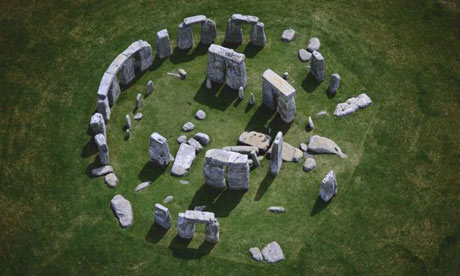
Archaeologists have discovered a second henge at Stonehenge, described as the most exciting find there in 50 years.

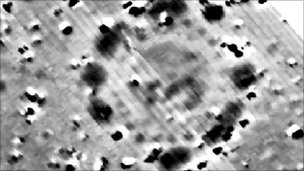
The circular ditch surrounding a smaller circle of deep pits about a metre (3ft) wide has been unearthed at the world-famous site in Wiltshire.

Archaeologists conducting a multi-million pound study believe timber posts were in the pits.

Project leader Professor Vince Gaffney, from the University of Birmingham, said the discovery was “exceptional”.

The new “henge” – which means a circular monument dating to Neolithic and Bronze Ages – is situated about 900m (2,950ft) from the giant stones on Salisbury Plain.

It’s a timber equivalent to Stonehenge”

End Quote Professor Vince Gaffney University of Birmingham

Images show it has two entrances on the north-east and south-west sides and inside the circle is a burial mound on top which appeared much later, Professor Gaffney said.

”You seem to have a large-ditched feature, but it seems to be made of individual scoops rather than just a straight trench,” he said.

”When we looked a bit more closely, we then realised there was a ring of pits about a metre wide going all the way around the edge.

”When you see that as an archaeologist, you just looked at it and thought, ‘that’s a henge monument’ – it’s a timber equivalent to Stonehenge.

”From the general shape, we would guess it dates backs to about the time when Stonehenge was emerging at its most complex.
”This is probably the first major ceremonial monument that has been found in the past 50 years or so.
’Terra incognita’

“This is really quite interesting and exceptional, it starts to give us a different perspective of the landscape.”

Data from the site is being collected as part of a virtual excavation to see what the area looked like when Stonehenge was built.

Speculation as to why the 4,500-year-old landmark was built will continue for years to come, but various experts believe it was a cemetery for 500 years, from the point of its inception.

In 2008, the first excavation in nearly half a century was carried out at the iconic site on Salisbury Plain.

This latest project is being funded by the Ludwig Boltzmann Institute for Archaeological Prospection and Virtual Archaeology, in Vienna, and the University of Birmingham, and is assisted by the National Trust and English Heritage.

Professor Gaffney said he was “certain” they would make further discoveries as 90% of the landscape around the giant stones was “terra incognita” – an unexplored region.

”The presumption was this was just an empty field – now you’ve got a major ceremonial monument looking at Stonehenge,” he said.

Reccommended Tours of Stonehenge Stone Circle:
The Stonehenge Tour Company
HisTOURies UK – Salisbury, Bath and London
Salisbury Guided Tours

>Move over Stonehenge, there’s a bigger stone circle in town.

Archaeologists are busy excavating Marden Henge, a giant stone circle and earthwork ten times larger than its more famous cousin. It’s not nearly as well-known, however, because all of its stones have been lost or buried. Traces of a giant earthwork and ditch that encircled the monument do survive, and archaeologists hope they’ll reveal secrets of England’s prehistoric past.
While everyone knows about Stonehenge, many people don’t realize there are nearly a thousand stone circles in the British Isles, from massive ones like Avebury (shown here) to smaller ones like the Rollright Stones. Marden Henge is in Wiltshire, close to Stonehenge and Avebury, and could provide clues to how and why they were constructed. The giant circle encloses about 15 hectares (37 acres) and has a mound at its center. Archaeologists plan to investigate both the central mound and the earthwork and ditch. The Neolithic farmers who built these monuments often put sacrifices in the surrounding ditches.
While there are no current plans for a visitor’s center at Marden Henge, there are plenty of other stone circles open to the public. Some of the more famous cater to visitors with interpretive signs and parking lots, while others simply stand in open fields, an enduring part of Europe’s ancient landscape. An excellent website to help you plan a visit is The Megalithic Portal, which includes information on stone circles and other megaliths such as barrows (tombs) and menhirs (individual standing stones) in the UK and all around the world.

Wessex Tour Guide

>

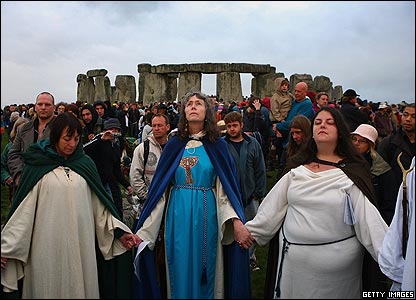
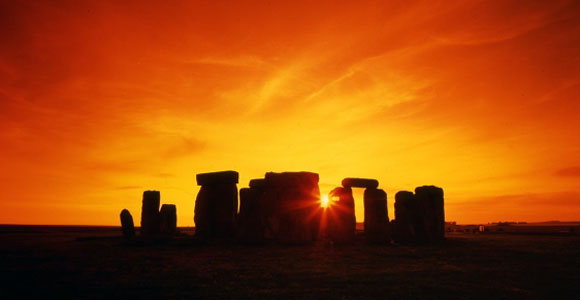
Thousands of Summer Solstice revellers gathered at Stonehenge today to watch dawn break on the longest day of the year.

Thousands flocked to Stonehenge this morning to celebrate the solstice, with the sun visible for the first time in recent years.

The solstice annually attracts an eclectic mix – Druids, hippies, sun worshippers and those who are curious to experience the ancient festival.
Nearly 20,000 people attended the event, with 15 arrests overnight for minor public disorder, a Wiltshire Police spokesman said.

As the sun rose at 0452, a cheer went up from those gathered overnight at the stone circle on Salisbury Plain in Wiltshire.

The crowds were treated to clear views of the sunrise – previous years have seen the spectacle obscured by mist and cloud.
Last year a record 36,500 revellers attended, causing traffic chaos and road closures.

It was announced last week that £10 million of funding for a proposed visitor centre at the prehistoric site has been axed, putting the plans on hold indefinitely.

Stonehenge Tour Guide

>A chance to catch the sunrise in a most magical place…………..

The Summer Solstice at Stonehenge is a truly magical time to be there. It’s an ad hoc celebration that brings together England’s New Age Tribes (neo-druids, neo-pagans, Wiccans) with ordinary families, travelers and party people.

Solstice nowadays is a peaceful and moving experience, but that wasn’t always the case. For years, Wiltshire police fought pitched battles with the people who were drawn to see the sunrise on the longest day of the year at Stonehenge. Every year the news carried the numbers arrested. In 1985, in a notorious event named “The Battle of the Beanfield”, Wiltshire police were accused by participants journalists and other witnesses, of brutality against a convoy of New Age travelers heading for the site. The event resulted in law suits against the police that went on for years.

At last the authorities saw the light

In more recent times, everyone has seen sense.

For many the impulse to arrive at Stonehenge in time for the Solstice is a little like all those people drawn to the strange rock in Close Encounters of the Third Kind. It’s akin to a spiritual experience. Anyone who has witnessed the crowd become silent as the sky begins to brighten can attest to that.

English Heritage, who manage Stonehenge, have establish a set of ground rules and now allow visitors to spend all night – From sundown to sun-up. By contrast to the wild and wooly 1980s, the atmosphere is peaceful and happy. There is usually impromptu music, sharing of picnics and the like and if you are in the UK for the Summer Solstice it is a fabulous way to see Stonehenge.

The Summer Solstice at Stonehenge 2010

When: Sunday evening, June 20 to Monday morning, June 21

Parking:

Parking is free.

The parking lot opens at 7 p.m. Sunday evening. Cars will not be admitted before then.

Last admission is 6 a.m. Monday morning, June 21.

The car park must be vacated by noon on June 21.

Access to the monument: 7:00 p.m. Sunday evening to 8 a.m. Monday morning.

The shortest night: Sunset on Sunday 20th June 2010 is at 9:26p.m. Sunrise occurs at 4:52 a.m. on Monday 21st June 2010.

Visit the English Heritage Website
Visit Stonehenge Web Site
Private Stonehenge Tours – HisTOURies UK
Salisbury Guided Tours

David – Stonehenge Tour Guide (see you there!)

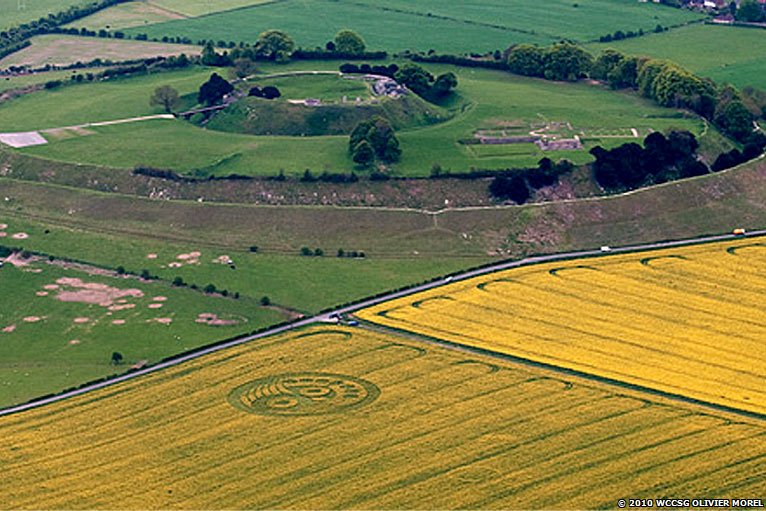
>THE first crop circles of the year in Wiltshire have appeared at Old Sarum and Stonehenge.

The one at Old Sarum was discovered in a field that is part of Little Durnford Farm last Tuesday.

Estate manager Philip Simmonds said it had been created overnight, but people living in former farmworkers’ cottages nearby did not see or hear anything unusual.

Since then enthusiasts from across Europe have been travelling to Salisbury to see the intricate design, photographed by Old Sarum flying instructor Mark McClelland.

“People have come from Holland, and this morning two ladies arrived from Austria,” Mr Simmonds said on Saturday. “On Thursday evening we had a Dutch film crew, and we’ve had an approach from a Californian film crew to film here next week. It’s all over the internet.”

The circle is in a 110-acre field of oil seed rape, owned by Lord and Lady Chichester.

“I’ve not seen one in a rape field before,” said Mr Simmonds, “although we did have a simple circle in the adjoining field, in a crop of barley, about five years ago.”

Unfortunately for Mr Simmonds the circle has caused £1,000 worth of damage to his crop, so to recoup his loss he is charging visitors to view it close up.

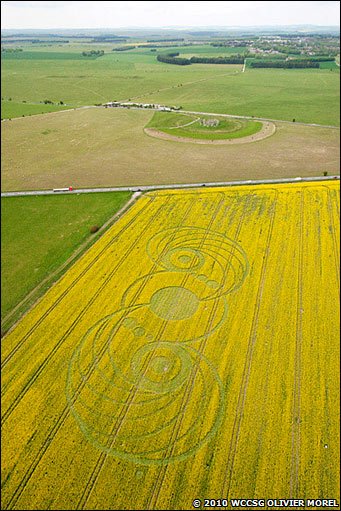
Excitement grew with the discovery of the second circle – or rather three swirling interlinked circles – across the A303 from Stonehenge at 9am on Monday.

Wiltshire Crop Circle Study Group sent up photographer Olivier Morel to take aerial pictures of the design, estimated at 350ft long.
According to the group’s website http://www.wccsg.com, another circle appeared in the same field in 1996.

Salisbury crop circle researcher and lecturer John Bannister, who has been fascinated by the phenomenon ever since seeing his first circle in a 1950s newspaper article, said: “The geometry of these things is inch-perfect. And no two are ever the same. We send soil samples from the circles away for analysis and they show significant changes.
“We usually get between 60 and 70 in Wiltshire each year because we have got so many ancient sites and ley lines.”

HisTOURies UK, a tour operator based in Salisbury have already started taking private tours to the circles.  The manager, Tim quoted “this is great for tourism in Wilsthire” and looks forward to a bumper year of mysterious crop circles.

David
Stonehenge Tour Guide

>

A Histouries UK tour guide has just sent this information through.  The very first crop circle in Britain for 2010, see image below.  We have also been sent an aeriel image of a crop circle next to Old Sarum hillfort – 8 miles southj of Stonehenge, we will add more details as we get them.  A big thank you to Histouries UK for keeping us up to date, keep up the good work!

David – Stonehenge Tour Guide Private Stonehenge and Crop Circle Tours
Crop Circle Tours and private guided tours of Salisbury and Stonehenge – click here (Histouries UK)

>London coach tour operator Evan Evans launches new Stonehenge tour that includes a sunrise viewing beyond the fences and before the site is open to the public.  Many would say that their itinerary is a little ambitious (see below) and that they are just copying other companies offering such tours.  Anway I have included their itinerary below and there are links on my blog to book them if you desire.  I will aslo add some alternative links below:

A PRIVATE VIEWING OF THE INNER CIRCLE AT STONEHENGE – a later start gives the opportunity to visit the state apartments of Windsor Castle, a walking tour of Oxford and a private visit to the inner circle of Stonehenge.

Included Highlights

Entrance to Windsor Castle and a tour of the State Apartments and St George’s Chapel


Walking tour of Oxford


Visit Christ Church college (where Harry Potter was filmed)


Private Visit ot the Inner Circle of Stonehenge at Sunset


First-class luxury Motor-coach and the services of a Professional Guide
Windsor Castle

Our day starts with a visit to Windsor Castle, the largest and oldest occupied Castle in the world and the home of the Royal Family for 900 years. Its proud, strong walls dominate the delightful town that has grown around the castle over the years. You’ll see the lavishly decorated State Apartments containing priceless furniture in glorious colours and St George’s Chapel, home to the 14th Century Order of the Royal Garter, our senior chivalric order
Oxford

The colleges in Oxford date back to the 13th century and among its famous students were Bill Clinton, C.S. Lewis, J.R.R. Tolkien and Lewis Carroll. We take you on a fascinating walking tour, which includes visiting the Great Hall in Christ Church, where many scenes from Harry Potter were filmed. We’ll also see the Bodleian Library and the picture perfect college courtyards for which Oxford is famous.
Private Viewing of Stonehenge

Most visitors to Stonehenge are not allowed direct access to the stones. On this special day trip from London, you’ll be invited to enter the stone circle itself, and stand beside the mysterious rocks towering above you. Your guide will unlock the secrets of this ancient World Heritage site. Enjoy the peace, away from the crowds, as you experience Stonehenge at its atmospheric best at sunset.

Departures April to September 2010
Days of operation: Monday, Friday

Tour Starts: 10.30am, Royal National Hotel

Tour Finishes: 9.00pm, Victoria Train Station

Departs from:

10.30am Royal National Hotel, Russell Square


10.45am, Guoman Thistle Marble Arch


11.00am, Grosvenor Victoria


11.15am, Millennium Gloucester


11.30am, Kensington Hilton
Adults: £84.00 Children (3-16): £74.00


Seniors (60+)/Students (with ID): £79.00

Other recommended Stonehenge Tour Companies:
The Stonehenge Tour Company – click here

Premium Tours – Click here
International Friends – Small group tours – Click here

Histouries UK Tours based in Salisbury – click here

David
Stonehenge Tour Guide
The Stonehenge Stone Circle Website

>

In the latest rather, er, unique bid to boost tourism, an Australian town is planning to build a life-size replica of the famous 4,000 year-old rock formation Stonehenge – so let’s check out if this is a rock-solid plan or a rather rocky road to disaster…

Twilight Beach in Esperance, Western Australia, is the planned venue for the ‘new’ Stonehenge.

The controversial plan aims to recreate the ancient Wiltshire monument on a hillside overlooking the beach, 740km southeast of Perth. More than 100 stones are to be erected, with the largest stone standing more than seven metres high and weighing in at more than 50 tonnes.

The plan was originally announced back in 2008, when local businessman Ross Smith ordered the granite blocks. But, his £850,000 project collapsed after the proposed development went into the hands of liquidators.

Now, the plan has been raised from the dead and the quarry has offered the stone blocks to the town of Esperance for £180,000. A further £545,000 is needed for site works, a car park and tourism facilities.

The project, to be called The Henge, will include 101 granite stones arranged in an inner and outer circle and a central altar.

Unlike the original Stonehenge, guests will be encouraged to play around the new monument, which will also have an interpretive centre and a children’s playground.

Mr Smith said The Henge would be a business venture, to be hired out for weddings and other events.
A small team of quarry workers has spent the past five months drilling and blasting the stones into shape.

The ‘REAL’ Stonehenge Stone Circle website

>What is a ‘Henge’ monument

Stone Henge – What is one?

Definition:

A henge is the term given to a large prehistoric earthwork, usually but not always circular, whether of stones, wood, or earth.

This word, interestingly, is a back-formation from Stonehenge. Additionally some spell it stone henge or stonehedge even though that is incorrect. Stonehenge was the Saxon name for the famous monument on the Salisbury plain, and the “henge” part is Old English for “hang,” not earthwork. Nonetheless, the term henge is in wide use in both popular and scientific literature to refer to megalithic monuments of the Neolithic and Bronze ages.

Whether you are thinking stone henge or Stonehenge, both are basically Megaliths. Megaliths are single large stones, or a group of “standing stones” usually arranged in a circular or semi-circular formation, and that archaeologists believe were religious temples or monuments. The earliest sites are thought to date back to the millenia. The word, “megalith” itself has Greek origins: “mega” meaning “great” and “lithos” meaning “stone”. Certain megalith sites, and there are thousands of them all around the world, were also known burial sites. England seems to have the greatest concentration of megaliths that carry names like Avebury, the Hurlers, the Merry Maidens, and the Rollright Stones. The most famous of these is, of course, Stonehenge.

People do commonly mistake the words stone henge for Stonehenge and should learn the difference so they may find the correct information.

The Stonehenge Web Site

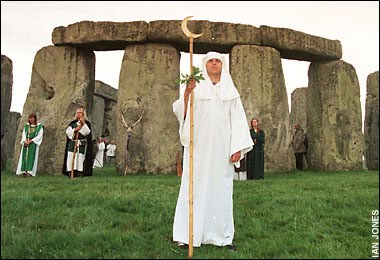
>”The sun rises over Stonehenge as druids celebrate the Spring Equinox at Stonehenge near Amesbury, Wiltshire, England. Several hundred druids and pagans were granted special access to the ancient monument to mark the date in the calender when the length of the day and the night are equal (this happens twice a year, at Spring and Autumn Equinox). To the druids Spring Equinox celebrates the renewed life of the Earth that comes with spring and attribute the changes that are going on in the world to an increase in the powers of their God and Goddess.”

« Previous Page — Next Page »