Uncategorized


Once again, we are offering a guided tours / transport from London to the Stonehenge Summer Solstice: Experience sunset or sunrise from within the inner circle. A magical experience – http://www.stonehengetours.com/summer-solstice-tour.htm

StonehengeNews's avatarStonehenge Stone Circle News and Information

English Heritage is pleased to be providing Managed Open Access to Stonehenge for the Summer Solstice on 20-21 June 2014. Please help us to create a peaceful occasion by taking personal responsibility and following the Conditions of Entry and guidelines set out on these pages. The full Conditions of Entry can also be downloaded from their website.

midsummer-sunset

We have a duty of care to ensure public safety and are responsible for protecting Stonehenge and its surrounding Monuments. If we are to ensure that future access is sustainable, it is essential that everyone observes and abides by these Conditions of Entry.

Celebrating the Summer Solstice at Stonehenge

Stonehenge is an ancient prehistoric site and has been a place of worship and celebration at the time of Summer Solstice since time immemorial.

During Managed Open Access for Summer Solstice at Stonehenge, we support all individuals and groups conducting their own forms of ceremony and celebration providing…

View original post 255 more words

New research suggests stones came from Carn Goedog in Pembrokeshire – almost a mile from site of excavations

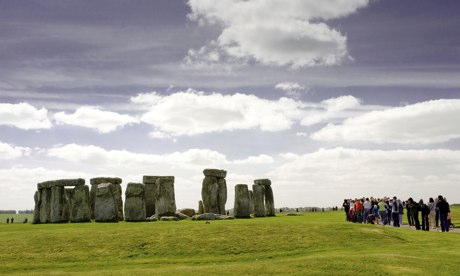
One of the mysteries of Stonehenge is how some of its stones were brought from Pembrokeshire in Wales to Wiltshire. Photograph: I Capture Photography/Alamy

One of the mysteries of Stonehenge is how some of its stones were brought from Pembrokeshire in Wales to Wiltshire. Photograph: I Capture Photography/Alamy

For almost a century archaeologists have been braving the wind and rain on an exposed Welsh hillside in an attempt to solve one of the key mysteries of Stonehenge.

But new research about to be published suggests that over the decades they may have been chipping away at the wrong rocky outcrop on the Preseli Hills in Pembrokeshire.

The work in the hills is a crucial element in the understanding of Stonehenge because it is generally accepted that the bluestones that form part of the ancient Wiltshire monument came from this remote spot in south-west Wales. One of the many huge puzzles remains how the bluestone from Wales travelled 190 miles to the heart of south-west England.

Since the 1920s much of the work in Preseli has focused on a spot known as Carn Meini. Now researchers are claiming that in fact the Stonehenge bluestones actually came from Carn Goedog – almost a mile away.

Richard Bevins, keeper of geology at the National Museum of Wales and one of those involved in the study, suggested he was not going to be terribly popular with some fellow experts.

“I don’t expect to be getting Christmas cards from the archaeologists who have been excavating at the wrong place over all these years,” he said.

The celebrated geologist Herbert Henry Thomas linked the Stonehenge bluestones with Preseli in 1923 and pinpointed the tor on Carn Meini as the likely source. Over the years teams worked assiduously on the spot searching for evidence of a Stonehenge quarry.

Two years ago there was excitement when a burial chamber was found, leading to speculation that this could be the resting spot of an architect of Stonehenge.

Now, using geochemical techniques, Bevins and his colleagues have compared samples of rock and debris from Stonehenge with data from the Preseli site and concluded the bluestones in fact came from Carn Goedog.

Bevins, who has been studying the geology of Pembrokeshire for over 30 years, said: “I hope that our recent scientific findings will influence the continually debated question of how the bluestones were transported to Salisbury Plain.”

There are different theories about how the bluestone may have got to Wiltshire. Some believe it was laboriously transported by man but there is another theory that it could have been swept east by glaciers.

Rob Ixer, of University College London, who also took part in the new research, said: “Almost everything we believed 10 years ago about the bluestones has been shown to be partially or completely incorrect. We are still in the stages of redress and shall continue to research the bluestones for answers.”

Bluestones are believed to have arrived at Stonehenge about 4,500 years ago. Some experts believe the bluestones – rather than the much larger sarsen stones that give Stonehenge its familiar shape – were the real draw because they were believed to have healing powers.

The paper setting out the discovery is to be published in the Journal of Archaeological Science.

: theguardian.com http://www.theguardian.com/culture/2013/nov/20/archaeologists-stonehenge-origins-wrong-place

Guest Blogger
Stonehenge Tour Guide

Needless to say ‘Stonehenge Guided Tours’ will be offering a small group guided tour from London on the 21st December 2013: http://stonehengetours.com/stonehenge-winter-solstice-tour.htm

StonehengeNews's avatarStonehenge Stone Circle News and Information

The celebration of the Winter Solstice at Stonehenge will take place at sunrise on Saturday 21 December 2013 (approximately 08:09 hrs).

English Heritage is pleased to be offering ‘Managed Open Access’ for those who wish to celebrate the Winter Solstice peacefully

Visitors will be allowed into the Monument when it is considered sufficiently light to ensure safe Stonehenge Winter Solsticeaccess. Entry will be available from approximately 07:30 hrs until 09:00 hrs when visitors will be asked to vacate the site. All vehicles must vacate the area by 09.30.

Access might not be possible if the ground conditions are poor or if it is felt that access might result ¡n severe damage to the Monument.

Toilets are available at Stonehenge for the duration of the access although these facilities will not be available prior to access commencing.

Public car parking will be made available on Byway 12, the old Visitor Centre Car Park…

View original post 96 more words

nancy wisser's avatarCLONEHENGE

Attention hengers of all kinds: Clonehenge’s 5th birthday is coming up on the 20th of this month, and what better way to celebrate than with photos of Stonehenge cakes?

Your challenge is to make a Stonehenge cake (or other dessert of your choice), and send us a photo (nancy (dot) wisser (at) gmail.com), or post it to our Facebook group or page, or address it to us on Twitter, @Clonehenge. These can be brilliant or lame. They don’t even have to be cakes. Any sweet goodie roughly Stonehenge-shaped will do.

We’ll love them regardless! We’ll post the pictures on Facebook, on Twitter, and on the Clonehenge blog itself, and then you get to eat your entry!

You make it, we post it, you eat it. Yum! Happy birthday to us.

Hengers, you may start your ovens!

View original post

The new Stonehenge visitor centre is due to open on Wednesday December 18th 2013.

English Heritage have been unveiling details of the first exhibitions at the site of the Stone Circle.221699-320x240_credit-show
It’s taken a number of years to get to this stage – and at a cost of £27 million, it’s the biggest capital project English Heritage have ever done.

300 prehistoric artefacts will be displayed in the exhibitions, and there’ll be a virtual experience where we can take a look at the stones from within the circle.
Today will also be the first time the visitor centre building itself, which is almost complete 1.5 kilometres away at Airman’s Cross, will be seen without its scaffolding.

Lorraine Knowles is from English Heritage – click play to hear her interview with Spire FM’s Faye Marsh:
http://www.spirefm.co.uk/news/local-news/1086351/opening-date-of-stonehenge-visitor-centre-revealed/

Article with thanks tp Spire FM, Salisbury

Stonehenge Tour Guide

Modern researchers have puzzled for centuries over the striking stone construction known as Stonehenge. But now researchers have discovered new aspects of the site, including a processional road, that may eventually help unravel some of its mysteries.

Researchers believe they have found an ancient path that once connected Stonehenge with a river and possible village nearby.

Researchers believe they have found an ancient path that once connected Stonehenge with a river and possible village nearby.

There are many theories about why ancient peoples constructed the prehistoric megalithic monument, which is estimated to have been built between 3000 and 1520 B.C. Located outside Salisbury, England, Stonehenge is the focus of ongoing research projects coordinated by English Heritage, a cultural preservation agency.

One of those projects recently uncovered previously hidden sections of an ancient pathway that researchers believe led directly to the site from the Avon River in the nearby town of Amesbury.

Known as the Avenue, the pathway is believed to have been built sometime between 2600 and 2200 B.C., according to English Heritage. Over time, parts of the road were obscured, and a modern road called A344 was built across it, reports LiveScience. The new road has made it almost impossible for researchers to confirm the purpose of the Avenue, according to LiveScience.

In an effort to answer some of these questions, researchers carefully began removing the paved A344. While the banks of the original path had long since eroded away, archaeologists were excited to find traces of two parallel ditches that once ran on either side of the path. These ditches connected segments of the Avenue bisected by A344.

“And here we have it –- the missing piece in the jigsaw,” Heather Sebire, properties curator and archaeologist at English Heritage, said in an interview with BBC History Magazine. “It is very exciting to find a piece of physical evidence that officially makes the connection which we were hoping for.”

While the purpose of the Avenue is not exactly clear, Sebire told LiveScience she believes it was involved in ancient processions to and from the site.

“It was constructed in 2300 BC so is a later addition to the stone circle, but people would have processed along it to the monument,” Sebire told BBC Magazine. “It’s quite a dramatic finding.”

At least one researcher unaffiliated with English Heritage believes the excavation could help confirm a theory that the Avenue leading to Stonehenge was built along the solstice axis. As archaeologist Mike Parker Pearson told National Geographic, this means that the direction of the Avenue moving away from the monument points toward where the sun rises on the midsummer solstice, the longest day of the year. But if you turn, the path leading back toward Stonehenge points toward where the sun sets on the midwinter solstice, the shortest day of the year.

Article source: The Huffington Post  By : http://www.huffingtonpost.com/

Stonehenge Tour Guide

StonehengeNews's avatarStonehenge Stone Circle News and Information

Two ditches belonging to the Stonehenge Avenue buried beneath the modern roadbed of the A344 have been uncovered during works to decommission the road as part of English Heritage’s project to transform the setting and visitor experience of Stonehenge.

The two ditches represent either side of The Avenue, a long linear feature to the north-east of Stonehenge

linking it with the River Avon. It has long been considered as the formal processional approach to the monument and is aligned with the solstice axis of Stonehenge. But its connection with Stonehenge had been severed by the A344 for centuries as the road cut through the delicate earthwork at an almost perpendicular angle.

The two ditches were found in excavations undertaken by Wessex Archaeology in their expected positions near to the Heel Stone, about 24 metres from the entrance to monument.


Missing Piece in the Jigsaw

Heather Sebire…

View original post 478 more words

The Heritage Trust's avatarThe Heritage Trust

A French postcard (circa 1916) depicting a Bristol Monoplane flying over Stonehenge
Private collection Great Britain


View original post

« Previous PageNext Page »